

I am continuing my Y-STR boycott, but I have to note that the paper uses the "evolutionary rate", and hence its age estimates are wrong. A great range of ages can be supported when one uses Y-STRs, because of their poor qualities, but, as a first step the 19ky estimate should be downsized to about 6ky.
I know next to nothing about Tibeto-Burman languages, but, apparently the age estimate for Proto-Han and Proto-Tibeto-Burman unity is... 6ky. I would wager that we have here, one more piece of evidence for Y-chromosome-language correlation, and not at all events of glacial antiquity.
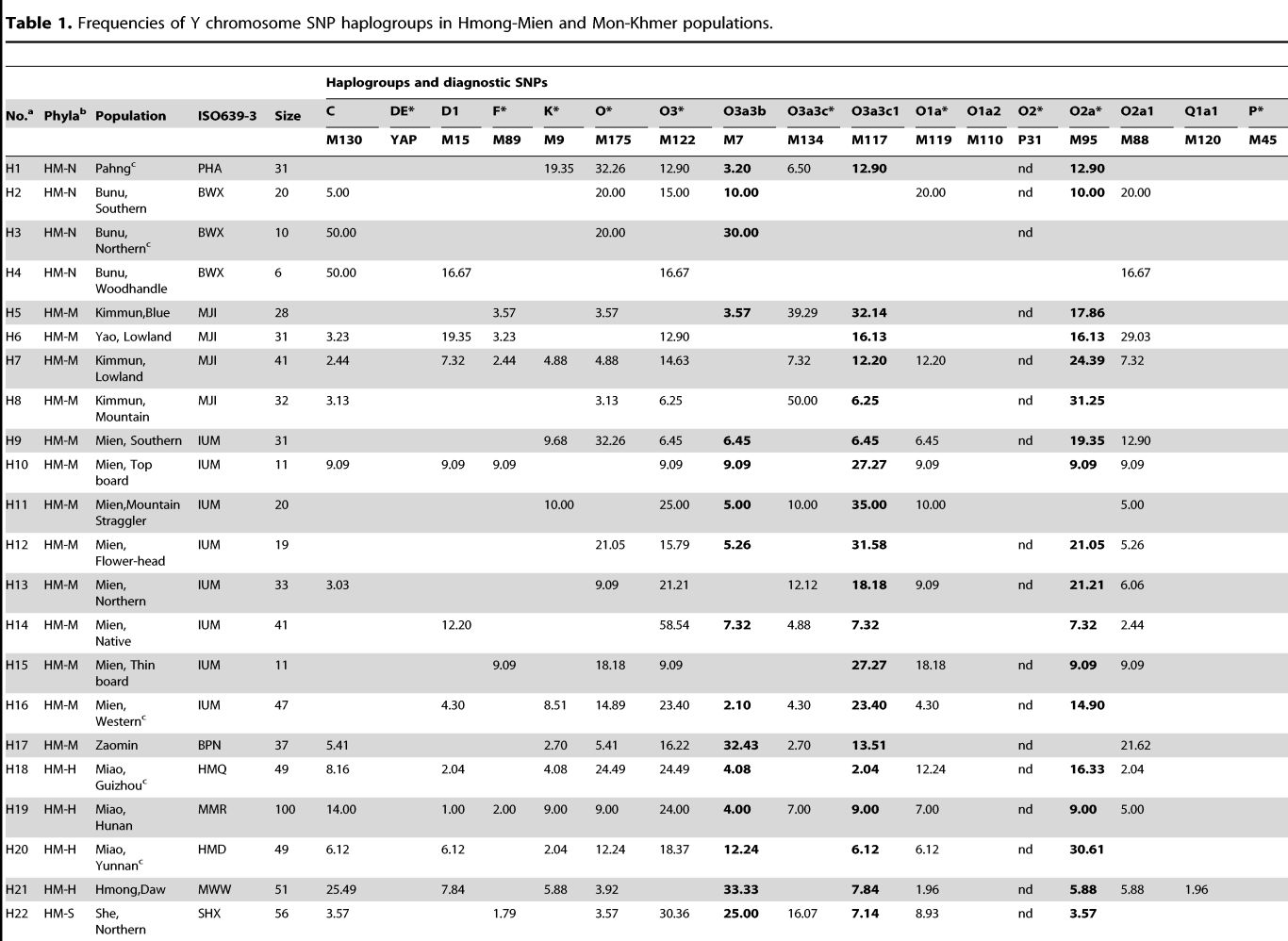
Table 1 contains the haplogroup frequencies:

PLoS ONE 6(8): e24282. doi:10.1371/journal.pone.0024282
Human Migration through Bottlenecks from Southeast Asia into East Asia during Last Glacial Maximum Revealed by Y Chromosomes
Xiaoyun Cai et al.
Molecular anthropological studies of the populations in and around East Asia have resulted in the discovery that most of the Y-chromosome lineages of East Asians came from Southeast Asia. However, very few Southeast Asian populations had been investigated, and therefore, little was known about the purported migrations from Southeast Asia into East Asia and their roles in shaping the genetic structure of East Asian populations. Here, we present the Y-chromosome data from 1,652 individuals belonging to 47 Mon-Khmer (MK) and Hmong-Mien (HM) speaking populations that are distributed primarily across Southeast Asia and extend into East Asia. Haplogroup O3a3b-M7, which appears mainly in MK and HM, indicates a strong tie between the two groups. The short tandem repeat network of O3a3b-M7 displayed a hierarchical expansion structure (annual ring shape), with MK haplotypes being located at the original point, and the HM and the Tibeto-Burman haplotypes distributed further away from core of the network. Moreover, the East Asian dominant haplogroup O3a3c1-M117 shows a network structure similar to that of O3a3b-M7. These patterns indicate an early unidirectional diffusion from Southeast Asia into East Asia, which might have resulted from the genetic drift of East Asian ancestors carrying these two haplogroups through many small bottle-necks formed by the complicated landscape between Southeast Asia and East Asia. The ages of O3a3b-M7 and O3a3c1-M117 were estimated to be approximately 19 thousand years, followed by the emergence of the ancestors of HM lineages out of MK and the unidirectional northward migrations into East Asia.
Link
Human Migration through Bottlenecks from Southeast Asia into East Asia during Last Glacial Maximum Revealed by Y Chromosomes
Xiaoyun Cai et al.
Molecular anthropological studies of the populations in and around East Asia have resulted in the discovery that most of the Y-chromosome lineages of East Asians came from Southeast Asia. However, very few Southeast Asian populations had been investigated, and therefore, little was known about the purported migrations from Southeast Asia into East Asia and their roles in shaping the genetic structure of East Asian populations. Here, we present the Y-chromosome data from 1,652 individuals belonging to 47 Mon-Khmer (MK) and Hmong-Mien (HM) speaking populations that are distributed primarily across Southeast Asia and extend into East Asia. Haplogroup O3a3b-M7, which appears mainly in MK and HM, indicates a strong tie between the two groups. The short tandem repeat network of O3a3b-M7 displayed a hierarchical expansion structure (annual ring shape), with MK haplotypes being located at the original point, and the HM and the Tibeto-Burman haplotypes distributed further away from core of the network. Moreover, the East Asian dominant haplogroup O3a3c1-M117 shows a network structure similar to that of O3a3b-M7. These patterns indicate an early unidirectional diffusion from Southeast Asia into East Asia, which might have resulted from the genetic drift of East Asian ancestors carrying these two haplogroups through many small bottle-necks formed by the complicated landscape between Southeast Asia and East Asia. The ages of O3a3b-M7 and O3a3c1-M117 were estimated to be approximately 19 thousand years, followed by the emergence of the ancestors of HM lineages out of MK and the unidirectional northward migrations into East Asia.
Link