Hum Genet. 2006 Sep 28; [Epub ahead of print]
Elevated male European and female African contributions to the genomes of African American individuals.
Lind JM, Hutcheson-Dilks HB, Williams SM, Moore JH, Essex M, Ruiz-Pesini E, Wallace DC, Tishkoff SA, O'brien SJ, Smith MW.
The differential relative contribution of males and females from Africa and Europe to individual African American genomes is relevant to mapping genes utilizing admixture analysis. The assessment of ancestral population contributions to the four types of genomic DNA (autosomes, X and Y chromosomes, and mitochondrial) with their differing modes of inheritance is most easily addressed in males. A thorough evaluation of 93 African American males for 2,018 autosomal single nucleotide polymorphic (SNP) markers, 121 X chromosome SNPs, 10 Y chromosome haplogroups specified by SNPs, and six haplogroup defining mtDNA SNPs is presented. A distinct lack of correlation observed between the X chromosome and the autosomal admixture fractions supports separate treatment of these chromosomes in admixture-based gene mapping applications. The European genetic contributions were highest (and African lowest) for the Y chromosome (28.46%), followed by the autosomes (19.99%), then the X chromosome (12.11%), and the mtDNA (8.51%). The relative order of admixture fractions in the genomic compartments validates previous studies that suggested sex-biased gene flow with elevated European male and African female contributions. There is a threefold higher European male contribution compared with European females (Y chromosome vs. mtDNA) to the genomes of African American individuals meaning that admixture-based gene discovery will have the most power for the autosomes and will be more limited for X chromosome analysis.
Link

September 29, 2006


September 28, 2006
Stature of early Europeans
Hormones (Athens). 2003 Jul-Sep;2(3):175-8.
Stature of early Europeans
Hermanussen M.
The ancestors of modern Europeans arrived in Europe at least 40,000 years before present. Pre-glacial maximum Upper Palaeolithic males (before 16,000 BC) were tall and slim (mean height 179 cm, estimated average body weight 67 kg), while the females were comparably small and robust (mean height 158 cm, estimated average body weight 54 kg). Late Upper Palaeolithic males (8000-6600 BC) were of medium stature and robusticity (mean height 166 cm, estimated average body weight 62 kg). Stature further decreased to below 165 cm with estimated average body weight of 64 kg in Neolithic males of the Linear Band Pottery Culture, and to 150 cm with estimated average body weight of 49 kg in Neolithic females. The body stature of European males remained within the range of 165 to 170 cm up to the end of the 19(th) century.
Link
Stature of early Europeans
Hermanussen M.
The ancestors of modern Europeans arrived in Europe at least 40,000 years before present. Pre-glacial maximum Upper Palaeolithic males (before 16,000 BC) were tall and slim (mean height 179 cm, estimated average body weight 67 kg), while the females were comparably small and robust (mean height 158 cm, estimated average body weight 54 kg). Late Upper Palaeolithic males (8000-6600 BC) were of medium stature and robusticity (mean height 166 cm, estimated average body weight 62 kg). Stature further decreased to below 165 cm with estimated average body weight of 64 kg in Neolithic males of the Linear Band Pottery Culture, and to 150 cm with estimated average body weight of 49 kg in Neolithic females. The body stature of European males remained within the range of 165 to 170 cm up to the end of the 19(th) century.
Link
A new "article" suggests that using "race" is ok as long as it is used to meet the spiritual needs of indigenous people
According to these authors there are no biological "races", but nonetheless forensic anthropologists are not wrong to determine the "races" of individuals from skeletally distinctive populations in the interest of meeting their "spiritual needs". From the article:
Forensic Identification of "Race" The Issues in New Zealand
Katharine Cox, Nancy G. Tayles, and Hallie R. Buckley
The identification of the "race" of human remains by forensic anthropologists in New Zealand provides Maori with a service that is both helpful and contentious. In estimating "race" anthropologists acknowledge the Maori view that physical remains are important because they retain the spirit of the deceased after death. Doing so is ethically paradoxical because the estimation of "race" implies that races exist, a concept that has been questioned and rejected by most anthropologists. Despite this, to meet the needs of Maori and to treat human remains with the respect that is traditionally accorded them, forensic anthropologists have a responsibility to attempt to estimate "race."
Link
The reality in New Zealand is that many Maori and other Polynesians have distinctive characteristics that would permit identification of their ancestry from their skeletal remains. There is no justification for forensic anthropologists' refusing to attempt the identification of ancestry because of the abuse of human biological variation in the form of cultural racism. While not all Maori can be identified as such from their remains, because of the homogeneity of Maori and the distinctive morphology of many of them New Zealand may provide an opportunity for forensic anthropologists to meet the spiritual needs of the indigenous people without compromising their scientific principles.CURRENT ANTHROPOLOGY Volume 47, Number 5, October 2006
Forensic Identification of "Race" The Issues in New Zealand
Katharine Cox, Nancy G. Tayles, and Hallie R. Buckley
The identification of the "race" of human remains by forensic anthropologists in New Zealand provides Maori with a service that is both helpful and contentious. In estimating "race" anthropologists acknowledge the Maori view that physical remains are important because they retain the spirit of the deceased after death. Doing so is ethically paradoxical because the estimation of "race" implies that races exist, a concept that has been questioned and rejected by most anthropologists. Despite this, to meet the needs of Maori and to treat human remains with the respect that is traditionally accorded them, forensic anthropologists have a responsibility to attempt to estimate "race."
Link
Sociocultural Heterogeneity and the Commons
CURRENT ANTHROPOLOGY Volume 47, Number 5, October 2006
Sociocultural Heterogeneity and the Commons
Lore M. Ruttan
The effect of social and cultural heterogeneity on collective action and the management of natural resources is disputed. Some researchers have claimed that there are broadly negative effects, largely due to reduced levels of trust. Others have argued that there are specific positive effects; political entrepreneurs may appear who instigate collective action. Here, alternative predictions derived from these competing claims are tested against data on 40 fisheries and 54 irrigation cases contained in the Common-pool Resource Database. Results do not support the hypothesis that sociocultural heterogeneity is associated with positive outcomes, and in fact, among the irrigation cases, more entrepreneurial activity is observed when there is homogeneity. However, there is good support for the argument that trust is required for successful outcomes and that heterogeneity can limit levels of trust. In this respect, it is notable that differences in cultural view of the resource are salient in fisheries whereas differences in social categories matter in irrigation systems. Finally, the impact of heterogeneity depends heavily on how success is defined.
Link
Sociocultural Heterogeneity and the Commons
Lore M. Ruttan
The effect of social and cultural heterogeneity on collective action and the management of natural resources is disputed. Some researchers have claimed that there are broadly negative effects, largely due to reduced levels of trust. Others have argued that there are specific positive effects; political entrepreneurs may appear who instigate collective action. Here, alternative predictions derived from these competing claims are tested against data on 40 fisheries and 54 irrigation cases contained in the Common-pool Resource Database. Results do not support the hypothesis that sociocultural heterogeneity is associated with positive outcomes, and in fact, among the irrigation cases, more entrepreneurial activity is observed when there is homogeneity. However, there is good support for the argument that trust is required for successful outcomes and that heterogeneity can limit levels of trust. In this respect, it is notable that differences in cultural view of the resource are salient in fisheries whereas differences in social categories matter in irrigation systems. Finally, the impact of heterogeneity depends heavily on how success is defined.
Link
September 27, 2006
mtDNA of domestic yaks
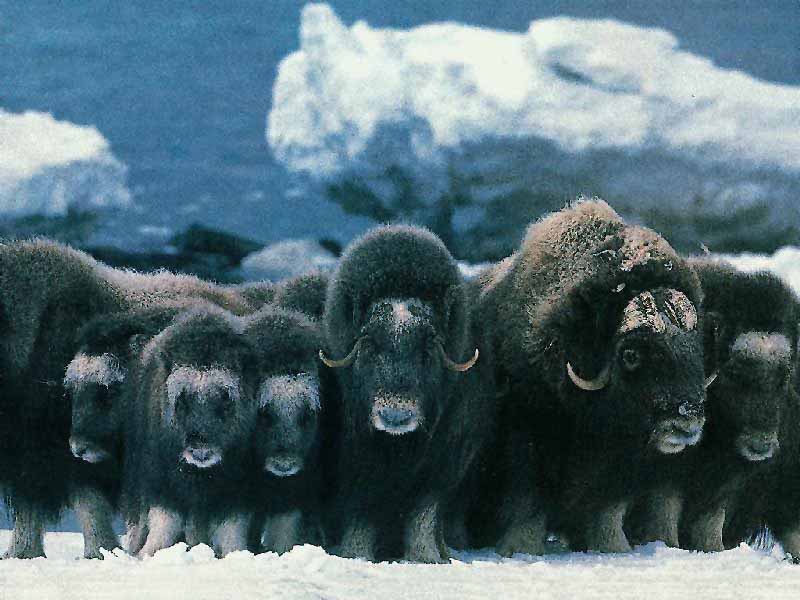
BMC Evol Biol. 2006 Sep 22;6(1):73 [Epub ahead of print]
Origin of mitochondrial DNA diversity of domestic yaks.
Guo S et al.
ABSTRACT: BACKGROUND: The domestication of plants and animals was extremely important anthropologically. Previous studies have revealed a general tendency for populations of livestock species to include deeply divergent maternal lineages, indicating that they were domesticated in multiple, independent events from genetically discrete wild populations. However, in water buffalo, there are suggestions that a similar deep maternal bifurcation may have originated from a single population. These hypotheses have rarely been rigorously tested because of a lack of sufficient wild samples. To investigate the origin of the domestic yak (Poephagus grunnies), we analyzed 637 bp of maternal inherited mtDNA from 13 wild yaks (including eight wild yaks from a small population in west Qinghai) and 250 domesticated yaks from major herding regions. RESULTS: The domestic yak populations had two deeply divergent phylogenetic groups with a divergence time of > 100,000 yrs BP. We here show that haplotypes clustering with two deeply divergent maternal lineages in domesticated yaks occur in a single, small, wild population. This finding suggests that all domestic yaks are derived from a single wild gene pool. However, there is no clear correlation of the mtDNA phylogenetic clades and the 10 morphological types of sampled yaks indicating that the latter diversified recently. Relatively high diversity was found in Qinghai and Tibet around the current wild distribution, in accordance with previous suggestions that the earliest domestications occurred in this region. Conventional molecular clock estimation led to an unrealistic early dating of the start of the domestication. However, Bayesian estimation of the coalescence time allowing a relaxation of the mutation rate are better in agreement with a domestication during the Holocene as supported by archeological records. CONCLUSION: The information gathered here and the previous studies of other animals show that the demographic histories of domestication of livestock species were highly diverse despite the common general feature of deeply divergent maternal lineages. The results further suggest that domestication of local wild prey ungulate animals was a common occurrence during the development of human civilization following the postglacial colonization in different locations of the world, including the high, arid Qinghai-Tibetan Plateau.
Link
September 26, 2006
Naturalism, final causes, religion, and atheism
Naturalism can be defined in many different ways, but a useful one is that it represents the idea that things happen because of natural causes and not for any particular purpose.
A naturalistic explanation about life on earth, for example, is that it is the product of natural causes, i.e., chemical molecules attaining the ability to replicate, and then evolving by modification and selection. And, of course, this explanation is true.
Acceptance of naturalism does not, however, imply atheism, as some prominent atheists seem to believe. The argument seems to be that if things are perfectly explained by natural causes, then there is no room for god: the assumption of the existence of god, is not necessary.
A commonly used argument against this explanation is that of natural exceptionalism. This argument goes like this: the world can be explained naturalistically, but the deity can bend the rules and suspend their operation, operating miraculously.
This argument is not very persuasive, since it requires that one should document the existence of miracles, and miracles are notoriously difficult to document to a skeptic's satisfaction, and rightly so.
However, miracles (*) are not necessary to support a theist's belief in god.
We can think of a digital computer whose operation is perfectly predictable: its state at any point in time is precisely determined from its state at previous points in time. The computer's operation can be precisely determined by the digital logic of its circuits, the oscillation of its clock, and the contents of its memory. It is thus a perfectly naturalistic system, whose operation is precisely determined by natural causes.
Nonetheless, computers typically compute "something". At short time scales, a scientist examining the computer would be able to discover some natural "laws" governing its operation, say, that when a particular instruction is read from memory, the content of two memory locations is added and placed in a third one. A whole repertoire of such laws could be determined, and the scientist could predict the computer's operation exactly. Nonetheless, this would give him no knowledge about what the computer was actually doing, what the purpose of the computation was.
The naturalist is content with determining the "laws of nature". But, the laws of nature are simply the allowed moves in the "game of reality", they are the instruction set of the universe. Knowing them tells us nothing about whether or not the unravelling computation has a final cause or not, whether it aims to compute something or not.
From this perspective, the atheist resembles a chess spectator who is able, by observation, to determine the rules of chess, e.g., that bishops move diagonally and rooks along straight lines, but claims that the game has no inherent purpose. The theist on the other hand believes that the sequence of legal moves are not meaningless, but rather aim towards a goal, which is victory. (**)
It seems to me that the theist has a much better ground to stand on than the atheist. Even though we are unable to determine the goal of the universe's evolution (if any), we can still observe it, and draw some tentative conclusions.
There are 2n n-bit long programs, for example, yet only a tiny fraction of them compute anything meaningful. You could fill up your computer's memory with random junk, and it would still work by following the random instructions. Our observation of the universe looks nothing like a random program however; it looks more like an orderly and well-behaved program, so, in my opinion, the idea that it has a purpose is more defensible than the idea that it does not.(***)
(*) It should be noted that the idea of a miracle as a suspension of natural law is modern, dating to the post-Newtonian period and the worldview of the world-as-a-clock. In the original sense, miracles (Gk. θαύματα) are extra-ordinary phenomena that cause a sense of wonder (θαυμάζειν) and are not "supernatural" events, but rather rare events, outliers.
(**) Chess is actually a great example of this, since the game itself is finite and can be computed. Of course, the number of possible chess games is finite, although very large, but in principle, a superfast computer could determine whether an optimally played chess of game will lead to a white victory or a draw, even though we have no idea what the answer will be. But, our inability (as humans) to compute the answer to "chess" does not mean that it does not have a clear (albeit exceedingly difficult) solution.
(***) Atheists often use an anthropic argument against this observation; they claim that all possible sets of laws are operating, and we are lucky enough to be in a region where the laws tend to allow for intelligence. This argument is not very persuasive though, since it postulates an infinite number of non-observable realities. Moreover, intelligence could very well have evolved in a tiny patch of order of an otherwise chaotic universe; it would not make one iota of difference for life on earth if, e.g., gravity operated differently in galaxies billions of light years away. The fact that not only our small patch of reality that is the solar system, but the entire observable universe is orderly is a pretty good argument against anthropic explanations.
A naturalistic explanation about life on earth, for example, is that it is the product of natural causes, i.e., chemical molecules attaining the ability to replicate, and then evolving by modification and selection. And, of course, this explanation is true.
Acceptance of naturalism does not, however, imply atheism, as some prominent atheists seem to believe. The argument seems to be that if things are perfectly explained by natural causes, then there is no room for god: the assumption of the existence of god, is not necessary.
A commonly used argument against this explanation is that of natural exceptionalism. This argument goes like this: the world can be explained naturalistically, but the deity can bend the rules and suspend their operation, operating miraculously.
This argument is not very persuasive, since it requires that one should document the existence of miracles, and miracles are notoriously difficult to document to a skeptic's satisfaction, and rightly so.
However, miracles (*) are not necessary to support a theist's belief in god.
We can think of a digital computer whose operation is perfectly predictable: its state at any point in time is precisely determined from its state at previous points in time. The computer's operation can be precisely determined by the digital logic of its circuits, the oscillation of its clock, and the contents of its memory. It is thus a perfectly naturalistic system, whose operation is precisely determined by natural causes.
Nonetheless, computers typically compute "something". At short time scales, a scientist examining the computer would be able to discover some natural "laws" governing its operation, say, that when a particular instruction is read from memory, the content of two memory locations is added and placed in a third one. A whole repertoire of such laws could be determined, and the scientist could predict the computer's operation exactly. Nonetheless, this would give him no knowledge about what the computer was actually doing, what the purpose of the computation was.
The naturalist is content with determining the "laws of nature". But, the laws of nature are simply the allowed moves in the "game of reality", they are the instruction set of the universe. Knowing them tells us nothing about whether or not the unravelling computation has a final cause or not, whether it aims to compute something or not.
From this perspective, the atheist resembles a chess spectator who is able, by observation, to determine the rules of chess, e.g., that bishops move diagonally and rooks along straight lines, but claims that the game has no inherent purpose. The theist on the other hand believes that the sequence of legal moves are not meaningless, but rather aim towards a goal, which is victory. (**)
It seems to me that the theist has a much better ground to stand on than the atheist. Even though we are unable to determine the goal of the universe's evolution (if any), we can still observe it, and draw some tentative conclusions.
There are 2n n-bit long programs, for example, yet only a tiny fraction of them compute anything meaningful. You could fill up your computer's memory with random junk, and it would still work by following the random instructions. Our observation of the universe looks nothing like a random program however; it looks more like an orderly and well-behaved program, so, in my opinion, the idea that it has a purpose is more defensible than the idea that it does not.(***)
(*) It should be noted that the idea of a miracle as a suspension of natural law is modern, dating to the post-Newtonian period and the worldview of the world-as-a-clock. In the original sense, miracles (Gk. θαύματα) are extra-ordinary phenomena that cause a sense of wonder (θαυμάζειν) and are not "supernatural" events, but rather rare events, outliers.
(**) Chess is actually a great example of this, since the game itself is finite and can be computed. Of course, the number of possible chess games is finite, although very large, but in principle, a superfast computer could determine whether an optimally played chess of game will lead to a white victory or a draw, even though we have no idea what the answer will be. But, our inability (as humans) to compute the answer to "chess" does not mean that it does not have a clear (albeit exceedingly difficult) solution.
(***) Atheists often use an anthropic argument against this observation; they claim that all possible sets of laws are operating, and we are lucky enough to be in a region where the laws tend to allow for intelligence. This argument is not very persuasive though, since it postulates an infinite number of non-observable realities. Moreover, intelligence could very well have evolved in a tiny patch of order of an otherwise chaotic universe; it would not make one iota of difference for life on earth if, e.g., gravity operated differently in galaxies billions of light years away. The fact that not only our small patch of reality that is the solar system, but the entire observable universe is orderly is a pretty good argument against anthropic explanations.
Decorated skulls in Syria
 Decorated skulls have been found in Syria. The picture on the left is from the BBC. AFP reports:
DAMASCUS (AFP) - Archaeologists said they had uncovered decorated human skulls dating back as long as 9,500 years ago from a burial site near the Syrian capital Damascus.
"The human skulls date back between 9,500 and 9,000 years ago, (on which) lifelike faces were modelled with clay earth ... then coloured to accentuate the features," said Danielle Stordeur, head of the joint French-Syrian archaeological mission behind the discovery.
Located at a burial site near a prehistoric village, the five skulls were found earlier this month in a pit resting against one another, underneath the remains of an infant, said Stordeur.
The French archaeologist described as "extraordinary" the find at the Neolithic site of Tell Aswad, at Jaidet al-Khass village, 35 kilometres (22 miles) from Damascus.
The discovery was not the first of its kind in the Middle East, but "the realism of two of these skulls is striking," stressed Stordeur, in charge of the excavation along with Bassam Jamous, the chief of antiquities of Syria's National Museum.
"They surprise by the regularity and the smoothness of their features," Stordeur said of the skulls.
"The eyes are shown as closed, underlined by black bitumen. The nose is straight and fine, with a pinched base to portray the nostrils.
"The mouth is reduced to a slit," said Stordeur, of the Asian research house of the National Centre for Scientific Research (CNRS), France's largest scientific establishment.
The decorated skulls were devoted "only to important individuals, chosen according to social or religious criteria," she added.
September 23, 2006
mtDNA haplogroup M in prehistoric North Americans
One more for the Ancient DNA compendium:
Journal of Archaeological Science (Article in Press)
Mitochondrial haplogroup M discovered in prehistoric North Americans
Ripan S. Malhi et al.
Abstract
We analyzed two mid-Holocene (not, vert, similar5000 years before present) individuals from North America that belong to mitochondrial DNA (mtDNA) haplogroup M, a common type found in East Asia, but one that has never before been reported in ancient or living indigenous populations in the Americas. This study provides evidence that the founding migrants of the Americas exhibited greater genetic diversity than previously recognized, prompting us to reconsider the widely accepted five-founder model that posits that the Americas were colonized by only five founding mtDNA lineages. Additional genetic studies of prehistoric remains in the Americas are likely to reveal important insights into the early population history of Native Americans. However, the usefulness of this information will be tempered by the ability of researchers to distinguish novel founding lineages from contamination and, as such, we recommend strategies to successfully accomplish this goal.
Link
Journal of Archaeological Science (Article in Press)
Mitochondrial haplogroup M discovered in prehistoric North Americans
Ripan S. Malhi et al.
Abstract
We analyzed two mid-Holocene (not, vert, similar5000 years before present) individuals from North America that belong to mitochondrial DNA (mtDNA) haplogroup M, a common type found in East Asia, but one that has never before been reported in ancient or living indigenous populations in the Americas. This study provides evidence that the founding migrants of the Americas exhibited greater genetic diversity than previously recognized, prompting us to reconsider the widely accepted five-founder model that posits that the Americas were colonized by only five founding mtDNA lineages. Additional genetic studies of prehistoric remains in the Americas are likely to reveal important insights into the early population history of Native Americans. However, the usefulness of this information will be tempered by the ability of researchers to distinguish novel founding lineages from contamination and, as such, we recommend strategies to successfully accomplish this goal.
Link
So, what did Muhammed bring that was not evil and inhuman?
"Show me just what Mohammed brought that was new, and there you will find things only evil and inhuman, such as his command to spread by the sword the faith he preached." - Manuel II
I am interested in hearing the opinion of Muslims and non-Muslims alike. I can't think of a single element of the Muslim religion that wasn't (i) already established or preached by previous religions, (ii) a religiously unimportant convention, or (iii) evil and inhuman.
An example of category (i) is e.g., monotheism, which is an integral part of Judaism.
An example of category (ii) is praying towards Mecca.
An example of category (iii) is Muhammad's commandment to slay the unbelievers.
So, what Islamic innovation isn't covered by (i-iii) but belongs in a category (iv) of good and positive innovations brought by Muhammed?
I am interested in hearing the opinion of Muslims and non-Muslims alike. I can't think of a single element of the Muslim religion that wasn't (i) already established or preached by previous religions, (ii) a religiously unimportant convention, or (iii) evil and inhuman.
An example of category (i) is e.g., monotheism, which is an integral part of Judaism.
An example of category (ii) is praying towards Mecca.
An example of category (iii) is Muhammad's commandment to slay the unbelievers.
So, what Islamic innovation isn't covered by (i-iii) but belongs in a category (iv) of good and positive innovations brought by Muhammed?
Oppenheimer on British Origins
I have glanced through many popular books on human population genetics (HPG), and I find most of them to be worthless. Unlike physics or other established sciences, where popularizers work against the background of well-established theories, HPG popularizers are working with a field that is fairly new, and where many theories are fiercely debated. As a result, they run the constant risk of either presenting elaborate theories that are demolished by newer findings, reading more to the evidence than is warranted by the facts, or dumbing down the material to such a degree, that anyone with even a superficial knowledge of the field loses all interest.
I had enjoyed reading Stephen Oppenheimer's previous book The Real Eve; even though I disagreed with many of the things written in it, at least it was a thoughtful and informative read, which really tried to interpret and present the best available evidence. Even though Oppenheimer is not a professional geneticist, his book was more thoughtful and "deep" than most of the high-profile figures of the field.
Oppenheimer has a new book out about the origins of the British, and a new article in Prospect magazine:
I have mostly accepted the traditional theory of Central European origins of the Celts, even though I know (or care) very little about that subject. I am not sure how Oppenheimer derives them from Southwest Europe, but that idea makes some excellent sense. After all, the Celts were first identified by classical writers in Southwestern, not Central Europe, and that is where their languages survived to this day.
The idea that the Celts were drawn from the same dispersal out of the southeast into southwest Europe is also attractive because it explains readily the commonalities between Celtic and Italic languages; it also harmonizes with the relative lack of DNA "signals" that would link the inhabitants of Western Europe with those of Central Europe. It fits quite well into the emerging picture of Indo-European dispersals out of Southeastern Europe, with Italo-Celts being responsible for maritime pioneer colonization across the northern Mediterranean, Germanics being responsible for northward movements from Central European descendants of the Linearbandkeramik, and Balto-Slavs derived from northeastern movements of the Bronze Age which brought Corded Ware type people into contact with the Finno-Ugric substratum of eastern Europe.
Oppenheimer also addresses the idea of an Anglo-Saxon imposed apartheid in Britain:
I like the idea that England was not mainly Celtic speaking before the invasion of Anglo-Saxons. For one thing, the native inhabitants of the British Isles were not identified as Celts by the ancient writers; this is puzzling if they were kinsmen of the continental Celts. The existence of Celts in the British Isles is of course proven on linguistic grounds, but their dominance is very speculative. It is probably due to the fact that the Celts are the only identifiable non-Germanic inhabitants of the Isles who have left a linguistic and cultural legacy (to some extent), so pre-Anglo-Saxons are assumed -wrongly- to have been Celtic.
I had enjoyed reading Stephen Oppenheimer's previous book The Real Eve; even though I disagreed with many of the things written in it, at least it was a thoughtful and informative read, which really tried to interpret and present the best available evidence. Even though Oppenheimer is not a professional geneticist, his book was more thoughtful and "deep" than most of the high-profile figures of the field.
Oppenheimer has a new book out about the origins of the British, and a new article in Prospect magazine:
Given the distribution of Celtic languages in southwest Europe, it is most likely that they were spread by a wave of agriculturalists who dispersed 7,000 years ago from Anatolia, travelling along the north coast of the Mediterranean to Italy, France, Spain and then up the Atlantic coast to the British Isles. There is a dated archaeological trail for this. My genetic analysis shows exact counterparts for this trail both in the male Y chromosome and the maternally transmitted mitochondrial DNA right up to Cornwall, Wales, Ireland and the English south coast.
Further evidence for the Mediterranean origins of Celtic invaders is preserved in medieval Gaelic literature. According to the orthodox academic view of "iron-age Celtic invasions" from central Europe, Celtic cultural history should start in the British Isles no earlier than 300 BC. Yet Irish legend tells us that all six of the cycles of invasion came from the Mediterranean via Spain, during the late Neolithic to bronze age, and were completed 3,700 years ago.
I have mostly accepted the traditional theory of Central European origins of the Celts, even though I know (or care) very little about that subject. I am not sure how Oppenheimer derives them from Southwest Europe, but that idea makes some excellent sense. After all, the Celts were first identified by classical writers in Southwestern, not Central Europe, and that is where their languages survived to this day.
The idea that the Celts were drawn from the same dispersal out of the southeast into southwest Europe is also attractive because it explains readily the commonalities between Celtic and Italic languages; it also harmonizes with the relative lack of DNA "signals" that would link the inhabitants of Western Europe with those of Central Europe. It fits quite well into the emerging picture of Indo-European dispersals out of Southeastern Europe, with Italo-Celts being responsible for maritime pioneer colonization across the northern Mediterranean, Germanics being responsible for northward movements from Central European descendants of the Linearbandkeramik, and Balto-Slavs derived from northeastern movements of the Bronze Age which brought Corded Ware type people into contact with the Finno-Ugric substratum of eastern Europe.
Oppenheimer also addresses the idea of an Anglo-Saxon imposed apartheid in Britain:
Some geneticists still cling to the genocide story. Research by several genetics teams associated with University College London has concentrated in recent years on proving the wipeout view on the basis of similarities of male Y chromosome gene group frequency between Frisia/north Germany and England. One of the London groups attracted press attention in July by claiming that the close similarities were the result of genocide followed by a social-sexual apartheid that enhanced Anglo-Saxon reproductive success over Celtic.
The problem is that the English resemble in this way all the other countries of northwest Europe as well as the Frisians and Germans. Using the same method (principal components analysis, see note below), I have found greater similarities of this kind between the southern English and Belgians than the supposedly Anglo-Saxon homelands at the base of the Danish peninsula. These different regions could not all have been waiting their turn to commit genocide on the former Celtic population of England. The most likely reason for the genetic similarities between these neighbouring countries and England is that they all had similar prehistoric settlement histories.
...
The orthodox view is that the entire population of the British Isles, including England, was Celtic-speaking when Caesar invaded. But if that were the case, a modest Anglo-Saxon invasion is unlikely to have swept away all traces of Celtic language from the pre-existing population of England. Yet there are only half a dozen Celtic words in English, the rest being mainly Germanic, Norman or medieval Latin. One explanation is that England was not mainly Celtic-speaking before the Anglo-Saxons. Consider, for example, the near-total absence of Celtic inscriptions in England (outside Cornwall), although they are abundant in Ireland, Wales, Scotland and Brittany.
I like the idea that England was not mainly Celtic speaking before the invasion of Anglo-Saxons. For one thing, the native inhabitants of the British Isles were not identified as Celts by the ancient writers; this is puzzling if they were kinsmen of the continental Celts. The existence of Celts in the British Isles is of course proven on linguistic grounds, but their dominance is very speculative. It is probably due to the fact that the Celts are the only identifiable non-Germanic inhabitants of the Isles who have left a linguistic and cultural legacy (to some extent), so pre-Anglo-Saxons are assumed -wrongly- to have been Celtic.
September 21, 2006
Human pigmentation genes in Africans, Europeans, and Chinese
Mark Stoneking and co-authors from the Max Planck Institute for Evolutionary Anthropology have a new paper on human pigmentation genes in Human Genetics. From the paper:
These results probably suggest that early Eurasians were dark, and evolved their light skin pigmentation separately, with different genes contributing to the depigmentation of Caucasoids and Mongoloids.
Human Genetics (online first)
Identifying genes underlying skin pigmentation differences among human populations
Sean Myles et al.
Skin pigmentation is a human phenotype that varies greatly among human populations and it has long been speculated that this variation is adaptive. We therefore expect the genes that contribute to these large differences in phenotype to show large allele frequency differences among populations and to possibly harbor signatures of positive selection. To identify the loci that likely contribute to among-population human skin pigmentation differences, we measured allele frequency differentiation among Europeans, Chinese and Africans for 24 human pigmentation genes from 2 publicly available, large scale SNP data sets. Several skin pigmentation genes show unusually large allele frequency differences among these populations. To determine whether these allele frequency differences might be due to selection, we employed a within-population test based on long-range haplotype structure and identified several outliers that have not been previously identified as putatively adaptive. Most notably, we identify the DCT gene as a candidate for recent positive selection in the Chinese. Moreover, our analyses suggest that it is likely that different genes are responsible for the lighter skin pigmentation found in different non-African populations.
Link
It is notable that no gene shows a shared signature of selection in Europeans and Chinese, relative to Africans. These results suggest that the lighter skin pigmentation observed in non-African populations is the result of positive selection on different loci in different human populations. The identification and analysis of additional genes involved in human skin pigmentation and the functional characterization of the allelic variants at the candidate loci presented here will help clarify the nature and extent of skin pigmentation adaptation in human populations.
These results probably suggest that early Eurasians were dark, and evolved their light skin pigmentation separately, with different genes contributing to the depigmentation of Caucasoids and Mongoloids.
Human Genetics (online first)
Identifying genes underlying skin pigmentation differences among human populations
Sean Myles et al.
Skin pigmentation is a human phenotype that varies greatly among human populations and it has long been speculated that this variation is adaptive. We therefore expect the genes that contribute to these large differences in phenotype to show large allele frequency differences among populations and to possibly harbor signatures of positive selection. To identify the loci that likely contribute to among-population human skin pigmentation differences, we measured allele frequency differentiation among Europeans, Chinese and Africans for 24 human pigmentation genes from 2 publicly available, large scale SNP data sets. Several skin pigmentation genes show unusually large allele frequency differences among these populations. To determine whether these allele frequency differences might be due to selection, we employed a within-population test based on long-range haplotype structure and identified several outliers that have not been previously identified as putatively adaptive. Most notably, we identify the DCT gene as a candidate for recent positive selection in the Chinese. Moreover, our analyses suggest that it is likely that different genes are responsible for the lighter skin pigmentation found in different non-African populations.
Link
September 20, 2006
Ethnogenesis of indigenous Southeast Asians
See also 25,800-year old Australoid from Thailand and Coastal Migration Theory.
Mol Biol Evol. 2006 Sep 18; [Epub ahead of print]
Phylogeography and Ethnogenesis of Aboriginal Southeast Asians.
Hill C, Soares P, Mormina M, Macaulay V, Meehan W, Blackburn J, Clarke D, Raja JM, Ismail P, Bulbeck D, Oppenheimer S, Richards M.
Studying the genetic history of the Orang Asli of Peninsular Malaysia can provide crucial clues to the peopling of Southeast Asia as a whole. We have analyzed mitochondrial DNA control-region and coding-region markers in 447 mitochondrial DNAs (mtDNAs) from the region, including 260 Orang Asli, representative of each of the traditional groupings, the Semang, the Senoi and the Aboriginal Malays, allowing us to test hypotheses about their origins. All of the Orang Asli groups have undergone high levels of genetic drift, but phylogeographic traces nevertheless remain of the ancestry of their maternal lineages. The Semang have a deep ancestry within the Malay Peninsula, dating to the initial settlement from Africa >50,000 years ago. The Senoi appear to be a composite group, with approximately half of the maternal lineages tracing back to the ancestors of the Semang, and about half to Indochina. This is in agreement with the suggestion that they represent the descendants of early Austroasiatic speaking agriculturalists, who brought both their language and their technology to the southern part of the peninsula approximately 4000 years ago, and coalesced with the indigenous population. The Aboriginal Malays are more diverse, and although they show some connections with island Southeast Asia, as expected, they also harbor haplogroups that are either novel or rare elsewhere. Contrary to expectations, complete mtDNA genome sequences from one of these, R9b, suggest an ancestry in Indochina around the time of the Last Glacial Maximum, followed by an early-Holocene dispersal through the Malay Peninsula into island Southeast Asia.
Link
Mol Biol Evol. 2006 Sep 18; [Epub ahead of print]
Phylogeography and Ethnogenesis of Aboriginal Southeast Asians.
Hill C, Soares P, Mormina M, Macaulay V, Meehan W, Blackburn J, Clarke D, Raja JM, Ismail P, Bulbeck D, Oppenheimer S, Richards M.
Studying the genetic history of the Orang Asli of Peninsular Malaysia can provide crucial clues to the peopling of Southeast Asia as a whole. We have analyzed mitochondrial DNA control-region and coding-region markers in 447 mitochondrial DNAs (mtDNAs) from the region, including 260 Orang Asli, representative of each of the traditional groupings, the Semang, the Senoi and the Aboriginal Malays, allowing us to test hypotheses about their origins. All of the Orang Asli groups have undergone high levels of genetic drift, but phylogeographic traces nevertheless remain of the ancestry of their maternal lineages. The Semang have a deep ancestry within the Malay Peninsula, dating to the initial settlement from Africa >50,000 years ago. The Senoi appear to be a composite group, with approximately half of the maternal lineages tracing back to the ancestors of the Semang, and about half to Indochina. This is in agreement with the suggestion that they represent the descendants of early Austroasiatic speaking agriculturalists, who brought both their language and their technology to the southern part of the peninsula approximately 4000 years ago, and coalesced with the indigenous population. The Aboriginal Malays are more diverse, and although they show some connections with island Southeast Asia, as expected, they also harbor haplogroups that are either novel or rare elsewhere. Contrary to expectations, complete mtDNA genome sequences from one of these, R9b, suggest an ancestry in Indochina around the time of the Last Glacial Maximum, followed by an early-Holocene dispersal through the Malay Peninsula into island Southeast Asia.
Link
Haplogroup Z in the Saami
From the article:
European Journal of Human Genetics advance online publication 20 September 2006; doi: 10.1038/sj.ejhg.5201712
A recent genetic link between Sami and the Volga-Ural region of Russia
Max Ingman and Ulf Gyllensten
Abstract
The genetic origin of the Sami is enigmatic and contributions from Continental Europe, Eastern Europe and Asia have been proposed. To address the evolutionary history of northern and southern Swedish Sami, we have studied their mtDNA haplogroup frequencies and complete mtDNA genome sequences. While the majority of mtDNA diversity in the northern Swedish, Norwegian and Finnish Sami is accounted for by haplogroups V and U5b1b1, the southern Swedish Sami have other haplogroups and a frequency distribution similar to that of the Continental European population. Stratification of the southern Sami on the basis of occupation indicates that this is the result of recent admixture with the Swedish population. The divergence time for the Sami haplogroup V sequences is 7600 YBP (years before present), and for U5b1b1, 5500 YBP amongst Sami and 6600 YBP amongst Sami and Finns. This suggests an arrival in the region soon after the retreat of the glacial ice, either by way of Continental Europe and/or the Volga-Ural region. Haplogroup Z is found at low frequency in the Sami and Northern Asian populations but is virtually absent in Europe. Several conserved substitutions group the Sami Z lineages strongly with those from Finland and the Volga-Ural region of Russia, but distinguish them from Northeast Asian representatives. This suggests that some Sami lineages shared a common ancestor with lineages from the Volga-Ural region as recently as 2700 years ago, indicative of a more recent contribution of people from the Volga-Ural region to the Sami population.
Link
The presence of haplogroup Z implies a contribution, albeit limited, to the Sami gene pool from Asia. The close relationship of Z1a lineages from Finns and Sami with those of the Volga-Ural again implicates that region as a probable source for Sami mitochondrial diversity. There is, however, a difference in the apparent ages of the different Sami haplogroups. The nucleotide diversity among Sami sequences for the three haplogroups studied here is very low. The ages of the variation for U5b1b1 and V among Swedish Sami are similar (5500 and 7600 YBP, respectively) but considerably older than for Z (2700 YBP). The surprisingly close link between haplogroup Z1a among Sami and the Volga-Ural sequences suggest that this haplogroup was brought in during the last 2–3000 YBP. Our data supports that a migration from Eastern Europe, in the vicinity of the Volga-Ural region, is the likely source for much of the Sami mtDNA diversity14 but indicates multiple migrations, the first being 6–7000 YBP and at least one additional migration 2–3000 YBP. Considering the similarity observed between Sami and Finnish mitochondrial lineages, this observation of multiple migration events would also support previous population genetic studies that have indicated dual origins of the Finnish people.37
European Journal of Human Genetics advance online publication 20 September 2006; doi: 10.1038/sj.ejhg.5201712
A recent genetic link between Sami and the Volga-Ural region of Russia
Max Ingman and Ulf Gyllensten
Abstract
The genetic origin of the Sami is enigmatic and contributions from Continental Europe, Eastern Europe and Asia have been proposed. To address the evolutionary history of northern and southern Swedish Sami, we have studied their mtDNA haplogroup frequencies and complete mtDNA genome sequences. While the majority of mtDNA diversity in the northern Swedish, Norwegian and Finnish Sami is accounted for by haplogroups V and U5b1b1, the southern Swedish Sami have other haplogroups and a frequency distribution similar to that of the Continental European population. Stratification of the southern Sami on the basis of occupation indicates that this is the result of recent admixture with the Swedish population. The divergence time for the Sami haplogroup V sequences is 7600 YBP (years before present), and for U5b1b1, 5500 YBP amongst Sami and 6600 YBP amongst Sami and Finns. This suggests an arrival in the region soon after the retreat of the glacial ice, either by way of Continental Europe and/or the Volga-Ural region. Haplogroup Z is found at low frequency in the Sami and Northern Asian populations but is virtually absent in Europe. Several conserved substitutions group the Sami Z lineages strongly with those from Finland and the Volga-Ural region of Russia, but distinguish them from Northeast Asian representatives. This suggests that some Sami lineages shared a common ancestor with lineages from the Volga-Ural region as recently as 2700 years ago, indicative of a more recent contribution of people from the Volga-Ural region to the Sami population.
Link
The Legal Consequences of Apostasy in Islam
No compulsion in religion indeed...
Apostasy in Islam
Rudolph Peters; Gert J. J. De Vries
Die Welt des Islams > New Ser., Vol. 17, Issue 1/4 (1976), pp. 1-25

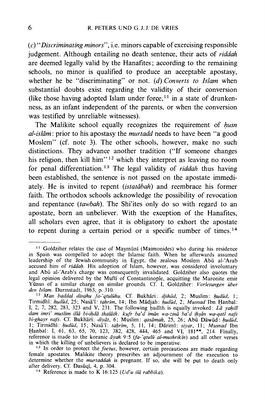


Apostasy in Islam
Rudolph Peters; Gert J. J. De Vries
Die Welt des Islams > New Ser., Vol. 17, Issue 1/4 (1976), pp. 1-25


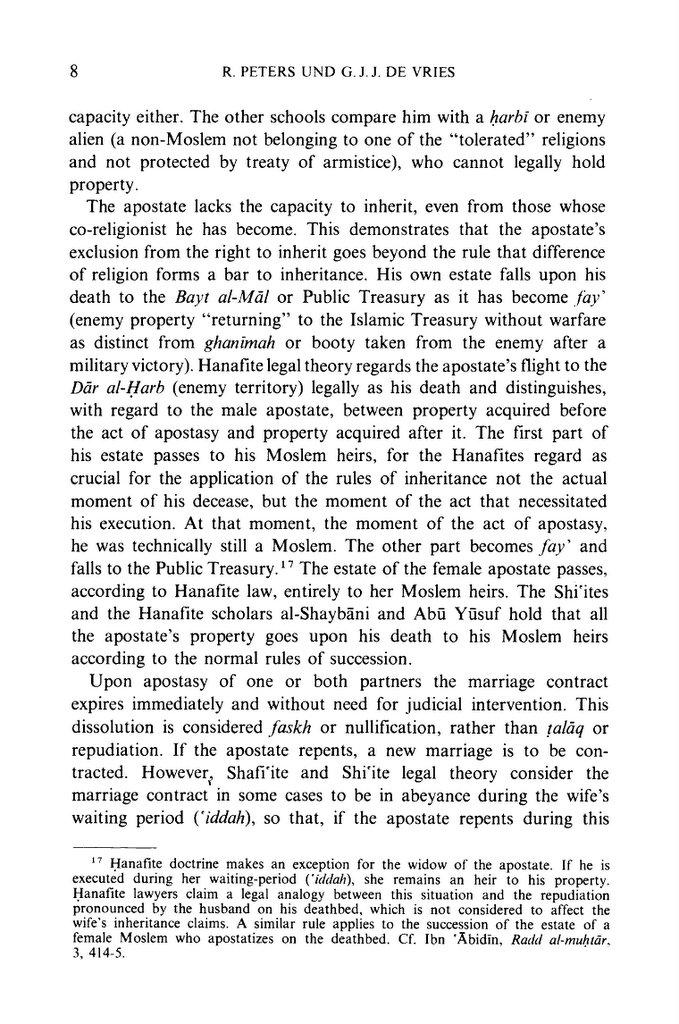
September 19, 2006
Reported sexual orientation doesn't match with sexual behavior
From EurekAlert:
PHILADELPHIA, September 19, 2006 – A survey of 4,193 men living in New York City conducted by the New York City Department of Health and Mental Hygiene found that nearly 10 percent of male participants who identified themselves as straight reported having sex with at least one man during the previous year.
...
Compared to men who identified themselves as gay, these men were more likely to belong to a minority racial or ethnic group, be foreign-born, have a lower educational level, and live outside Manhattan. Seventy percent reported being married. This group also was less likely to have been tested for HIV infection during the previous year and less likely to have used a condom during the last sexual encounter than men who identified themselves as gay.
Subscribe to:
Posts (Atom)