Science 9 May 2014:
Vol. 344 no. 6184 pp. 603-608
DOI: 10.1126/science.1246850
Large-Scale Psychological Differences Within China Explained by Rice Versus Wheat Agriculture
T. Talhelm et al.
Cross-cultural psychologists have mostly contrasted East Asia with the West. However, this study shows that there are major psychological differences within China. We propose that a history of farming rice makes cultures more interdependent, whereas farming wheat makes cultures more independent, and these agricultural legacies continue to affect people in the modern world. We tested 1162 Han Chinese participants in six sites and found that rice-growing southern China is more interdependent and holistic-thinking than the wheat-growing north. To control for confounds like climate, we tested people from neighboring counties along the rice-wheat border and found differences that were just as large. We also find that modernization and pathogen prevalence theories do not fit the data.
Link

Showing posts with label Domestication. Show all posts
Showing posts with label Domestication. Show all posts
April 03, 2014
Where pastoralist met farmer and East met West (Spengler et al. 2014)

Archaeobotanical data from Central Eurasian pastoralist campsites have major implications for our understanding of late prehistoric agriculture across Asia. Sites like Tasbas and Begash illustrate the earliest acquisition of domesticated crops by mobile pastoralists and illustrate their capacity to participate in exchanges that bridged East Asian and Central Asian farming cultures by the early third millennium BC. Mobile pastoralists living in (southern) Central Asian alluvial fans and along the mountainous spine of Central Eurasia also integrated farming into their own domestic strategies (at least) by the mid second millenniumBC. Their pastoral mobility and the formation of extensive networks throughout the IAMC helped spread particular grain morphotypes and a mixed plant cohort of wheat, barley, millet and green peas through the mountains between Xinjiang, China and southwest Asia in the second millennium BC. The seasonal campsites of Begash, Tasbas, Ojakly and Site 1211/1219 are the earliest sites thus far reported to break down the strict polarization between nomads and farmers in prehistoric Central Eurasia. They also transform our comprehension of the vast arena of interaction that defines this region in ancient times.Related:
- Frachetti on the multiregional emergence of mobile pastoralism
- Horse not important for the emergence of steppe pastoralism
- Michael Frachetti on the Inner Asian Mountain Corridor
Early agriculture and crop transmission among Bronze Age mobile pastoralists of Central Eurasia
Robert Spengler et al.
Archaeological research in Central Eurasia is exposing unprecedented scales of trans-regional interaction and technology transfer between East Asia and southwest Asia deep into the prehistoric past. This article presents a new archaeobotanical analysis from pastoralist campsites in the mountain and desert regions of Central Eurasia that documents the oldest known evidence for domesticated grains and farming among seasonally mobile herders. Carbonized grains from the sites of Tasbas and Begash illustrate the first transmission of southwest Asian and East Asian domesticated grains into the mountains of Inner Asia in the early third millennium BC. By the middle second millennium BC, seasonal camps in the mountains and deserts illustrate that Eurasian herders incorporated the cultivation of millet, wheat, barley and legumes into their subsistence strategy. These findings push back the chronology for domesticated plant use among Central Eurasian pastoralists by approximately 2000 years. Given the geography, chronology and seed morphology of these data, we argue that mobile pastoralists were key agents in the spread of crop repertoires and the transformation of agricultural economies across Asia from the third to the second millennium BC.
Link
November 15, 2013
European origin of domesticated dogs
It seems like yesterday that a paper suggested a Southeast Asian origin of domestic dogs. It always seems that ancient DNA upsets inferences from modern populations alone.
Science 15 November 2013: Vol. 342 no. 6160 pp. 871-874
Complete Mitochondrial Genomes of Ancient Canids Suggest a European Origin of Domestic Dogs
O. Thalmann et al.
The geographic and temporal origins of the domestic dog remain controversial, as genetic data suggest a domestication process in East Asia beginning 15,000 years ago, whereas the oldest doglike fossils are found in Europe and Siberia and date to >30,000 years ago. We analyzed the mitochondrial genomes of 18 prehistoric canids from Eurasia and the New World, along with a comprehensive panel of modern dogs and wolves. The mitochondrial genomes of all modern dogs are phylogenetically most closely related to either ancient or modern canids of Europe. Molecular dating suggests an onset of domestication there 18,800 to 32,100 years ago. These findings imply that domestic dogs are the culmination of a process that initiated with European hunter-gatherers and the canids with whom they interacted.
Link
November 08, 2013
Early cattle management in NE China

The haplogroup retrieved has so far not been found in modern cattle. However, as mtDNA represents a single genetic locus, it is prone to genetic drift and could easily have been lost by drift even if hybridization between the population to which the Chinese specimen belonged and other domesticated cattle populations has occurred. Further analyses on nuclear DNA will be necessary to show whether this early Chinese cattle management was a short-lived episode or whether it has contributed to the nuclear gene pool of modern cattle.
Nature Communications 4, Article number: 2755 doi:10.1038/ncomms3755
Morphological and genetic evidence for early Holocene cattle management in northeastern China
Hucai Zhang et al.
The domestication of cattle is generally accepted to have taken place in two independent centres: around 10,500 years ago in the Near East, giving rise to modern taurine cattle, and two millennia later in southern Asia, giving rise to zebu cattle. Here we provide firmly dated morphological and genetic evidence for early Holocene management of taurine cattle in northeastern China. We describe conjoining mandibles from this region that show evidence of oral stereotypy, dated to the early Holocene by two independent 14C dates. Using Illumina high-throughput sequencing coupled with DNA hybridization capture, we characterize 15,406 bp of the mitogenome with on average 16.7-fold coverage. Phylogenetic analyses reveal a hitherto unknown mitochondrial haplogroup that falls outside the known taurine diversity. Our data suggest that the first attempts to manage cattle in northern China predate the introduction of domestic cattle that gave rise to the current stock by several thousand years.
Link
September 23, 2013
Ancestry and Admixture of Domesticated Cattle
Quite an interesting new preprint on the arXiv.
arXiv:1309.5118 [q-bio.PE]
Worldwide Patterns of Ancestry, Divergence, and Admixture in Domesticated Cattle
Jared E. Decker et al.
The domestication and development of cattle has considerably impacted human societies, but the histories of cattle breeds have been poorly understood especially for African, Asian, and American breeds. Using genotypes from 43,043 autosomal single nucleotide polymorphism markers scored in 1,543 animals, we evaluate the population structure of 134 domesticated bovid breeds. Regardless of the analytical method or sample subset, the three major groups of Asian indicine, Eurasian taurine, and African taurine were consistently observed. Patterns of geographic dispersal resulting from co-migration with humans and exportation are recognizable in phylogenetic networks. All analytical methods reveal patterns of hybridization which occurred after divergence. Using 19 breeds, we map the cline of indicine introgression into Africa. We infer that African taurine possess a large portion of wild African auroch ancestry, causing their divergence from Eurasian taurine. We detect exportation patterns in Asia and identify a cline of Eurasian taurine/indicine hybridization in Asia. We also identify the influence of species other than Bos taurus in the formation of Asian breeds. We detect the pronounced influence of Shorthorn cattle in the formation of European breeds. Iberian and Italian cattle possess introgression from African taurine. American Criollo cattle are shown to be of Iberian, and not African, decent. Indicine introgression into American cattle occurred in the Americas, and not Europe. We argue that cattle migration, movement and trading followed by admixture have been important forces in shaping modern bovine genomic variation.
Link
August 31, 2013
Multiple sources of European barley

The wild progenitor of barley, Hordeum spontaneum, is typically a winter-germinating species, responsive to day length (Turner et al. 2005), but recent work (H. Jones et al. 2008) has demonstrated that the non-responsive allele also occurs in wild barley in Israel, Jordan and Iran, in regions where this allele is favoured by the climatic conditions. There is strong evidence to suggest that the non-responsive allele in European cultivars (Group A) is genetically more similar to the allele in Iranian wild barleys than to the allele in wild barleys from Israel and Jordan.and:
Detailed genetic comparisons between groups A, B and C (H. Jones 2008; H. Jones et al. 2008) suggest that Group A represents a more recent introduction of day-length non-responsive barley into Europe, rather than the selection of non-responsiveness from within populations that diffused into Europe in the Early Neolithic. In addition, three of the nine principal groups identified on the basis of the neutral SSR markers (groups 1–3) are genetically closely related and very similar in their phenotypic characteristics. They are located in north-west and Central Europe (Figure 3b), and are made up almost entirely of day-length non-responsive barleys (98 per cent) with a spring growth habit (98 per cent) (H. Jones et al. 2011). The distinctiveness of the landraces making up groups 1–3 suggests that the responsive/non-responsive difference between Southern and Northern Europe is not simply a reflection of current selective pressure but rather is one aspect of a more fundamental genetic difference between barley populations. These day-length non-responsive cultivars have therefore been interpreted as representing a later spread of barley into Northern Europe from the eastern part of the Fertile Crescent or beyond. This raises the issue of when they spread into Europe and whether or not they were introduced via the same route as the initial spread of agriculture.and:
A possible channel for the introduction of day-length non-responsive barley into Northern Europe from the east at this time could have been through early exchange networks with metal-working communities of south-eastern Europe (Sherratt 1976; Bogucki 1999: 220–21). The Chalcolithic societies of the Balkans also maintained connections further east with the west Eurasian Steppes, Anatolia, and the Caucasus in the fifth and early fourth millennia, and copper was exchanged from west to east across the steppes north of the Black Sea (Kohl 2007: 31–39). Day-length non-responsive barley could, therefore, have travelled from east to west along the same route, north of the Black Sea via the Caucasus or, perhaps more likely given its agricultural nature, south of the Black Sea through Anatolia, possibly via a coastal route around the Black Sea, and then from the Carpatho-Balkan metallurgical region into Northern Europe (Figure 3b). A similar suggestion has been made for the later appearance of the oil plant Lallemantia, which was apparently introduced into Europe in the third millennium BC, possibly along the same trade routes as tin-bronzes (Valamoti & Jones 2010).Antiquity Volume: 87 Number: 337 Page: 701–713
DNA evidence for multiple introductions of barley into Europe following dispersed domestications in Western Asia
G. Jones et al.
It has long been recognised that the Neolithic spread across Europe via two separate routes, one along the Mediterranean coasts, the other following the axis of the major rivers. But did these two streams have a common point of origin in south-west Asia, at least with regard to the principal plant and animals species that were involved? This study of barley DNA shows that the domesticated barley grown in Neolithic Europe falls into three separate types (groups A, B and C), each of which may have had a separate centre of origin in south-west Asia. Barley was relatively rarely cultivated by the early Linearbandkeramik farmers of Central and Northern Europe, but became more common during the fifth and fourth millennia BC. The analysis reported here indicates that a genetic variety of barley more suitable for northern growing conditions was introduced from south-west Asia at this period. It also suggests that the barley grown in south-eastern Europe at the very beginning of the Neolithic may have arrived there by different routes from two separate centres of domestication in south-west Asia. The multiple domestications that this pattern reveals imply that domestication may have been more a co-evolutionary process between plants and people than an intentional human action.
Link
August 27, 2013
European hunter-gatherers acquired pigs with Near Eastern and European mtDNA

Related: Ottoni et al. (2012).
Nature Communications 4, Article number: 2348 doi:10.1038/ncomms3348
Use of domesticated pigs by Mesolithic hunter-gatherers in northwestern Europe
Ben Krause-Kyora et al.
Mesolithic populations throughout Europe used diverse resource exploitation strategies that focused heavily on collecting and hunting wild prey. Between 5500 and 4200 cal BC, agriculturalists migrated into northwestern Europe bringing a suite of Neolithic technologies including domesticated animals. Here we investigate to what extent Mesolithic Ertebølle communities in northern Germany had access to domestic pigs, possibly through contact with neighbouring Neolithic agricultural groups. We employ a multidisciplinary approach, applying sequencing of ancient mitochondrial and nuclear DNA (coat colour-coding gene MC1R) as well as traditional and geometric morphometric (molar size and shape) analyses in Sus specimens from 17 Neolithic and Ertebølle sites. Our data from 63 ancient pig specimens show that Ertebølle hunter-gatherers acquired domestic pigs of varying size and coat colour that had both Near Eastern and European mitochondrial DNA ancestry. Our results also reveal that domestic pigs were present in the region ~500 years earlier than previously demonstrated.
Link
July 15, 2013
Early European farmers used manure
PNAS doi: 10.1073/pnas.1305918110
Crop manuring and intensive land management by Europe’s first farmers
Amy Bogaard et al.
The spread of farming from western Asia to Europe had profound long-term social and ecological impacts, but identification of the specific nature of Neolithic land management practices and the dietary contribution of early crops has been problematic. Here, we present previously undescribed stable isotope determinations of charred cereals and pulses from 13 Neolithic sites across Europe (dating ca. 5900–2400 cal B.C.), which show that early farmers used livestock manure and water management to enhance crop yields. Intensive manuring inextricably linked plant cultivation and animal herding and contributed to the remarkable resilience of these combined practices across diverse climatic zones. Critically, our findings suggest that commonly applied paleodietary interpretations of human and herbivore δ15N values have systematically underestimated the contribution of crop-derived protein to early farmer diets.
Link
July 11, 2013
Native Native American dogs
Proc. R. Soc. B doi: 10.1098/rspb.2013.1142
Pre-Columbian origins of Native American dog breeds, with only limited replacement by European dogs, confirmed by mtDNA analysis
Barbara van Asch et al.
Dogs were present in pre-Columbian America, presumably brought by early human migrants from Asia. Studies of free-ranging village/street dogs have indicated almost total replacement of these original dogs by European dogs, but the extent to which Arctic, North and South American breeds are descendants of the original population remains to be assessed. Using a comprehensive phylogeographic analysis, we traced the origin of the mitochondrial DNA lineages for Inuit, Eskimo and Greenland dogs, Alaskan Malamute, Chihuahua, xoloitzcuintli and perro sín pelo del Peru, by comparing to extensive samples of East Asian (n = 984) and European dogs (n = 639), and previously published pre-Columbian sequences. Evidence for a pre-Columbian origin was found for all these breeds, except Alaskan Malamute for which results were ambigous. No European influence was indicated for the Arctic breeds Inuit, Eskimo and Greenland dog, and North/South American breeds had at most 30% European female lineages, suggesting marginal replacement by European dogs. Genetic continuity through time was shown by the sharing of a unique haplotype between the Mexican breed Chihuahua and ancient Mexican samples. We also analysed free-ranging dogs, confirming limited pre-Columbian ancestry overall, but also identifying pockets of remaining populations with high proportion of indigenous ancestry, and we provide the first DNA-based evidence that the Carolina dog, a free-ranging population in the USA, may have an ancient Asian origin.
Link
July 05, 2013
Early agriculture from Iran
A quite useful map from the press release of this paper:

The following map from an accompanying perspective is also quite interesting; "Dates in blue denote early cultivation of wild cereals" but "Ongoing excavations in central Anatolia and Cyprus are pushing dates back in these areas."

The issue of whether there was a single or (more likely multiple) areas of early agriculture is potentially important as it would imply that there were genetically differentiated (due to geographic distance) populations in the Neolithic womb of nations. In a global, or even a Eurasian context, these populations would be relatively genetically close, but not identical; it would be interesting to see to what extent present-day differentiation in the Near East reflects those early differences as opposed to more recent events.
Science 5 July 2013: Vol. 341 no. 6141 pp. 65-67
Emergence of Agriculture in the Foothills of the Zagros Mountains of Iran
Simone Riehl et al.
The role of Iran as a center of origin for domesticated cereals has long been debated. High stratigraphic resolution and rich archaeological remains at the aceramic Neolithic site of Chogha Golan (Ilam Province, present-day Iran) reveal a sequence ranging over 2200 years of cultivation of wild plants and the first appearance of domesticated-type species. The botanical record from Chogha Golan documents how the inhabitants of the site cultivated wild barley (Hordeum spontaneum) and other wild progenitor species of modern crops, such as wild lentil and pea. Wild wheat species (Triticum spp.) are initially present at less than 10% of total plant species but increase to more than 20% during the last 300 years of the sequence. Around 9800 calendar years before the present, domesticated-type emmer appears. The archaeobotanical remains from Chogha Golan represent the earliest record of long-term plant management in Iran.
Link

The following map from an accompanying perspective is also quite interesting; "Dates in blue denote early cultivation of wild cereals" but "Ongoing excavations in central Anatolia and Cyprus are pushing dates back in these areas."
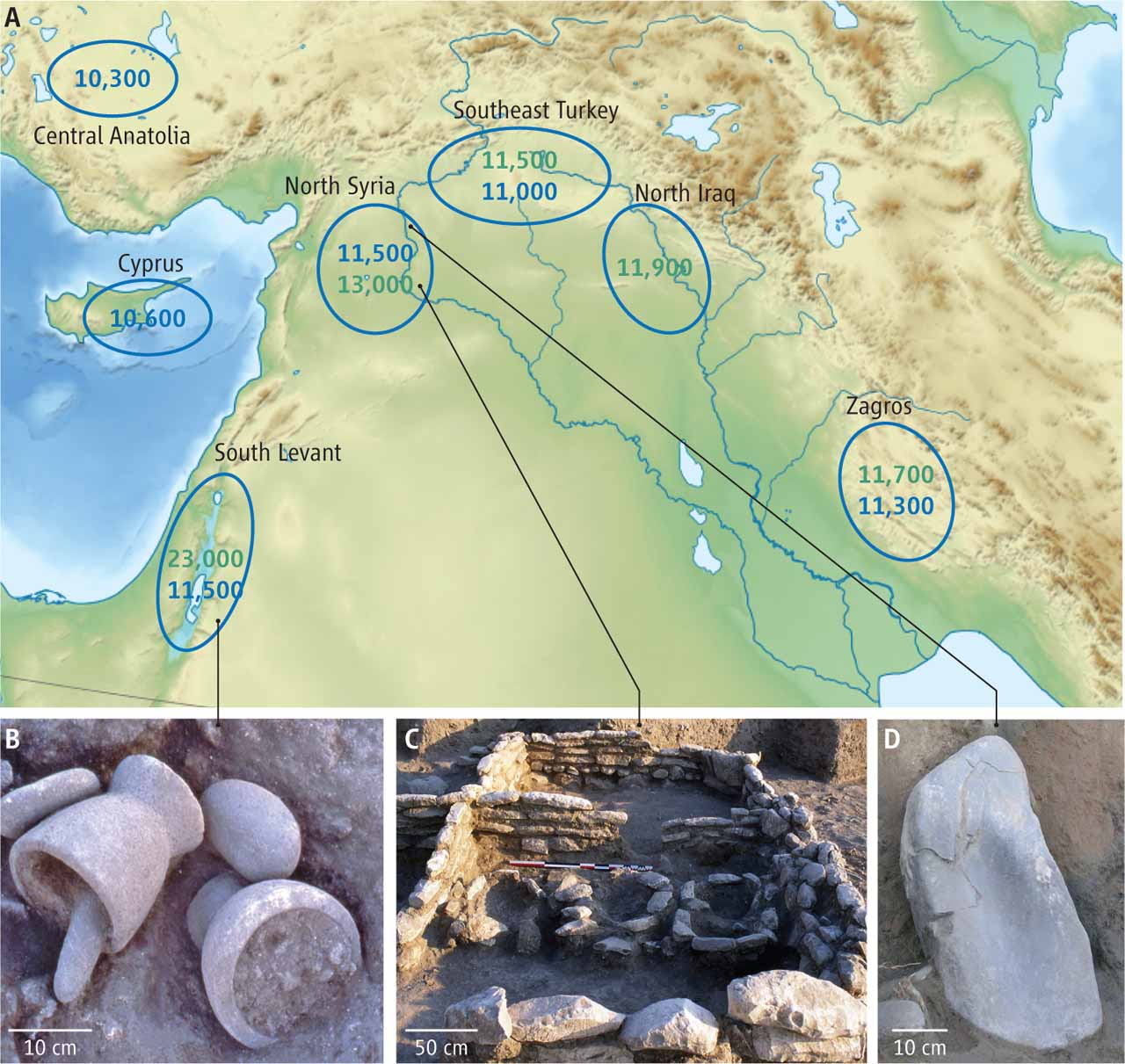
The issue of whether there was a single or (more likely multiple) areas of early agriculture is potentially important as it would imply that there were genetically differentiated (due to geographic distance) populations in the Neolithic womb of nations. In a global, or even a Eurasian context, these populations would be relatively genetically close, but not identical; it would be interesting to see to what extent present-day differentiation in the Near East reflects those early differences as opposed to more recent events.
Science 5 July 2013: Vol. 341 no. 6141 pp. 65-67
Emergence of Agriculture in the Foothills of the Zagros Mountains of Iran
Simone Riehl et al.
The role of Iran as a center of origin for domesticated cereals has long been debated. High stratigraphic resolution and rich archaeological remains at the aceramic Neolithic site of Chogha Golan (Ilam Province, present-day Iran) reveal a sequence ranging over 2200 years of cultivation of wild plants and the first appearance of domesticated-type species. The botanical record from Chogha Golan documents how the inhabitants of the site cultivated wild barley (Hordeum spontaneum) and other wild progenitor species of modern crops, such as wild lentil and pea. Wild wheat species (Triticum spp.) are initially present at less than 10% of total plant species but increase to more than 20% during the last 300 years of the sequence. Around 9800 calendar years before the present, domesticated-type emmer appears. The archaeobotanical remains from Chogha Golan represent the earliest record of long-term plant management in Iran.
Link
June 03, 2013
Dog domestication parameters from full genome sequencing
This paper casts doubt on the dominant scenario about the Southeast Asian geographical origin of dogs, while at the same time affirming their monophyletic origin and late pre-Neolithic domestication. The authors also document traits that were under selection during domestication.
It would be interesting to know what kinds of roles early dogs. Presumably early pre-Neolithic dogs functioned more as hunting companions, while those of Neolithic societies also had an increasing role as guards -since there was then property that needed guarding. How do modern dog breeds differ genetically to accommodate these roles, and might we one day figure out the original tasks of "multi-purpose" animals such as dogs?
arXiv:1305.7390 [q-bio.GN]
Genome Sequencing Highlights Genes Under Selection and the Dynamic Early History of Dogs
Adam H. Freedman et al.
To identify genetic changes underlying dog domestication and reconstruct their early evolutionary history, we analyzed novel high-quality genome sequences of three gray wolves, one from each of three putative centers of dog domestication, two ancient dog lineages (Basenji and Dingo) and a golden jackal as an outgroup. We find dogs and wolves diverged through a dynamic process involving population bottlenecks in both lineages and post-divergence gene flow, which confounds previous inferences of dog origins. In dogs, the domestication bottleneck was severe involving a 17 to 49-fold reduction in population size, a much stronger bottleneck than estimated previously from less intensive sequencing efforts. A sharp bottleneck in wolves occurred soon after their divergence from dogs, implying that the pool of diversity from which dogs arose was far larger than represented by modern wolf populations. Conditional on mutation rate, we narrow the plausible range for the date of initial dog domestication to an interval from 11 to 16 thousand years ago. This period predates the rise of agriculture, implying that the earliest dogs arose alongside hunter-gathers rather than agriculturists. Regarding the geographic origin of dogs, we find that surprisingly, none of the extant wolf lineages from putative domestication centers are more closely related to dogs, and the sampled wolves instead form a sister monophyletic clade. This result, in combination with our finding of dog-wolf admixture during the process of domestication, suggests a re-evaluation of past hypotheses of dog origin is necessary. Finally, we also detect signatures of selection, including evidence for selection on genes implicated in morphology, metabolism, and neural development. Uniquely, we find support for selective sweeps at regulatory sites suggesting gene regulatory changes played a critical role in dog domestication.
Link
May 28, 2013
Coevolution of farming and private property rights
PNAS May 28, 2013 vol. 110 no. 22
Coevolution of farming and private property during the early Holocene
Samuel Bowles, and Jung-Kyoo Choi
The advent of farming around 12 millennia ago was a cultural as well as technological revolution, requiring a new system of property rights. Among mobile hunter–gatherers during the late Pleistocene, food was almost certainly widely shared as it was acquired. If a harvested crop or the meat of a domesticated animal were to have been distributed to other group members, a late Pleistocene would-be farmer would have had little incentive to engage in the required investments in clearing, cultivation, animal tending, and storage. However, the new property rights that farming required—secure individual claims to the products of one’s labor—were infeasible because most of the mobile and dispersed resources of a forager economy could not cost-effectively be delimited and defended. The resulting chicken-and-egg puzzle might be resolved if farming had been much more productive than foraging, but initially it was not. Our model and simulations explain how, despite being an unlikely event, farming and a new system of farming-friendly property rights nonetheless jointly emerged when they did. This Holocene revolution was not sparked by a superior technology. It occurred because possession of the wealth of farmers—crops, dwellings, and animals—could be unambiguously demarcated and defended. This facilitated the spread of new property rights that were advantageous to the groups adopting them. Our results thus challenge unicausal models of historical dynamics driven by advances in technology, population pressure, or other exogenous changes. Our approach may be applied to other technological and institutional revolutions such as the 18th- and 19th-century industrial revolution and the information revolution today.
Link
April 04, 2013
Horse Y chromosomes

Identification of Genetic Variation on the Horse Y Chromosome and the Tracing of Male Founder Lineages in Modern Breeds
Barbara Wallner et al.
The paternally inherited Y chromosome displays the population genetic history of males. While modern domestic horses (Equus caballus) exhibit abundant diversity within maternally inherited mitochondrial DNA, no significant Y-chromosomal sequence diversity has been detected. We used high throughput sequencing technology to identify the first polymorphic Y-chromosomal markers useful for tracing paternal lines. The nucleotide variability of the modern horse Y chromosome is extremely low, resulting in six haplotypes (HT), all clearly distinct from the Przewalski horse (E. przewalskii). The most widespread HT1 is ancestral and the other five haplotypes apparently arose on the background of HT1 by mutation or gene conversion after domestication. Two haplotypes (HT2 and HT3) are widely distributed at high frequencies among modern European horse breeds. Using pedigree information, we trace the distribution of Y-haplotype diversity to particular founders. The mutation leading to HT3 occurred in the germline of the famous English Thoroughbred stallion “Eclipse” or his son or grandson and its prevalence demonstrates the influence of this popular paternal line on modern sport horse breeds. The pervasive introgression of Thoroughbred stallions during the last 200 years to refine autochthonous breeds has strongly affected the distribution of Y-chromosomal variation in modern horse breeds and has led to the replacement of autochthonous Y chromosomes. Only a few northern European breeds bear unique variants at high frequencies or fixed within but not shared among breeds. Our Y-chromosomal data complement the well established mtDNA lineages and document the male side of the genetic history of modern horse breeds and breeding practices.
Link
March 18, 2013
Millet use ~11 thousand years ago in northern China
PNAS March 6, 2012 vol. 109 no. 10 3726-3730
Early millet use in northern China
Xiaoyan Yang et al.
It is generally understood that foxtail millet and broomcorn millet were initially domesticated in Northern China where they eventually became the dominant plant food crops. The rarity of older archaeological sites and archaeobotanical work in the region, however, renders both the origins of these plants and their processes of domestication poorly understood. Here we present ancient starch grain assemblages recovered from cultural deposits, including carbonized residues adhering to an early pottery sherd as well as grinding stone tools excavated from the sites of Nanzhuangtou (11.5–11.0 cal kyBP) and Donghulin (11.0–9.5 cal kyBP) in the North China Plain. Our data extend the record of millet use in China by nearly 1,000 y, and the record of foxtail millet in the region by at least two millennia. The patterning of starch residues within the samples allow for the formulation of the hypothesis that foxtail millets were cultivated for an extended period of two millennia, during which this crop plant appears to have been undergoing domestication. Future research in the region will help clarify the processes in place.
Link
March 07, 2013
33,000-year old dog from the Altai

In conclusion, our analyses support the hypothesis that the Altai specimen is more closely related to domestic dogs than to extant wolves, but we stress the point that these analyses were limited to a single, maternally inherited locus and more sequence data would be needed to obtain a statistically well supported phylogeny and unambiguously resolve the genetic relationship of the Altai specimen. However, this preliminary analysis affirms the conclusion that the Altai specimen is likely an ancient dog with a shallow divergence from ancient wolves. These results suggest a more ancient history of the dog outside the Middle East or East Asia, previously suggested as centres of dog origin. Additional discoveries of ancient dog-like remains are essential for further narrowing the time and region of origin for the domestic dog [5].An ancient dog with shallow divergence from ancient wolves is probably what we might expect if dogs had been domesticated by some of the first Upper Paleolithic Eurasians a few thousand years prior to the date of this particular specimen.
PLoS ONE 8(3): e57754. doi:10.1371/journal.pone.0057754
Ancient DNA Analysis Affirms the Canid from Altai as a Primitive Dog
Anna S. Druzhkova et al.
The origin of domestic dogs remains controversial, with genetic data indicating a separation between modern dogs and wolves in the Late Pleistocene. However, only a few dog-like fossils are found prior to the Last Glacial Maximum, and it is widely accepted that the dog domestication predates the beginning of agriculture about 10,000 years ago. In order to evaluate the genetic relationship of one of the oldest dogs, we have isolated ancient DNA from the recently described putative 33,000-year old Pleistocene dog from Altai and analysed 413 nucleotides of the mitochondrial control region. Our analyses reveal that the unique haplotype of the Altai dog is more closely related to modern dogs and prehistoric New World canids than it is to contemporary wolves. Further genetic analyses of ancient canids may reveal a more exact date and centre of domestication.
Link
February 06, 2013
Complex history of the olive tree
Proc. R. Soc. B 7 April 2013 vol. 280 no. 1756
doi: 10.1098/rspb.2012.2833
The complex history of the olive tree: from Late Quaternary diversification of Mediterranean lineages to primary domestication in the northern Levant
G. Besnard et al.
The location and timing of domestication of the olive tree, a key crop in Early Mediterranean societies, remain hotly debated. Here, we unravel the history of wild olives (oleasters), and then infer the primary origins of the domesticated olive. Phylogeography and Bayesian molecular dating analyses based on plastid genome profiling of 1263 oleasters and 534 cultivated genotypes reveal three main lineages of pre-Quaternary origin. Regional hotspots of plastid diversity, species distribution modelling and macrofossils support the existence of three long-term refugia; namely the Near East (including Cyprus), the Aegean area and the Strait of Gibraltar. These ancestral wild gene pools have provided the essential foundations for cultivated olive breeding. Comparison of the geographical pattern of plastid diversity between wild and cultivated olives indicates the cradle of first domestication in the northern Levant followed by dispersals across the Mediterranean basin in parallel with the expansion of civilizations and human exchanges in this part of the world.
Link
January 31, 2013
Genetic diversity of modern horses

Horses are very mobile, and can also be traded; much of their existing variation may also be the result of artificial breeding which might have included both selection for particular desirable traits as well as mixing different populations.
 Now that there is a fairly clear picture of modern variation, it will be useful to explore how this has emerged over time. It'll be interesting to see how ancient horses fit into the modern picture: will they prove ancestral to those living in the same regions, or is there a process of continuous renewal, with multiple episodes of turnover, as good breeds emerge somewhere across the geographical range of the animal, and quickly replace less advantageous ones?

Genetic Diversity in the Modern Horse Illustrated from Genome-Wide SNP Data
Jessica L. Petersen et al.
Horses were domesticated from the Eurasian steppes 5,000–6,000 years ago. Since then, the use of horses for transportation, warfare, and agriculture, as well as selection for desired traits and fitness, has resulted in diverse populations distributed across the world, many of which have become or are in the process of becoming formally organized into closed, breeding populations (breeds). This report describes the use of a genome-wide set of autosomal SNPs and 814 horses from 36 breeds to provide the first detailed description of equine breed diversity. FST calculations, parsimony, and distance analysis demonstrated relationships among the breeds that largely reflect geographic origins and known breed histories. Low levels of population divergence were observed between breeds that are relatively early on in the process of breed development, and between those with high levels of within-breed diversity, whether due to large population size, ongoing outcrossing, or large within-breed phenotypic diversity. Populations with low within-breed diversity included those which have experienced population bottlenecks, have been under intense selective pressure, or are closed populations with long breed histories. These results provide new insights into the relationships among and the diversity within breeds of horses. In addition these results will facilitate future genome-wide association studies and investigations into genomic targets of selection.
Link
January 23, 2013
Dog food
Diet Shaped Dog Domestication
The genomic signature of dog domestication reveals adaptation to a starch-rich diet
Erik Axelsson et al.
The domestication of dogs was an important episode in the development of human civilization. The precise timing and location of this event is debated1, 2, 3, 4, 5 and little is known about the genetic changes that accompanied the transformation of ancient wolves into domestic dogs. Here we conduct whole-genome resequencing of dogs and wolves to identify 3.8 million genetic variants used to identify 36 genomic regions that probably represent targets for selection during dog domestication. Nineteen of these regions contain genes important in brain function, eight of which belong to nervous system development pathways and potentially underlie behavioural changes central to dog domestication6. Ten genes with key roles in starch digestion and fat metabolism also show signals of selection. We identify candidate mutations in key genes and provide functional support for an increased starch digestion in dogs relative to wolves. Our results indicate that novel adaptations allowing the early ancestors of modern dogs to thrive on a diet rich in starch, relative to the carnivorous diet of wolves, constituted a crucial step in the early domestication of dogs.
Link
The analysis turned up 36 regions, with 122 genes in all, that may have contributed to dog evolution, the team reports online today in Nature. Nineteen of these regions contain genes important for the brain, eight of which are involved with nervous system development, which makes sense given the importance of behavioral changes in the transition to becoming man's best friend, Axelsson notes.Nature (2013) doi:10.1038/nature11837
More surprising were genes for digesting starch. Dogs had four to 30 copies of the gene for amylase, a protein that starts the breakdown of starch in the intestine. Wolves have only two copies, one on each chromosome. As a result, that gene was 28-fold more active in dogs, the researchers found. More copies means more protein, and test-tube studies indicate that dogs should be fivefold better than wolves at digesting starch, the chief nutrient in agricultural grains such as wheat and rice. The number of copies of this gene also varies in people: Those eating high carbohydrate diets -- such as the Japanese and European Americans -- have more copies than people with starch-poor diets, such as the Mbuti in Africa. "We have adapted in a very similar way to the dramatic changes that happened when agriculture was developed," Axelsson says.
The genomic signature of dog domestication reveals adaptation to a starch-rich diet
Erik Axelsson et al.
The domestication of dogs was an important episode in the development of human civilization. The precise timing and location of this event is debated1, 2, 3, 4, 5 and little is known about the genetic changes that accompanied the transformation of ancient wolves into domestic dogs. Here we conduct whole-genome resequencing of dogs and wolves to identify 3.8 million genetic variants used to identify 36 genomic regions that probably represent targets for selection during dog domestication. Nineteen of these regions contain genes important in brain function, eight of which belong to nervous system development pathways and potentially underlie behavioural changes central to dog domestication6. Ten genes with key roles in starch digestion and fat metabolism also show signals of selection. We identify candidate mutations in key genes and provide functional support for an increased starch digestion in dogs relative to wolves. Our results indicate that novel adaptations allowing the early ancestors of modern dogs to thrive on a diet rich in starch, relative to the carnivorous diet of wolves, constituted a crucial step in the early domestication of dogs.
Link
January 21, 2013
Sweet potato genome provides link between South America and Polynesia
The actual PNAS paper seems to be still under embargo, but here's a news story in Science about the new research:
By analyzing genetic markers specific to sweet potatoes in both modern samples of the plant and older herbarium specimens, the researchers discovered significant differences between varieties found in the western Pacific versus the eastern Pacific. This finding supports the so-called tripartite hypothesis, which argues that the sweet potato was introduced to the region three times: first through premodern contact between Polynesia and South America, then by Spanish traders sailing west from Mexico, and Portuguese traders coming east from the Caribbean. The Spanish and Portuguese varieties ended up in the western Pacific, while the older South American variety dominated in the east, which would explain the genetic differences the French team saw.Apart from the famous Heyerdahl voyage (which has recently become the subject of a 2012 movie), there was some other research regarding the introduction of Polynesian chickens to Chile. I have not followed the genetics of that part of the world very closely, but it's my impression that such a link between Polynesia and South America has not been found in the human populations of the two regions.
December 15, 2012
Local Origin of Domestic Pigs in the Upstream Region of the Yangtze River (Jin et al. 2012)
PLoS ONE 7(12): e51649. doi:10.1371/journal.pone.0051649
Mitochondrial DNA Evidence Indicates the Local Origin of Domestic Pigs in the Upstream Region of the Yangtze River
Long Jin et al.
Previous studies have indicated two main domestic pig dispersal routes in East Asia: one is from the Mekong region, through the upstream region of the Yangtze River (URYZ) to the middle and upstream regions of the Yellow River, the other is from the middle and downstream regions of the Yangtze River to the downstream region of the Yellow River, and then to northeast China. The URYZ was regarded as a passageway of the former dispersal route; however, this assumption remains to be further investigated. We therefore analyzed the hypervariable segements of mitochondrial DNA from 513 individual pigs mainly from Sichuan and the Tibet highlands and 1,394 publicly available sequences from domestic pigs and wild boars across Asia. From the phylogenetic tree, most of the samples fell into a mixed group that was difficult to distinguish by breed or geography. The total network analysis showed that the URYZ pigs possessed a dominant position in haplogroup A and domestic pigs shared the same core haplotype with the local wild boars, suggesting that pigs in group A were most likely derived from the URYZ pool. In addition, a region-wise network analysis determined that URYZ contains 42 haplotypes of which 22 are unique indicating the high diversity in this region. In conclusion, our findings confirmed that pigs from the URYZ were domesticated in situ.
Link
Subscribe to:
Posts (Atom)