PNAS DOI: doi: 10.1073/pnas.1523158113
A high-precision chronological model for the decorated Upper Paleolithic cave of Chauvet-Pont d’Arc, Ardèche, France
Anita Quiles et al.
Radiocarbon dates for the ancient drawings in the Chauvet-Pont d’Arc Cave revealed ages much older than expected. These early ages and nature of this Paleolithic art make this United Nations Educational, Scientific and Cultural Organization (UNESCO) site indisputably unique. A large, multidisciplinary dating program has recently mapped the anthropological evolution associated with the cave. More than 350 dates (by 14C, U-Th, TL and 36Cl) were obtained over the last 15 y. They include 259 radiocarbon dates, mainly related to the rock art and human activity in the cave. We present here more than 80 previously unpublished dates. All of the dates were integrated into a high-precision Bayesian model based on archaeological evidence to securely reconstruct the complete history of the Chauvet-Pont d’Arc Cave on an absolute timescale. It shows that there were two distinct periods of human activity in the cave, one from 37 to 33,500 y ago, and the other from 31 to 28,000 y ago. Cave bears also took refuge in the cave until 33,000 y ago.
Link

Showing posts with label France. Show all posts
Showing posts with label France. Show all posts
April 14, 2016
May 04, 2015
Ancient mtDNA from Neolithic France
PLoS ONE 10(4): e0125521. doi:10.1371/journal.pone.0125521
When the Waves of European Neolithization Met: First Paleogenetic Evidence from Early Farmers in the Southern Paris Basin
Maïté Rivollat et al.
An intense debate concerning the nature and mode of Neolithic transition in Europe has long received much attention. Recent publications of paleogenetic analyses focusing on ancient European farmers from Central Europe or the Iberian Peninsula have greatly contributed to this debate, providing arguments in favor of major migrations accompanying European Neolithization and highlighting noticeable genetic differentiation between farmers associated with two archaeologically defined migration routes: the Danube valley and the Mediterranean Sea. The aim of the present study was to fill a gap with the first paleogenetic data of Neolithic settlers from a region (France) where the two great currents came into both direct and indirect contact with each other. To this end, we analyzed the Gurgy 'Les Noisats' group, an Early/Middle Neolithic necropolis in the southern part of the Paris Basin. Interestingly, the archaeological record from this region highlighted a clear cultural influence from the Danubian cultural sphere but also notes exchanges with the Mediterranean cultural area. To unravel the processes implied in these cultural exchanges, we analyzed 102 individuals and obtained the largest Neolithic mitochondrial gene pool so far (39 HVS-I mitochondrial sequences and haplogroups for 55 individuals) from a single archaeological site from the Early/Middle Neolithic period. Pairwise FST values, haplogroup frequencies and shared informative haplotypes were calculated and compared with ancient and modern European and Near Eastern populations. These descriptive analyses provided patterns resulting from different evolutionary scenarios; however, the archaeological data available for the region suggest that the Gurgy group was formed through equivalent genetic contributions of farmer descendants from the Danubian and Mediterranean Neolithization waves. However, these results, that would constitute the most ancient genetic evidence of admixture between farmers from both Central and Mediterranean migration routes in the European Neolithization debate, are subject to confirmation through appropriate model-based approaches.
Link
When the Waves of European Neolithization Met: First Paleogenetic Evidence from Early Farmers in the Southern Paris Basin
Maïté Rivollat et al.
An intense debate concerning the nature and mode of Neolithic transition in Europe has long received much attention. Recent publications of paleogenetic analyses focusing on ancient European farmers from Central Europe or the Iberian Peninsula have greatly contributed to this debate, providing arguments in favor of major migrations accompanying European Neolithization and highlighting noticeable genetic differentiation between farmers associated with two archaeologically defined migration routes: the Danube valley and the Mediterranean Sea. The aim of the present study was to fill a gap with the first paleogenetic data of Neolithic settlers from a region (France) where the two great currents came into both direct and indirect contact with each other. To this end, we analyzed the Gurgy 'Les Noisats' group, an Early/Middle Neolithic necropolis in the southern part of the Paris Basin. Interestingly, the archaeological record from this region highlighted a clear cultural influence from the Danubian cultural sphere but also notes exchanges with the Mediterranean cultural area. To unravel the processes implied in these cultural exchanges, we analyzed 102 individuals and obtained the largest Neolithic mitochondrial gene pool so far (39 HVS-I mitochondrial sequences and haplogroups for 55 individuals) from a single archaeological site from the Early/Middle Neolithic period. Pairwise FST values, haplogroup frequencies and shared informative haplotypes were calculated and compared with ancient and modern European and Near Eastern populations. These descriptive analyses provided patterns resulting from different evolutionary scenarios; however, the archaeological data available for the region suggest that the Gurgy group was formed through equivalent genetic contributions of farmer descendants from the Danubian and Mediterranean Neolithization waves. However, these results, that would constitute the most ancient genetic evidence of admixture between farmers from both Central and Mediterranean migration routes in the European Neolithization debate, are subject to confirmation through appropriate model-based approaches.
Link
March 06, 2014
Chauvet cave art not the work of earliest Europeans
Many of you may have watched Cave of Forgotten Dreams, a great documentary about the paintings of Chauvet cave in France. It now turns out that the extraordinary art preserved in the cave may not date to ~36,000 years but rather to the Gravettian or Solutrean period.
L'Anthropologie Available online 11 February 2014
New investigations into the cultural and stylistic identity of the Chauvet cave and its radiocarbon dating
Jean Combiera, Guy Jouve
The discovery of Chauvet cave, at Vallon-Pont-d’Arc (Ardèche), in 1994, was an important event for our knowledge of palaeolithic parietal art as a whole. Its painted and engraved figures, thanks to their number (425 graphic units), and their excellent state of preservation, provide a documentary thesaurus comparable to that of the greatest sites known, and far beyond what had already been found in the group of Rhône valley caves (Ardèche and Gard). But its study – when one places it in its natural regional, cultural and thematic framework – makes it impossible to see it as an isolated entity of astonishing precocity. This needs to be reconsidered, and the affinities that our research has brought to light are clearly incompatible with the very early age which has been attributed to it. And if one extends this examination to the whole of the Franco-Cantabrian domain, the conclusion is inescapable: although Chauvet cave displays some unique characteristics (like every decorated cave), it belongs to an evolved phase of parietal art that is far removed from the motifs of its origins (known from art on blocks and on shelter walls dated by stratigraphy to the Aurignacian, in France and Cantabrian Spain). The majority of its works are therefore to be placed, quite normally, within the framework of the well-defined artistic creations of the Gravettian and Solutrean. Moreover, this phase of the Middle Upper Palaeolithic (26,000–18,000) coincides with a particularly intensive and diversified local human occupation, unknown in earlier periods and far less dense afterwards in the Magdalenian. A detailed critique of the treatment of the samples subjected to AMS radiocarbon dating makes it impossible to retain the very early age (36,000 cal BP) attributed by some authors to the painted and engraved figures of Chauvet cave.
Link
L'Anthropologie Available online 11 February 2014
New investigations into the cultural and stylistic identity of the Chauvet cave and its radiocarbon dating
Jean Combiera, Guy Jouve
The discovery of Chauvet cave, at Vallon-Pont-d’Arc (Ardèche), in 1994, was an important event for our knowledge of palaeolithic parietal art as a whole. Its painted and engraved figures, thanks to their number (425 graphic units), and their excellent state of preservation, provide a documentary thesaurus comparable to that of the greatest sites known, and far beyond what had already been found in the group of Rhône valley caves (Ardèche and Gard). But its study – when one places it in its natural regional, cultural and thematic framework – makes it impossible to see it as an isolated entity of astonishing precocity. This needs to be reconsidered, and the affinities that our research has brought to light are clearly incompatible with the very early age which has been attributed to it. And if one extends this examination to the whole of the Franco-Cantabrian domain, the conclusion is inescapable: although Chauvet cave displays some unique characteristics (like every decorated cave), it belongs to an evolved phase of parietal art that is far removed from the motifs of its origins (known from art on blocks and on shelter walls dated by stratigraphy to the Aurignacian, in France and Cantabrian Spain). The majority of its works are therefore to be placed, quite normally, within the framework of the well-defined artistic creations of the Gravettian and Solutrean. Moreover, this phase of the Middle Upper Palaeolithic (26,000–18,000) coincides with a particularly intensive and diversified local human occupation, unknown in earlier periods and far less dense afterwards in the Magdalenian. A detailed critique of the treatment of the samples subjected to AMS radiocarbon dating makes it impossible to retain the very early age (36,000 cal BP) attributed by some authors to the painted and engraved figures of Chauvet cave.
Link
Middle Neolithic European archers from France
Am J Phys Anthropol DOI: 10.1002/ajpa.22504
Bioarchaeology of the middle Neolithic: Evidence for archery among early european farmers
Aline Thomas
This article focuses on Neolithic skeletons associated with the first monumental cemeteries of Western Europe and specifically those of the Cerny culture (Paris Basin, France). While this cultural context is an agrarian one, numerous arrowheads derived from complete hunting equipment are present in numerous graves. The goal of this work is to evaluate the morphological and pathological differences among the individuals according to the presence of arrowheads in their graves. It is postulated that those buried with such artifacts practiced archery, unlike their counterparts. Only adult males were selected for study to limit the effect of non-mechanical factors such as age- and sex-related modifications. The corpus consists of 36 males reliably identified among the 101 Cerny adults currently available. Thirteen men are associated with arrowheads. Variations in morphology and robusticity are evaluated on the basis of the external geometric properties of the appendicular skeleton. Entheseal changes to fibrocartilaginous attachment sites of upper and lower limbs are also examined. Both nonpathological skeletal adaptations and pathological indicators are consistent and reveal significant differences between the two groups compared. Functional adaptation is observed in the forearm bones and the clavicle in response to mechanical loads, and enthesopathies suggest repeated forceful use of upper limb muscles. These osteological changes specifically reflect the higher intensity upper limb activity of the men buried with arrowheads and correspond with the medical data on known archers, suggesting that this specific forceful task is linked to the practice of archery.
Link
Bioarchaeology of the middle Neolithic: Evidence for archery among early european farmers
Aline Thomas
This article focuses on Neolithic skeletons associated with the first monumental cemeteries of Western Europe and specifically those of the Cerny culture (Paris Basin, France). While this cultural context is an agrarian one, numerous arrowheads derived from complete hunting equipment are present in numerous graves. The goal of this work is to evaluate the morphological and pathological differences among the individuals according to the presence of arrowheads in their graves. It is postulated that those buried with such artifacts practiced archery, unlike their counterparts. Only adult males were selected for study to limit the effect of non-mechanical factors such as age- and sex-related modifications. The corpus consists of 36 males reliably identified among the 101 Cerny adults currently available. Thirteen men are associated with arrowheads. Variations in morphology and robusticity are evaluated on the basis of the external geometric properties of the appendicular skeleton. Entheseal changes to fibrocartilaginous attachment sites of upper and lower limbs are also examined. Both nonpathological skeletal adaptations and pathological indicators are consistent and reveal significant differences between the two groups compared. Functional adaptation is observed in the forearm bones and the clavicle in response to mechanical loads, and enthesopathies suggest repeated forceful use of upper limb muscles. These osteological changes specifically reflect the higher intensity upper limb activity of the men buried with arrowheads and correspond with the medical data on known archers, suggesting that this specific forceful task is linked to the practice of archery.
Link
December 06, 2013
Merovingian mtDNA
From the paper:
Ancient DNA and kinship analysis of human remains deposited in Merovingian necropolis sarcophagi (Jau Dignac et Loirac, France, 7th–8th century AD)
M.F. Deguilloux et al.
The analysis of ancient DNA recovered from archaeological remains can be used to reconstruct kinship among the occupants of a necropolis and provide a more detailed portrait of the community considered. Such palaeogenetic analyses have been conducted on sarcophagi excavated from the Merovingian necropolis in Jau-Dignac et Loirac (7th–8th century AD, Aquitaine, southwest France). The genetic study consisted of the analysis of mitochondrial DNA and nuclear STRs (Short Tandem Repeats) from nine skeletons deposited in three grouped sarcophagi. Only data concerning the mitochondrial genomes could be obtained, and six different mitochondrial lineages were retrieved from eight samples. Our analyses permitted a high confidence characterisation of maternal relationships between individuals deposited in the same sepulchre. These results are important and novel for the period and region and argue that individuals were grouped inside sarcophagi according to relationship criteria. The presence of perinatal remains in one sarcophagus was particularly striking because access to this type of funerary structure during this period was generally reserved for older children. Moreover, we demonstrated genetically that the perinatal remains were not related maternally to two women found in the same sarcophagus (whereas the maternal relationship between the two young women could be determined), and we proposed different possible explanations for this unexpected observation. Overall, archaeological, anthropological and genetic data suggest that the Jau-Dignac et Loirac necropolis groups together the closely and distantly related members of a High Middle Ages familia. Our ancient DNA analyses note the important contribution of palaeogenetic analyses to archaeological kinship studies.
Link
Our approach clearly identified six different mitochondrial lineages (corresponding to five distinct haplogroups: J, H, K, X2 and W) among eight human remains, indicating noticeable mitochondrial diversity. During this period, the site might have been the cemetery for a social group with significant genetic diversity.Journal of Archaeological Science Volume 41, January 2014, Pages 399–405
Ancient DNA and kinship analysis of human remains deposited in Merovingian necropolis sarcophagi (Jau Dignac et Loirac, France, 7th–8th century AD)
M.F. Deguilloux et al.
The analysis of ancient DNA recovered from archaeological remains can be used to reconstruct kinship among the occupants of a necropolis and provide a more detailed portrait of the community considered. Such palaeogenetic analyses have been conducted on sarcophagi excavated from the Merovingian necropolis in Jau-Dignac et Loirac (7th–8th century AD, Aquitaine, southwest France). The genetic study consisted of the analysis of mitochondrial DNA and nuclear STRs (Short Tandem Repeats) from nine skeletons deposited in three grouped sarcophagi. Only data concerning the mitochondrial genomes could be obtained, and six different mitochondrial lineages were retrieved from eight samples. Our analyses permitted a high confidence characterisation of maternal relationships between individuals deposited in the same sepulchre. These results are important and novel for the period and region and argue that individuals were grouped inside sarcophagi according to relationship criteria. The presence of perinatal remains in one sarcophagus was particularly striking because access to this type of funerary structure during this period was generally reserved for older children. Moreover, we demonstrated genetically that the perinatal remains were not related maternally to two women found in the same sarcophagus (whereas the maternal relationship between the two young women could be determined), and we proposed different possible explanations for this unexpected observation. Overall, archaeological, anthropological and genetic data suggest that the Jau-Dignac et Loirac necropolis groups together the closely and distantly related members of a High Middle Ages familia. Our ancient DNA analyses note the important contribution of palaeogenetic analyses to archaeological kinship studies.
Link
October 14, 2013
Y-chromosome of Napoleon the Great

Such a well-resolved haplotype may now make it possible to both (i) find descendants and relatives of Napoleon that may be unaware of this connection, and (ii) to more precisely determine the ultimate origins of the house of Buonaparte.
International Journal of Sciences 2(9)
Reconstruction of the Lineage Y Chromosome Haplotype of Napoléon the First
Gerard Lucotte, Jacques Macé, Peter Hrechdakian
As part of the Napoléon I Genome (NIG) project we have reconstructed, based on more than one hundred Y-STRs (Y-short tandem repeats), the complete Y-haplotype of the non-recombinant part of the Y-chromosome (NRY) of French Emperor Napoléon I (1769-1821). We already knew the allelic values at Y-markers of the Y-chromosome of Napoléon I, but only for the palindromic STR YCAIIa and b and for the non-palindromic Y-STR DYS19. The present reconstruction aims to compare the allelic values at Y-STRs of the DNA of Charles Napoléon (C.N.), the living 4th generation descendant of Jérôme Bonaparte (Napoléon I’s youngest brother), with those of Alexandre Colonna Walewski (A.C.W.), the living 4th generation descendant of Count Alexandre Walewski (the son born of the union between Napoléon I and Countess Maria Walewska). We have previously established that Napoléon I, C.N. and A.C.W. are of the same Y-haplogroup E1b1b1b2a1. The allelic values for C.N. and A.C.W. are the same for ninety-three other non-palindromic markers (belonging to ninety different STRs) and for thirty-eight other palindromic markers (belonging to fifteen different STRs); these values then constitute those deduced in the reconstruction of the allelic values of the STR markers of the Napoléon I’s Y-haplotype. Four non-palindromic STRs and two palindromic STRs have different allelic values in C.N. and A.C.W.; we have deduced the allelic value of Napoléon I for one (DYS454), and the probable allelic values for two (Y-GATA-C4 and DYS712) of these non-palindromic variable STRs. To sum up, we have established, by reconstruction of the lineage, the allelic values of the markers of Napoléon I’s Y-haplotype for a total of one-hundred and thirty-three different Y-STR markers.
Link (pdf)
October 09, 2013
House of Bourbon belonged to Y-haplogroup R1b1b2a1a1b* (R-Z381*)

It is nice that this study was made possible by the co-operation of three patrilineal Bourbon descendants. I've mentioned before that the European nobility is an untapped resource for historical/genetic studies, as they can often document much longer lines of descent than most others, so it's good to see that at least some descendants of kings are willing to contribute to this kind of research.
European Journal of Human Genetics advance online publication 9 October 2013; doi: 10.1038/ejhg.2013.211
Genetic genealogy reveals true Y haplogroup of House of Bourbon contradicting recent identification of the presumed remains of two French Kings
Maarten H D Larmuseau et al.
Genetic analysis strongly increases the opportunity to identify skeletal remains or other biological samples from historical figures. However, validation of this identification is essential and should be done by DNA typing of living relatives. Based on the similarity of a limited set of Y-STRs, a blood sample and a head were recently identified as those belonging respectively to King Louis XVI and his paternal ancestor King Henry IV. Here, we collected DNA samples from three living males of the House of Bourbon to validate the since then controversial identification of these remains. The three living relatives revealed the Bourbon’s Y-chromosomal variant on a high phylogenetic resolution for several members of the lineage between Henry IV and Louis XVI. This ‘true’ Bourbon’s variant is different from the published Y-STR profiles of the blood as well as of the head. The earlier identifications of these samples can therefore not be validated. Moreover, matrilineal genealogical data revealed that the published mtDNA sequence of the head was also different from the one of a series of relatives. This therefore leads to the conclusion that the analyzed samples were not from the French kings. Our study once again demonstrated that in order to realize an accurate genetic identification of historical remains DNA typing of living persons, who are paternally or maternally related with the presumed donor of the samples, is required.
Link
January 01, 2013
Y-chromosome and mtDNA of Henri IV


The majority of the clones generated show an U5b* mtDNA haplotype defined by three nucleotide changes at positions 16239T 16270T 16311C (see Supplementary material). The three HVR1 diagnostic positions were confirmed in two different amplifications of the L16185-H16378 HVR1 fragment, proving that the results are reproducible. This mtDNA haplotype is present so far in one single individual from France (originally published in [10]) in an in-house database of 22,807 published European sequences, and it is absent in all people involved in the laboratory analysis.If I followed the trail of ancestry correctly, this matrilineage leads all the way to a Tochter von Egisheim in the 11th century.
Forensic Science International Available online 30 December 2012
Genetic comparison of the head of Henri IV and the presumptive blood from Louis XVI (both Kings of France)
Philippe Charlier et al.
A mummified head was identified in 2010 as belonging to Henri IV, King of France. A putative blood sample from the King Louis XVI preserved into a pyrographically decorated gourd was analyzed in 2011. Both kings are in a direct male-line descent, separated by seven generations. We have retrieved the hypervariable region 1 of the mitochondrial DNA as well as a partial Y-chromosome profile from Henri IV. Five STR loci match the alleles found in Louis XVI, while another locus shows an allele that is just one mutation step apart. Taking into consideration that the partial Y-chromosome profile is extremely rare in modern human databases, we concluded that both males could be paternally related. The likelihood ratio of the two samples belonging to males separated by seven generations (as opposed to unrelated males) was estimated as 246.3, with a 95% confidence interval between 44.2 and 9729. Historically speaking, this forensic DNA data would confirm the identity of the previous Louis XVI sample, and give another positive argument for the authenticity of the head of Henri IV.
Link
September 24, 2012
rolloff analysis of French as a mixture of Sardinian+Burusho
I obtain f3(French; Sardinian, Burusho) = -0.002652 (Z=-13.541) on the basis of 446,917 SNPs. This is the strongest signal of admixture in the French that involves a population that is high on the "West_Asian" component whose influence I have been investigating.
I thus carried out rolloff analysis using the French as a target population and the Sardinians and Burusho as reference populations. The exponential fit can be seen below:

The jackknife gives 239.556 +/- 50.553 generations for this admixture, which corresponds (assuming a generation length of 29 years) to 6,950 +/- 1,470 years.
Analysis of autosomal DNA from the Tyrolean Iceman and a Neolithic TRB farmer from Sweden have revealed an absence of the West Asian ancestral component and a Sardinian-like Neolithic population c. 5ka in Europe. This population may have extended to at least to the Balkans in space and down to the Iron Age in time.
In my opinion, the simplest explanaton for the evidence is that the admixture picked up by rolloff took place in West Asia itself c. 7ka, and then this population begun its movement into Europe at some post-5ka time period.
Importantly, the K=12 Caucasus component appears as a mixture of the K=7 West_Asian and Southern components. The former (West_Asian) is the most important one in the Burusho, and the latter (Southern) is the most important one in Sardinians.
European Neolithic farmers, of presumably West Asian origin only possessed Y-haplogroup G2a out of the wide variety of haplogroups found in West Asia today. They also lacked the West_Asian component which is modal in West Asia today. There is also physical anthropological evidence from Greece and Anatolia, for an introduction of new population elements during the Bronze Age.
These facts combine to make me believe that there were population movements across West Asia which preceded the Indo-European invasion of Europe during late pre-history. That event is then best seen as an extension of a broader Eurasian phenomenon that affected substantially both the western parts of Asia and Europe.
 Taking all the evidence into account, I hypothesize that:
- a "Southern"/"Atlantic_Med"/Sardinian-like population substratum existed in West Asia, and this spawned the early European Neolithic.
- a new "West_Asian"/Burusho-like population arrived from the east, perhaps associated with the Halaf/Hassuna cultures, or from some other unknown center of dispersal in the Transcaucasus or Iran. Mobility may have been encouraged post-8.2 kiloyear event.
- these two elements began mixing ~7 thousand years ago in West Asia
- the admixed population expanded at some post-5ka period into Western Europe.
(Obviously, more rolloff analyses are needed to study these ideas; the current one took about ~3 days, which was a little faster than I expected.)
Related (?): Is Burushaski Indo-European?
Image credit: Don Perrault (source)
September 09, 2012
IE-speaking West Europeans are West Asian-admixed relative to Non-IE speaking Basques

I wanted to test the admixture of IE-speaking populations formally, so I used threepop as implemented in TreeMix which performs a formal f3 test of admixture. According to Patterson et al. (2012):
An important feature of this test is that it definitively shows that the history of mixture occurred in population C; a complex history for A or B cannot produce negative F3(C; A,B).A negative Z-score of the f3 test is unambiguous evidence of admixture, but a zero or positive one does not exclude it.
I report f3 statistics of the following form:
f3(A; B, West_Asian)
where West_Asian consists of 50 random individuals drawn from the K7b West_Asian component.
The full list of populations used in this experiment can be seen below. They include two sources of Basques (from the HGDP and 1000Genomes Project, from France and Spain), as well as 22 Indo-European speaking populations from Western Europe

If my conjecture is correct, then I expect:
- the IE-speaking Europeans to show significantly negative f3(IE; non-IE, West_Asian) statistics
- the non-IE speaking Basques to show non-negative f3(non-IE; IE, West_Asian) statistics
- the remaining f3(IE1; IE2, West_Asian) statistics to be either negative or not, depending on different levels of West_Asian-related admixture in different IE populations associated with either the Indo-Europeans or other, later, population movements emanating from West Asia.
My expectation is confirmed by the evidence. You can see all f3 statistics in the spreadsheet. I note that:
(1) Here is a histogram of the 44 f3(IE; non-IE, West_Asian) comparisons:

As mentioned earlier, the only case where the f3-statistic for a population that is truly admixed fails to be negative is when the population has experienced a high degree of population-specific genetic drift after the admixture occurred.(2) All f3(non-IE; IE, West_Asian) statistics are positive. With the caveat about drift in mind, there does not seem to be any evidence that Basques are more West Asian-admixed than any other population.
(3) Here is a histogram of the 462 f3(IE1; IE2, West_Asian) statistics:

This shows evidence in differences in West_Asian admixture in some but not other IE populations. 55 of the 462 comparisons show significant evidence of admixture. These mostly involve German, French, and Italian populations vs. Iberian and British Isles ones. As mentioned above, this may reflect either the diminution of Indo-European-related West Asian ancestry across Europe, or it may be due to post-IE population movements.
Discussion
It is becoming increasingly apparent that modern Europeans are the descendants of both early Neolithic farmers, presumably from the Levant or Anatolia, as well as the indigenous Mesolithic hunter-gatherers. Neolithic ancestry has persisted most strongly in southern Europe, and in Sardinia above all. Mesolithic ancestry has persisted most strongly in northern Europe, and especially in the Baltic area; however, it is everywhere in the minority, as evidenced by the ~10-fold diminution of mtDNA haplogroup U related lineages from near 100% in the earliest samples until today.

The Saami have always been somewhat of a puzzle for prehistorians, with some attributing their physical appearance to survival of cold-adapted Paleolithic northern Europeans, while others attributing it to more recent movements from Siberia. As it is so often the case, both may have been partially right: it is now revealed that the Saami are not unique in possessing affinities with northeast Asians and Amerindians, so they are descended both from the Mesolithic northern European substratum (as evidenced by mtDNA haplogroup U5b) and from more recent Siberian peoples, and are thus positioned between east and west for more than one reason.

In continental, and especially, northern Europe, the Neolithic inhabitants, resembling modern southern Europeans, eventually admixed with the Mesolithic foragers. A legacy of this event, as well as, possibly further incursions from the east, combined to give modern northern Europeans a greater affiliation with the east of Eurasia. But, it turns out, things were not much simpler in southern and western Europe.

In the current post I make one such suggestion in the framework of my theory on the Indo-Europeanization of Europe. I showed that Basques differ from all their Romance, Celtic, and Germanic fellow West Europeans in lacking a "West_Asian" influence. I have previously investigated segments of such influence in two northern Europeans. In the future, with new instruments, such as ADMIXTOOLS, we may be able to figure out exactly when other European populations were affected by this influence. For peoples living close to West Asia (e.g., Greeks or Italians), the pattern may be obscured by recent historical contacts. But, the same will probably not be true for populations living in far Western Europe (e.g., Iberians or Irish).

June 10, 2012
Assessing Neolithic Europeans with 'weac2'
I have used the West Eurasian cline calculator 'weac2' to assess the Tyrolean Iceman and Neolithic Swedes. The admixture proportions can be seen below, and appear largely consistent with all previous analyses of the same individuals:

It is interesting that Gok4, the Swedish Megalithic TRB female belongs to the Atlantic_Baltic and Near_East components, while the two major Y-chromosome haplogroups associated with West European Neolithic sites so far are I2a1 and G2a (Treilles and Dolmen of La Pierre Fritte) whose distribution very well parallels these two components: Atlantic_Baltic/I2a1 in Europe, and Near_East/G2a in the Near East.
The simplest explanation, based on the available evidence, is that the Neolithic populations of Europe were descended from G2a-bearing pioneers entering Europe from the southeast, and encountering an I2a1-bearing population of pre-farmers in Europe itself. The high frequency of I2a1 in Sardinia, as well as the presence of G2a in that population serves to underscore the substantial genetic continuity between ancient Neolithic Europeans and modern Sardinians.
The absence of the South_Asian component in 'weac2' in all of these individuals is also important. This component captures ancestry (both Caucasoid and Ancestral South Indian) from further east and south, where both G2a/I2a1 are quite rare. As I have noted before, both Europe and South Asia have been affected in late/post-Neolithic times by migrations from West Asia.
It is tempting to associate this population movement with the spread of Indo-European languages, and we can only eagerly await more autosomal ancient DNA samples that will reveal the arrival of the "missing components" over the Neolithic substratum.

It is interesting that Gok4, the Swedish Megalithic TRB female belongs to the Atlantic_Baltic and Near_East components, while the two major Y-chromosome haplogroups associated with West European Neolithic sites so far are I2a1 and G2a (Treilles and Dolmen of La Pierre Fritte) whose distribution very well parallels these two components: Atlantic_Baltic/I2a1 in Europe, and Near_East/G2a in the Near East.
The simplest explanation, based on the available evidence, is that the Neolithic populations of Europe were descended from G2a-bearing pioneers entering Europe from the southeast, and encountering an I2a1-bearing population of pre-farmers in Europe itself. The high frequency of I2a1 in Sardinia, as well as the presence of G2a in that population serves to underscore the substantial genetic continuity between ancient Neolithic Europeans and modern Sardinians.
The absence of the South_Asian component in 'weac2' in all of these individuals is also important. This component captures ancestry (both Caucasoid and Ancestral South Indian) from further east and south, where both G2a/I2a1 are quite rare. As I have noted before, both Europe and South Asia have been affected in late/post-Neolithic times by migrations from West Asia.
It is tempting to associate this population movement with the spread of Indo-European languages, and we can only eagerly await more autosomal ancient DNA samples that will reveal the arrival of the "missing components" over the Neolithic substratum.
April 21, 2012
Bearers of French surnames in Flanders differ from those bearing Flemish surnames
This certainly appears consistent with my postulated origins of these subgroups within European R-M269. Hopefully the same process could be repeated in others parts of Europe.

We have a hierarchy of tools for uncovering the origins of modern populations: traditional genealogy for relatively recent ancestors, surnames for slightly older ancestors, and finally ancient DNA which could eventually be applied to historical persons and communities.
Related:
Heredity , (18 April 2012) | doi:10.1038/hdy.2012.17
In the name of the migrant father—Analysis of surname origins identifies genetic admixture events undetectable from genealogical records
M H D Larmuseau, J Vanoverbeke, G Gielis, N Vanderheyden, H F M Larmuseau and R Decorte
Abstract
Patrilineal heritable surnames are widely used to select autochthonous participants for studies on small-scale population genetic patterns owing to the unique link between the surname and a genetic marker, the Y-chromosome (Y-chr). Today, the question arises as to whether the surname origin will be informative on top of in-depth genealogical pedigrees. Admixture events that happened in the period after giving heritable surnames but before the start of genealogical records may be informative about the additional value of the surname origin. In this context, an interesting historical event is the demic migration from French-speaking regions in Northern France to the depopulated and Dutch-speaking region Flanders at the end of the sixteenth century. Y-chr subhaplogroups of individuals with a French/Roman surname that could be associated with this migration event were compared with those of a group with autochthonous Flemish surnames. Although these groups could not be differentiated based on in-depth genealogical data, they were significantly genetically different from each other. Moreover, the observed genetic divergence was related to the differences in the distributions of main Y-subhaplogroups between contemporary populations from Northern France and Flanders. Therefore, these results indicate that the surname origin can be an important feature on top of in-depth genealogical results to select autochthonous participants for a regional population genetic study based on Y-chromosomes.
Link

We have a hierarchy of tools for uncovering the origins of modern populations: traditional genealogy for relatively recent ancestors, surnames for slightly older ancestors, and finally ancient DNA which could eventually be applied to historical persons and communities.
Related:
Heredity , (18 April 2012) | doi:10.1038/hdy.2012.17
In the name of the migrant father—Analysis of surname origins identifies genetic admixture events undetectable from genealogical records
M H D Larmuseau, J Vanoverbeke, G Gielis, N Vanderheyden, H F M Larmuseau and R Decorte
Abstract
Patrilineal heritable surnames are widely used to select autochthonous participants for studies on small-scale population genetic patterns owing to the unique link between the surname and a genetic marker, the Y-chromosome (Y-chr). Today, the question arises as to whether the surname origin will be informative on top of in-depth genealogical pedigrees. Admixture events that happened in the period after giving heritable surnames but before the start of genealogical records may be informative about the additional value of the surname origin. In this context, an interesting historical event is the demic migration from French-speaking regions in Northern France to the depopulated and Dutch-speaking region Flanders at the end of the sixteenth century. Y-chr subhaplogroups of individuals with a French/Roman surname that could be associated with this migration event were compared with those of a group with autochthonous Flemish surnames. Although these groups could not be differentiated based on in-depth genealogical data, they were significantly genetically different from each other. Moreover, the observed genetic divergence was related to the differences in the distributions of main Y-subhaplogroups between contemporary populations from Northern France and Flanders. Therefore, these results indicate that the surname origin can be an important feature on top of in-depth genealogical results to select autochthonous participants for a regional population genetic study based on Y-chromosomes.
Link
March 22, 2012
Interpreting the Beaker phenomenon in Mediterranean France
Antiquity
Volume: 86 Number: 331 Page: 131–143
Interpreting the Beaker phenomenon in Mediterranean France: an Iron Age analogy
Olivier Lemercier
The author offers a new descriptive explanation of the Beaker phenomenon, by focusing on Mediterranean France and making reference to the Greek influx in the same area 2000 years later. In the Iron Age, the influence began with an exploratory phase, and then went on to create new settlements and colonise new areas away from the coast. The Beaker analogy is striking, with phases of exploration and implantation and acculturation, but adjusted to include a final phase where Beaker practice was more independent. Comparing the numerous models put forward to explain it, the author shows that immigration and a cultural package are both aspects of the Beaker phenomenon.
Link
Interpreting the Beaker phenomenon in Mediterranean France: an Iron Age analogy
Olivier Lemercier
The author offers a new descriptive explanation of the Beaker phenomenon, by focusing on Mediterranean France and making reference to the Greek influx in the same area 2000 years later. In the Iron Age, the influence began with an exploratory phase, and then went on to create new settlements and colonise new areas away from the coast. The Beaker analogy is striking, with phases of exploration and implantation and acculturation, but adjusted to include a final phase where Beaker practice was more independent. Comparing the numerous models put forward to explain it, the author shows that immigration and a cultural package are both aspects of the Beaker phenomenon.
Link
March 06, 2012
Neandertals may have adorned themselves with eagle claws

From the paper:
Presumed Symbolic Use of Diurnal Raptors by Neanderthals
Eugène Morin, Véronique Laroulandie
In Africa and western Eurasia, occurrences of burials and utilized ocher fragments during the late Middle and early Late Pleistocene are often considered evidence for the emergence of symbolically-mediated behavior. Perhaps less controversial for the study of human cognitive evolution are finds of marine shell beads and complex designs on organic and mineral artifacts in early modern human (EMH) assemblages conservatively dated to ≈100–60 kilo-years (ka) ago. Here we show that, in France, Neanderthals used skeletal parts of large diurnal raptors presumably for symbolic purposes at Combe-Grenal in a layer dated to marine isotope stage (MIS) 5b (≈90 ka) and at Les Fieux in stratigraphic units dated to the early/middle phase of MIS 3 (60–40 ka). The presence of similar objects in other Middle Paleolithic contexts in France and Italy suggest that raptors were used as means of symbolic expression by Neanderthals in these regions.
Link
Because claws are inedible, the specimens presented here are not compatible with human consumption. This means that the tool-marked terminal phalanges found at Combe-Grenal, Les Fieux, Pech de l'Azé IV, and Grotta di Fumane were likely used as tools and/or as items of symbolic expression. Although the sample size is small, the fact that all the terminal phalanges that show cutmarks are from eagles argues against their utilization in strictly non-symbolic contexts. This last pattern is noteworthy because eagles are among the rarest birds in the environment, a pattern explained by their high trophic position in the food web [31]. This bias toward large and powerful diurnal raptors possibly indicates that the claws were used in symbolically-oriented contexts by Neanderthals, although the latter contexts remain to be more precisely defined. One possibility is that they were used as ornaments, as has been suggested for the Upper Paleolithic occupations (dated to ca. 20 ka) at Meged Rockshelter in Israel [32].PLoS ONE 7(3): e32856. doi:10.1371/journal.pone.0032856
Presumed Symbolic Use of Diurnal Raptors by Neanderthals
Eugène Morin, Véronique Laroulandie
In Africa and western Eurasia, occurrences of burials and utilized ocher fragments during the late Middle and early Late Pleistocene are often considered evidence for the emergence of symbolically-mediated behavior. Perhaps less controversial for the study of human cognitive evolution are finds of marine shell beads and complex designs on organic and mineral artifacts in early modern human (EMH) assemblages conservatively dated to ≈100–60 kilo-years (ka) ago. Here we show that, in France, Neanderthals used skeletal parts of large diurnal raptors presumably for symbolic purposes at Combe-Grenal in a layer dated to marine isotope stage (MIS) 5b (≈90 ka) and at Les Fieux in stratigraphic units dated to the early/middle phase of MIS 3 (60–40 ka). The presence of similar objects in other Middle Paleolithic contexts in France and Italy suggest that raptors were used as means of symbolic expression by Neanderthals in these regions.
Link
January 13, 2012
Napoleon Bonaparte belonged to haplogroup E1b1b1c1* (E-M34*)
A previous paper on his mtDNA which was H. A previous study found that Hitler also belonged to haplogroup E1b1b. So, expect plenty of war and mayhem if a new European leader emerges with a haplogroup E1b1b chromosome -- and, yes, I'm joking.
Journal of Molecular Biology Research Vol 1, No 1 (2011)
Haplogroup of the Y Chromosome of Napoléon the First
Gerard Lucotte, Thierry Thomasset, Peter Hrechdakian
Abstract
This paper describes the finding of the determination of the Y-haplogroup of French Emperor Napoléon I (Napoléon Bonaparte). DNA was extracted from two islands of follicular sheaths located at the basis of two of his beard hairs, conserved in the Vivant Denon reliquary. The Y-haplogroup of Napoléon I, determined by the study of 10 NRY-SNPs (non-recombinant Y-single nucleotide polymorphisms), is E1b1b1c1*. Charles Napoléon, the current collateral male descendant of Napoléon I, belongs to this same Y-haplogroup; his Y-STR profile was determined by using a set of 37 NRY-STRs (non-recombinant Y-microsatellites).
Link
Journal of Molecular Biology Research Vol 1, No 1 (2011)
Haplogroup of the Y Chromosome of Napoléon the First
Gerard Lucotte, Thierry Thomasset, Peter Hrechdakian
Abstract
This paper describes the finding of the determination of the Y-haplogroup of French Emperor Napoléon I (Napoléon Bonaparte). DNA was extracted from two islands of follicular sheaths located at the basis of two of his beard hairs, conserved in the Vivant Denon reliquary. The Y-haplogroup of Napoléon I, determined by the study of 10 NRY-SNPs (non-recombinant Y-single nucleotide polymorphisms), is E1b1b1c1*. Charles Napoléon, the current collateral male descendant of Napoléon I, belongs to this same Y-haplogroup; his Y-STR profile was determined by using a set of 37 NRY-STRs (non-recombinant Y-microsatellites).
Link
October 02, 2011
Rapid onset of Aurignacian in Southwest France
Journal of Archaeological Science doi:10.1016/j.jas.2011.09.019
A Radiocarbon chronology for the complete Middle to Upper Palaeolithic transitional sequence of Les Cottés (France)
Sahra Talamo et al.
The Middle to Upper Palaeolithic transition is the key period for our understanding of Neanderthal and modern human interactions in Europe. The site of Les Cottés in south-west France is one of the rare sites with a complete and well defined sequence covering this transition period. We undertook an extensive radiocarbon dating program on mammal bone which allows us to propose a chronological framework of five distinct phases dating from the Mousterian to the Early Aurignacian at this site. We found that the Mousterian and Châtelperronian industries are separated from the overlying Protoaurignacian by a gap of approximately 1000 calendar years. Based on a comparison with Upper Paleolithic sites in Europe we see an overlap in the ages of Châtelperronian industries and Aurignacian lithic assemblages, which are usually associated with Anatomical Modern Humans, which is consistent with an acculturation at distance model for these late Neanderthals. The Proto and Early Aurignacian appear contemporaneous indicating that this transition was rapid in this region. Anatomically Modern Humans are present at the site of Les Cottés at least at 39,500 cal BP roughly coincident with the onset of the cold phase Heinrich 4.
Link
A Radiocarbon chronology for the complete Middle to Upper Palaeolithic transitional sequence of Les Cottés (France)
Sahra Talamo et al.
The Middle to Upper Palaeolithic transition is the key period for our understanding of Neanderthal and modern human interactions in Europe. The site of Les Cottés in south-west France is one of the rare sites with a complete and well defined sequence covering this transition period. We undertook an extensive radiocarbon dating program on mammal bone which allows us to propose a chronological framework of five distinct phases dating from the Mousterian to the Early Aurignacian at this site. We found that the Mousterian and Châtelperronian industries are separated from the overlying Protoaurignacian by a gap of approximately 1000 calendar years. Based on a comparison with Upper Paleolithic sites in Europe we see an overlap in the ages of Châtelperronian industries and Aurignacian lithic assemblages, which are usually associated with Anatomical Modern Humans, which is consistent with an acculturation at distance model for these late Neanderthals. The Proto and Early Aurignacian appear contemporaneous indicating that this transition was rapid in this region. Anatomically Modern Humans are present at the site of Les Cottés at least at 39,500 cal BP roughly coincident with the onset of the cold phase Heinrich 4.
Link
May 31, 2011
Y-chromosome, mtDNA, and autosomal DNA from Treilles (5,000 years ago, Neolithic France)
 The paper is behind a paywall, but there is plentiful raw genetic data in the online supplement. I'll probably have much more to say on this when I read it, but here's the groundbreaking part:
Most of this sample belonged to haplogroup G2a-P15 with some I2a-P37.2 also represented.
G2a was also one of the haplogroups represented in a small sample from Neolithic Central Europe. I think we can now safely say that G2a may have been the main Neolithic link that ties the farmers that went north across the Balkans to Central Europe, and those that followed the western, maritime route to the Western Mediterranean. The unambiguous West Asian origin of this lineage should put to rest any ideas about Neolithic farmers in the Western Mediterranean being descended from indigenous Mesolithic foragers.
I-P37.2 is also quite interesting, as it is tied to the Balkans, but also modern Southwestern Europe (it is especially frequent in Sardinia in its derived M26+ form). ISOGG tells me that:
I2-M438 et al includes I2* which shows some membership from Armenia, Georgia and Turkey; I2a-P37.2, which is the most common form in the Balkans and Sardinia. I2a1-M26 is especially prevalent in Sardinia. I2b-M436 et al reaches its highest frequency along the northwest coast of continental Europe. I2b1-M223 et al occurs in Britain and northwest continental Europe. I2b1a-M284 occurs almost exclusively in Britain, so it apparently originated there and has probably been present for thousands of years.
If these aren't signals of a maritime pioneer colonization that followed the maritime route along the Mediterranean and Atlantic, I don't know what is.

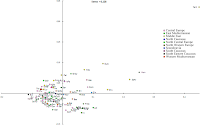 The Y-chromosome is an extreme outlier compared to modern groups, probably because of its heavy G2a domination, whereas the mtDNA from Treilles appears just like a normal and unexceptional Mediterranean-type population.
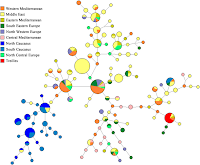
UPDATE V: The G2a median joining network shows that the Treilles haplotypes are disjoint from those that dominate the North Caucasus, with clear links to the Middle East, Central/East Mediterranean regions, as well as the South Caucasus.
Ancient DNA reveals male diffusion through the Neolithic Mediterranean route
Marie Lacan et al.
The Neolithic is a key period in the history of the European settlement. Although archaeological and present-day genetic data suggest several hypotheses regarding the human migration patterns at this period, validation of these hypotheses with the use of ancient genetic data has been limited. In this context, we studied DNA extracted from 53 individuals buried in a necropolis used by a French local community 5,000 y ago. The relatively good DNA preservation of the samples allowed us to obtain autosomal, Y-chromosomal, and/or mtDNA data for 29 of the 53 samples studied. From these datasets, we established close parental relationships within the necropolis and determined maternal and paternal lineages as well as the absence of an allele associated with lactase persistence, probably carried by Neolithic cultures of central Europe. Our study provides an integrative view of the genetic past in southern France at the end of the Neolithic period. Furthermore, the Y-haplotype lineages characterized and the study of their current repartition in European populations confirm a greater influence of the Mediterranean than the Central European route in the peopling of southern Europe during the Neolithic transition.
Link
What is absent is also quite interesting as what is present. The absence of E1b1b is consistent with my theory about the Bronze Age Greek expansion of that haplogroup in Europe that has been tied to the historical Greeks of the West Mediterranean.
R-M269 which, because of its apparent young Y-STR age has been tied by some to either the Mediterranean or Central European Neolithic is conspicuous absently from both at the moment. It may yet surface in a Neolithic context, but its absence this late from a region where, today, it is abundant only adds to its mystery. The absence of J2 is equally mysterious, as this is another putative Neolithic lineage which has failed to appear so far in a Neolithic context, while its J1 sister clade did make an appearance in much later aboriginals from the Canary Islands.
UPDATE I: Interestingly, some French researchers had noted a littoral distribution of haplogroups I, J, G in the Finistère, on the Atlantic side.
UPDATE II: I was reviewing my Ancient Y-chromosome studies compendium and one thing starts to become clear: how many of the earliest samples we have were dominated by 1-2 haplogroups, whereas there is a plethora of haplogroups in most modern populations: Treilles, Krasnoyarsk, Xiaohe, Pengyang all belonged to a single haplogroup, while Yangtze China to several lineages, all of which were in the O haplogroup.
Look at the MDS plot of the Y-chromosome and mtDNA from Treilles:

 The Y-chromosome is an extreme outlier compared to modern groups, probably because of its heavy G2a domination, whereas the mtDNA from Treilles appears just like a normal and unexceptional Mediterranean-type population.
Perhaps the modern Caucasus where particular ethnic groups are dominated by particular Y-haplogroups is a good analogy for prehistoric man, with many different groups with their signature haplogroups kept disjoint patrilineal gene pools before beginning to merge in late prehistorical and historical times.
UPDATE III: A poster at dna-forums as well as Ken Nordtvedt both agree that the I2a haplotypes belong to I-M26, a haplogroup that is modal in the SW Mediterranean, reaching very high frequencies in Sardinia. This may be consistent with the great biological continuity since the Neolithic in Sardinia, continuity which is also evident on the mtDNA. It also shows why the inference of pre-Neolithic I2a in Sardinia was flawed because of the use of the evolutionary mutation rate, while the origin and expansion of I-M26 in "genealogical rate" years becomes 5-7ky, consistent with the Neolithic origin of that haplogroup and the ancient DNA presence in Neolithic France.
UPDATE IV: Table S4 lists (in %) shared mtDNA lineages between Treilles and modern populations. The top ones are: Welsh (17.391), Cornish (16.667), Central Greeks (14.286), Bulgarians (12.5). Several Italian groups as well as South Tyrol Ladins and Germans are also greater than 10%.

UPDATE V: The G2a median joining network shows that the Treilles haplotypes are disjoint from those that dominate the North Caucasus, with clear links to the Middle East, Central/East Mediterranean regions, as well as the South Caucasus.
UPDATE VI: Some more good news: "The ancient DNA Lacan is now extracting from skeletons across France and Spain, Haak says, should provide more “piece[s] of the enormous puzzle we are trying to put together.”
PNAS doi: 10.1073/pnas.1100723108
Ancient DNA reveals male diffusion through the Neolithic Mediterranean route
Marie Lacan et al.
The Neolithic is a key period in the history of the European settlement. Although archaeological and present-day genetic data suggest several hypotheses regarding the human migration patterns at this period, validation of these hypotheses with the use of ancient genetic data has been limited. In this context, we studied DNA extracted from 53 individuals buried in a necropolis used by a French local community 5,000 y ago. The relatively good DNA preservation of the samples allowed us to obtain autosomal, Y-chromosomal, and/or mtDNA data for 29 of the 53 samples studied. From these datasets, we established close parental relationships within the necropolis and determined maternal and paternal lineages as well as the absence of an allele associated with lactase persistence, probably carried by Neolithic cultures of central Europe. Our study provides an integrative view of the genetic past in southern France at the end of the Neolithic period. Furthermore, the Y-haplotype lineages characterized and the study of their current repartition in European populations confirm a greater influence of the Mediterranean than the Central European route in the peopling of southern Europe during the Neolithic transition.
Link
March 14, 2011
The coming of the Greeks to Provence and Corsica (King et al. 2011)
 I am sure I will have much more to say on this paper once I read it carefully, but, for the moment, I will remind readers of my 2008 post on Expansion of E-V13 explained in which I postulated that E-V13 in Europe is attributed largely to Greek colonization.
The paper is also quite exciting as it includes samples of Greeks from the vicinity of Smyrna and Phocaia, the first, as far as I know published samples of Greek men from Asia Minor. I do find, however, somewhat bizarre the use of Anatolian Greeks as the putative ancestors of the colonization of the West Mediterranean and of Anatolian Turks as the supposed representatives of the Neolithic population (Table 1). The claim that the latest Anatolian population stratum (Turks) can be linked to its earliest (Neolithic-era Anatolians) is rather suspect.
UPDATE I (Mar 15)
The authors claim:
This high frequency ofhaplogroup J2a-Page55 (formerly DYS413≤ 18) in Smyrna is characteristic of non Greek Anatolia.
This claim is based entirely on the authors' limited Balkan Greek samples. An inspection of more Greek samples shows that DYS413 less or equal to 18 occurs at higher frequencies both in Crete, but also several mainland sites (Serrai, Larisa, Patrai) spanning the entire country. Hence, I believe that the claim that J2a-Page55 distinguishes Greeks from non-Greeks is spurious.
UPDATE II (Mar 15)
The authors cite the "Phoenician" paper:
Previous Y-chromosome genetic studies of Phoenician colonization have demonstrated that haplogroup J2 frequency was amplified in regions containing the Phoenician colonies of Iberia and North Africa in comparison to areas not containing Phoenician colonies [7]My scathing criticism of that paper, and the specific "Phoenician" association with J2 can be found here.
UPDATE III (Mar 15)
The authors make a big deal of the presumed relationship of Phocaea with Ionians and of Smyrna with Ionian/Aeolians. As I have mentioned before, it is a hard sell to think that two sites right next to each other, inhabited by people who had no ethnic or religious distinction for more than 2,000 years (any tribal Greek identities had disappeared by ancient times) managed to retain, nonetheless distinctive gene pools from each other over that time span that can be traced to archaic Greek tribal distinctions.
UPDATE (Mar 17)
The above-mentioned nitpicks do not, however, detract from the paper's thesis. So, it's worth repeating a few of the things on which this thesis is supported:
- We have new Greek population samples from Asia Minor that show E-V13 frequencies well within the regional variation of mainland Greece, and higher than in the Turkish Anatolian population. This disproves the theory that E-V13 may have been introduced to the mainland Greek population recently from Albanians, Thracians, and other bizarre theories advocated by some, as these would not have affected substantially the Greeks of West Asia Minor.
- It should be noted however, that E-V13 frequencies vary substantially among Greek populations. This seems consistent with my theory of its Bronze Age "heroic" origin, as late lineages are expected to have non-homogeneous frequency distributions.
- The Corsican evidence is consistent with the Greek origin of E-V13 due to the higher frequency of E-V13 around the colony of Alalia (4.6% East Corsica vs. 1.6% in West Corsica).
- The absence of I-M423 in Provence precludes a substantial contribution to the Provencal population by Balkan populations north of Greece where I-M423 reaches a higher frequency.
The coming of the Greeks to Provence and Corsica: Y-chromosome models of archaic Greek colonization of the western Mediterranean
Roy J King et al.
Abstract (provisional)
Background
The process of Greek colonization of the Central and Western Mediterranean during the Archaic and Classical Eras has been understudied from the perspective of population genetics. To investigate the Y chromosomal demography of Greek colonization in the Western Mediterranean, Y-chromosome data consisting of 29 YSNPs and 37 YSTRs were compared from 51 subjects from Provence, 56 subjects from Smyrna and 31 subjects whose paternal ancestry derives from Asia Minor Phokaia, the ancestral embarkation port to the 6th century BCE Greek colonies of Massalia (Marseilles) and Alalie (Aleria, Corsica).
Results
19% of the Phokaian and 12% of the Smyrnian representatives were derived for haplogroup E-V13, characteristic of the Greek and Balkan mainland, while 4% of the Provencal, 4.6% of West Corsican and 1.6% of East Corsican samples were derived for E-V13. An admixture analysis estimated that 17% of the Y-chromosomes of Provence may be attributed to Greek colonization. Using putative Neolithic Anatolian lineages: J2a-dys445=6, G2a-M406 and J2a1b1-M92 the data predict a 0% Neolithic contribution to Provence from Anatolia. Estimates of colonial Greek vs. indigenous Celto-Ligurian demography predict a maximum of a 10% Greek contribution, suggesting a Greek male elite-dominant input into the Iron Age Provence population.
Conclusions
Given the origin of viniculture in Provence is ascribed to Massalia, these results suggest that E-V13 may trace the demographic and socio-cultural impact of Greek colonization in Mediterranean Europe, a contribution that appears to be considerably larger than that of a Neolithic pioneer colonization.
Link
January 20, 2011
Study of French Canadian founder population
HUMAN GENETICS
DOI: 10.1007/s00439-010-0945-x
Genomic and genealogical investigation of the French Canadian founder population structure
Marie-Hélène Roy-Gagnon et al.
Abstract
DOI: 10.1007/s00439-010-0945-x
Genomic and genealogical investigation of the French Canadian founder population structure
Marie-Hélène Roy-Gagnon et al.
Abstract
Characterizing the genetic structure of worldwide populations is important for understanding human history and is essential to the design and analysis of genetic epidemiological studies. In this study, we examined genetic structure and distant relatedness and their effect on the extent of linkage disequilibrium (LD) and homozygosity in the founder population of Quebec (Canada). In the French Canadian founder population, such analysis can be performed using both genomic and genealogical data. We investigated genetic differences, extent of LD, and homozygosity in 140 individuals from seven sub-populations of Quebec characterized by different demographic histories reflecting complex founder events. Genetic findings from genome-wide single nucleotide polymorphism data were correlated with genealogical information on each of these sub-populations. Our genomic data showed significant population structure and relatedness present in the contemporary Quebec population, also reflected in LD and homozygosity levels. Our extended genealogical data corroborated these findings and indicated that this structure is consistent with the settlement patterns involving several founder events. This provides an independent and complementary validation of genomic-based studies of population structure. Combined genomic and genealogical data in the Quebec founder population provide insights into the effects of the interplay of two important sources of bias in genetic epidemiological studies, unrecognized genetic structure and cryptic relatedness.
Link
Link
December 16, 2010
Embalmed head of Henry IV found
 BMJ 2010; 341:c6805 doi: 10.1136/bmj.c6805
Multidisciplinary medical identification of a French king’s head (Henri IV)
Philippe Charlier et al.
From the paper:
Since the desecration of the French kings’ graves in the basilica of Saint-Denis by the revolutionaries in 1793, few remains of these mummified bodies have been preserved and identified. After a multidisciplinary analysis, we confirmed that an embalmed head reputed to be that of the French king Henri IV and conserved in successive private collections did indeed belong to that monarch.and:
Now positively identified according to the most rigorous arguments of any forensic anthropology examination, the French king’s head will be reinterred in the royal basilica of Saint-Denis after a solemn funeral ceremony. Similar methods could be used to identify all the other kings’ and queens’ skeletons lying in the mass grave of the basilica, so that they can be returned to their original tombs.Unfortunately, no "uncontaminated" mtDNA could be extracted. It would be interesting to compare his Y-chromosome to that of his descendant Louis XVI, but that doesn't seem to be possible.
(no abstract)
Subscribe to:
Posts (Atom)