Showing posts with label ancient DNA. Show all posts

August 07, 2017

Minoans and Mycenaeans

It is great to finally see the first data from the most ancient Greeks (Mycenaeans) and also the Cretan Minoans:

  • Ancestrally. both Mycenaeans and Minoans were basically Mediterranean, well outside the variation of most Europeans and Near Easterners and >75% from early European-Anatolian farmers.
  • Phenotypically, they were dark-haired/eyed
  • They weren't pure Mediterraneans, but also partly "West_Asian". Bronze Age people from S.W. Anatolia were even more "West_Asian".
  • Mycenaeans also had some "Ancient North Eurasian" ancestry, which may have come from either the north or east of Greece.
  • Two Minoans and a Mycenaean were haplogroup J2, one Minoan was G.
  • One high-status Mycenaean female from Messenia was not different from the other three Mycenaeans.


Modern Greeks from Greece are more "northern", more "European", and less "Mediterranean" than the Mycenaeans. Bust, Fst-wise Modern Greeks (and assorted neighbors) are still fairly close to Mycenaeans, more so than other people from Europe and the Middle East:


Nature (2017) doi:10.1038/nature23310

Genetic origins of the Minoans and Mycenaeans

Iosif Lazaridis, Alissa Mittnik, Nick Patterson, Swapan Mallick, Nadin Rohland, Saskia Pfrengle, Anja Furtwängler, Alexander Peltzer, Cosimo Posth, Andonis Vasilakis, P. J. P. McGeorge, Eleni Konsolaki-Yannopoulou, George Korres, Holley Martlew, Manolis Michalodimitrakis, Mehmet Özsait, Nesrin Özsait, Anastasia Papathanasiou, Michael Richards, Songül Alpaslan Roodenberg, Yannis Tzedakis, Robert Arnott, Daniel M. Fernandes, Jeffery R. Hughey, Dimitra M. Lotakis, Patrick A. Navas, Yannis Maniatis, John A. Stamatoyannopoulos, Kristin Stewardson, Philipp Stockhammer, Ron Pinhasi, David Reich, Johannes Krause & George Stamatoyannopoulos

The origins of the Bronze Age Minoan and Mycenaean cultures have puzzled archaeologists for more than a century. We have assembled genome-wide data from 19 ancient individuals, including Minoans from Crete, Mycenaeans from mainland Greece, and their eastern neighbours from southwestern Anatolia. Here we show that Minoans and Mycenaeans were genetically similar, having at least three-quarters of their ancestry from the first Neolithic farmers of western Anatolia and the Aegean1, 2, and most of the remainder from ancient populations related to those of the Caucasus3 and Iran4, 5. However, the Mycenaeans differed from Minoans in deriving additional ancestry from an ultimate source related to the hunter–gatherers of eastern Europe and Siberia6, 7, 8, introduced via a proximal source related to the inhabitants of either the Eurasian steppe1, 6, 9 or Armenia4, 9. Modern Greeks resemble the Mycenaeans, but with some additional dilution of the Early Neolithic ancestry. Our results support the idea of continuity but not isolation in the history of populations of the Aegean, before and after the time of its earliest civilizations.

Link

June 07, 2016

Neolithic Aegean genomes

I had covered this paper when it went on the bioRxiv, but the final version has been published in PNAS in open access.


PNAS doi: 10.1073/pnas.1523951113

Early farmers from across Europe directly descended from Neolithic Aegeans

Zuzana Hofmanová, Susanne Kreutzer et al.

Farming and sedentism first appeared in southwestern Asia during the early Holocene and later spread to neighboring regions, including Europe, along multiple dispersal routes. Conspicuous uncertainties remain about the relative roles of migration, cultural diffusion, and admixture with local foragers in the early Neolithization of Europe. Here we present paleogenomic data for five Neolithic individuals from northern Greece and northwestern Turkey spanning the time and region of the earliest spread of farming into Europe. We use a novel approach to recalibrate raw reads and call genotypes from ancient DNA and observe striking genetic similarity both among Aegean early farmers and with those from across Europe. Our study demonstrates a direct genetic link between Mediterranean and Central European early farmers and those of Greece and Anatolia, extending the European Neolithic migratory chain all the way back to southwestern Asia.

Link

Ancient DNA and human history

A very useful review of the field c. mid-2016. The only major addition would be the study on Upper Paleolithic Europeans that appeared recently.

The lack of East Asian DNA validates my New Year's wish for some. Hopefully my wish will be granted in the second half of 2016.

PNAS doi: 10.1073/pnas.1524306113

Ancient DNA and human history

Montgomery Slatkin, and Fernando Racimo

We review studies of genomic data obtained by sequencing hominin fossils with particular emphasis on the unique information that ancient DNA (aDNA) can provide about the demographic history of humans and our closest relatives. We concentrate on nuclear genomic sequences that have been published in the past few years. In many cases, particularly in the Arctic, the Americas, and Europe, aDNA has revealed historical demographic patterns in a way that could not be resolved by analyzing present-day genomes alone. Ancient DNA from archaic hominins has revealed a rich history of admixture between early modern humans, Neanderthals, and Denisovans, and has allowed us to disentangle complex selective processes. Information from aDNA studies is nowhere near saturation, and we believe that future aDNA sequences will continue to change our understanding of hominin history.

Link

Mungo Man DNA revisited + first ancient mtDNA from Australia

The authors find that previously published mtDNA from earliest Australians was contamination, and one S2 mtDNA haplogroup in an undated sample of likely Holocene origin.

PNAS doi: 10.1073/pnas.1521066113

Ancient mtDNA sequences from the First Australians revisited

Tim H. Heupink et al.

The publication in 2001 by Adcock et al. [Adcock GJ, et al. (2001) Proc Natl Acad Sci USA 98(2):537–542] in PNAS reported the recovery of short mtDNA sequences from ancient Australians, including the 42,000-y-old Mungo Man [Willandra Lakes Hominid (WLH3)]. This landmark study in human ancient DNA suggested that an early modern human mitochondrial lineage emerged in Asia and that the theory of modern human origins could no longer be considered solely through the lens of the “Out of Africa” model. To evaluate these claims, we used second generation DNA sequencing and capture methods as well as PCR-based and single-primer extension (SPEX) approaches to reexamine the same four Willandra Lakes and Kow Swamp 8 (KS8) remains studied in the work by Adcock et al. Two of the remains sampled contained no identifiable human DNA (WLH15 and WLH55), whereas the Mungo Man (WLH3) sample contained no Aboriginal Australian DNA. KS8 reveals human mitochondrial sequences that differ from the previously inferred sequence. Instead, we recover a total of five modern European contaminants from Mungo Man (WLH3). We show that the remaining sample (WLH4) contains ∼1.4% human DNA, from which we assembled two complete mitochondrial genomes. One of these was a previously unidentified Aboriginal Australian haplotype belonging to haplogroup S2 that we sequenced to a high coverage. The other was a contaminating modern European mitochondrial haplotype. Although none of the sequences that we recovered matched those reported by Adcock et al., except a contaminant, these findings show the feasibility of obtaining important information from ancient Aboriginal Australian remains.

Link

May 19, 2016

35,000 year old mtDNA haplogroup U6 from Romania

I wouldn't be very surprised if many of the markers supposedly signifying recent gene flow Africa and Eurasia were actually quite old in Eurasia. The trouble is that reports of such gene flow were often based on simply observing that marker "X" occurs at a higher frequency in Africa than in Eurasia, so a common sense explanation is that it reflects limited recent gene flow between the continents. But, it is now known that common sense is not always the best guide, as e.g., ancient Europeans had mtDNA haplogroup M (in the past considered evidence of Asian admixture), Y-chromosome haplogroup C (ditto), and now U6.

The same should also apply to the Middle East where there has been admixture with Africans since the Islamic period at least. The existence of such admixture does not mean that every single lineage that occurs at low frequency in the Middle East and high frequency in Africa is diagnostic of this later period of admixture. Some of them could well be relics of old Middle Eastern populations. Who knows what people inhabited the presently inhospitable landscape of the Saharan-Arabian desert zone? The living populations can certainly make no claim to being the first ones there, but the genetic heritage of those earlier occupants may still persist in them in traces.

Similarly for the New World; in that case, there is a better case that European-looking lineages are indeed due to the colonization of the Americas over the last five centuries. However, that does not mean that all of them are, and we should be mindful of the possibility of pre-Columbian contact between the Old and New worlds.

Scientific Reports 6, Article number: 25501 (2016)

The mitogenome of a 35,000-year-old Homo sapiens from Europe supports a Palaeolithic back-migration to Africa

M. Hervella et al.

After the dispersal of modern humans (Homo sapiens) Out of Africa, hominins with a similar morphology to that of present-day humans initiated the gradual demographic expansion into Eurasia. The mitogenome (33-fold coverage) of the Peştera Muierii 1 individual (PM1) from Romania (35 ky cal BP) we present in this article corresponds fully to Homo sapiens, whilst exhibiting a mosaic of morphological features related to both modern humans and Neandertals. We have identified the PM1 mitogenome as a basal haplogroup U6*, not previously found in any ancient or present-day humans. The derived U6 haplotypes are predominantly found in present-day North-Western African populations. Concomitantly, those found in Europe have been attributed to recent gene-flow from North Africa. The presence of the basal haplogroup U6* in South East Europe (Romania) at 35 ky BP confirms a Eurasian origin of the U6 mitochondrial lineage. Consequently, we propose that the PM1 lineage is an offshoot to South East Europe that can be traced to the Early Upper Paleolithic back migration from Western Asia to North Africa, during which the U6 lineage diversified, until the emergence of the present-day U6 African lineages.

Link

April 30, 2016

More on Kennewick Man

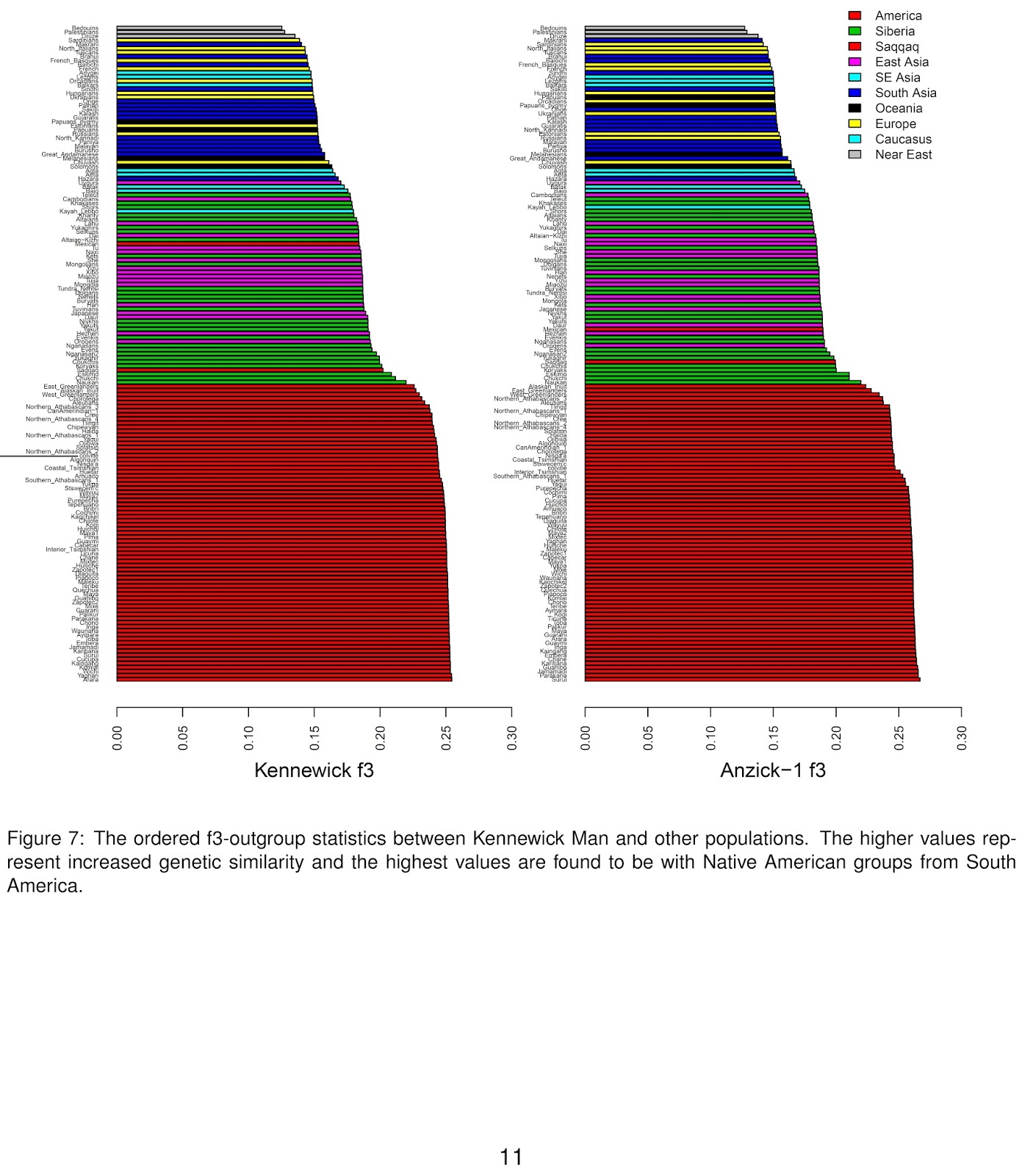
A new technical report re-analyzes the data of Rasmussen et al. study on Kennewick man and confirms that he is related to Native Americans. From the report:
We find the Kennewick sample has the highest shared similarity to Native American populations with the highest values observed being with populations from South America (Figure 7), in line with the observations from Rasmussen et al.
Hopefully this will end the campaign to put him back to the ground. I have added a horizontal line to the new study's Figure 7 to mark the population claiming the skeleton among the huge number considered, showing that there's no particularly strong relationship to it (the strongest connection is at the bottom of the figure).


The Rasmussen et al. and Novembre et al. studies are really science working at its best: simultaneously falsifying claims that Kennewick was some sort of Australoid (or even more implausibly Caucasoid) based on its craniofacial morphology, but not overreaching to validate emotional appeals to make him into an ancestor he wasn't. Thankfully, the way forward is to keep studying Kennewick Man (and modern Native Americans) with ever-better data and techniques which may turn up (who knows?) a real (rather than imagined) ancestral link.


Technical Report: Assessment of the genetic analyses of Rasmussen et al. (2015)

John Novembre, PhD, David Witonsky, Anna Di Rienzo, PhD

The primary aim of the analysis undertaken here (U.S. Army Corps of Engineers, St Louis District Contract #W912P9-16-P-0010) is to provide an independent validation of the genetic evidence underlying a recent publication by Morten Rasmussen and colleagues on July 23rd, 2015, in Nature (Vol 523:455–58). Based on our analysis of the Kennewick Man’s sequence data and Colville tribe genotype data generated by Rasmussen et al., we concur with the findings of the original paper that the sample is genetically closer to modern Native Americans than to any other population worldwide. We carried out several analyses to support this conclusion, including (i) principal component analysis (PCA; Patterson et al. 2006), (ii) unsupervised genetic clustering using ADMIXTURE (Alexander, Novembre, and Lange 2009), (iii) estimation of genetic affinity to modern human populations using f3 and D statistics (Patterson et al. 2012), and (iv) a novel approach based on the geographic distribution of rare variants. Importantly, these distinct analyses, spanning three non-overlapping subsets of the data, are each consistent with Native American ancestry.

Link

March 25, 2016

Bronze Age war in northern Germany

Slaughter at the bridge: Uncovering a colossal Bronze Age battle
About 3200 years ago, two armies clashed at a river crossing near the Baltic Sea. The confrontation can’t be found in any history books—the written word didn’t become common in these parts for another 2000 years—but this was no skirmish between local clans. Thousands of warriors came together in a brutal struggle, perhaps fought on a single day, using weapons crafted from wood, flint, and bronze, a metal that was then the height of military technology.

...

In 1996, an amateur archaeologist found a single upper arm bone sticking out of the steep riverbank—the first clue that the Tollense Valley, about 120 kilometers north of Berlin, concealed a gruesome secret. A flint arrowhead was firmly embedded in one end of the bone, prompting archaeologists to dig a small test excavation that yielded more bones, a bashed-in skull, and a 73-centimeter club resembling a baseball bat. The artifacts all were radiocarbon-dated to about 1250 B.C.E., suggesting they stemmed from a single episode during Europe’s Bronze Age.

...

Northern Europe in the Bronze Age was long dismissed as a backwater, overshadowed by more sophisticated civilizations in the Near East and Greece. Bronze itself, created in the Near East around 3200 B.C.E., took 1000 years to arrive here. But Tollense’s scale suggests more organization—and more violence—than once thought. “We had considered scenarios of raids, with small groups of young men killing and stealing food, but to imagine such a big battle with thousands of people is very surprising,” says Svend Hansen, head of the German Archaeological Institute’s (DAI’s) Eurasia Department in Berlin. The well-preserved bones and artifacts add detail to this picture of Bronze Age sophistication, pointing to the existence of a trained warrior class and suggesting that people from across Europe joined the bloody fray.

...

There was reason for skepticism. Before Tollense, direct evidence of large-scale violence in the Bronze Age was scanty, especially in this region. Historical accounts from the Near East and Greece described epic battles, but few artifacts remained to corroborate these boastful accounts. “Even in Egypt, despite hearing many tales of war, we never find such substantial archaeological evidence of its participants and victims,” UCD’s Molloy says.

...

Ancient DNA could potentially reveal much more: When compared to other Bronze Age samples from around Europe at this time, it could point to the homelands of the warriors as well as such traits as eye and hair color. Genetic analysis is just beginning, but so far it supports the notion of far-flung origins. DNA from teeth suggests some warriors are related to modern southern Europeans and others to people living in modern-day Poland and Scandinavia. “This is not a bunch of local idiots,” says University of Mainz geneticist Joachim Burger. “It’s a highly diverse population.”

February 08, 2016

mtDNA from 55 hunter-gatherers across 35,000 years in Europe

The fact that UP Europeans had mtDNA haplogroup M really destroys any lingering justification for a coastal migration that first brought (M, N) to Asia and then a subset (N) into Europe.

Another justification for the "Asia-first" model was the presence of Y-haplogroup C in Australians and Asians. But, that too was found in UP Europeans (K14).

So, I think things are looking good for my theory that Eurasians came out of Arabia northwards, interbred with Neandertals, headed both west and east, populating both Europe and Asia. The inferred date for both M and N (55kya) is on the cusp of the 50kya technological transition.

The authors also propose a major turnover in Europe at 14.5kya that replaced (not necessarily completely) the previous occupants. The authors write:
In European hunter-gatherers, our model best explains this period of upheaval as a replacement of the post-LGM maternal population by one from another source. Although the exact origin for this later population is unknown, the inferred demographic history (Figure 3 and 2b in Figure S2) suggests that it descended from another, separate LGM refugium.
Where was this LGM refugium?
Exactly where this new population came from is still unclear, but it seems likely that they came from warmer areas further south. “The main hypothesis would be glacial refugia in south-eastern Europe,” says Johannes Krause at the Max Planck Institute for the Science of Human History in Jena, Germany, who led the analysis.

Current Biology DOI: http://dx.doi.org/10.1016/j.cub.2016.01.037

Pleistocene Mitochondrial Genomes Suggest a Single Major Dispersal of Non-Africans and a Late Glacial Population Turnover in Europe

Cosimo Posth et al.

How modern humans dispersed into Eurasia and Australasia, including the number of separate expansions and their timings, is highly debated [ 1, 2 ]. Two categories of models are proposed for the dispersal of non-Africans: (1) single dispersal, i.e., a single major diffusion of modern humans across Eurasia and Australasia [ 3–5 ]; and (2) multiple dispersal, i.e., additional earlier population expansions that may have contributed to the genetic diversity of some present-day humans outside of Africa [ 6–9 ]. Many variants of these models focus largely on Asia and Australasia, neglecting human dispersal into Europe, thus explaining only a subset of the entire colonization process outside of Africa [ 3–5, 8, 9 ]. The genetic diversity of the first modern humans who spread into Europe during the Late Pleistocene and the impact of subsequent climatic events on their demography are largely unknown. Here we analyze 55 complete human mitochondrial genomes (mtDNAs) of hunter-gatherers spanning ∼35,000 years of European prehistory. We unexpectedly find mtDNA lineage M in individuals prior to the Last Glacial Maximum (LGM). This lineage is absent in contemporary Europeans, although it is found at high frequency in modern Asians, Australasians, and Native Americans. Dating the most recent common ancestor of each of the modern non-African mtDNA clades reveals their single, late, and rapid dispersal less than 55,000 years ago. Demographic modeling not only indicates an LGM genetic bottleneck, but also provides surprising evidence of a major population turnover in Europe around 14,500 years ago during the Late Glacial, a period of climatic instability at the end of the Pleistocene.

Link

January 06, 2016

Even more Anatolian Neolithic genomes

Recently I proclaimed the problem of "Neolithization of Europe" to be "done", but it doesn't hurt to have more confirmation as this new paper does. The Anatolian data is from a different site than those used by Mathieson et al. and Hofmanová, Kreutzer et al. albeit still in the extreme northwest of Asia Minor. Nonetheless, the individual from Kumtepe doesn't seem to carry any major surprises, so "Neolithization of Europe" remains "done".

Current Biology http://dx.doi.org/10.1016/j.cub.2015.12.019

Genomic Evidence Establishes Anatolia as the Source of the European Neolithic Gene Pool 

Ayça Omrak et al.

Anatolia and the Near East have long been recognized as the epicenter of the Neolithic expansion through archaeological evidence. Recent archaeogenetic studies on Neolithic European human remains have shown that the Neolithic expansion in Europe was driven westward and northward by migration from a supposed Near Eastern origin [ 1–5 ]. However, this expansion and the establishment of numerous culture complexes in the Aegean and Balkans did not occur until 8,500 before present (BP), over 2,000 years after the initial settlements in the Neolithic core area [ 6–9 ]. We present ancient genome-wide sequence data from 6,700-year-old human remains excavated from a Neolithic context in Kumtepe, located in northwestern Anatolia near the well-known (and younger) site Troy [ 10 ]. Kumtepe is one of the settlements that emerged around 7,000 BP, after the initial expansion wave brought Neolithic practices to Europe. We show that this individual displays genetic similarities to the early European Neolithic gene pool and modern-day Sardinians, as well as a genetic affinity to modern-day populations from the Near East and the Caucasus. Furthermore, modern-day Anatolians carry signatures of several admixture events from different populations that have diluted this early Neolithic farmer component, explaining why modern-day Sardinian populations, instead of modern-day Anatolian populations, are genetically more similar to the people that drove the Neolithic expansion into Europe. Anatolia’s central geographic location appears to have served as a connecting point, allowing a complex contact network with other areas of the Near East and Europe throughout, and after, the Neolithic.

Link

November 26, 2015

Neolithic farmers from Greece and Anatolia

A couple of new papers appeared this week. First, an article in Nature on natural selection in ancient Europe includes a sample of Anatolian Neolithic farmers and concludes that the European Neolithic farmers were descended from them with a bit of extra European hunter-gatherer admixture. Second, a new preprint on the bioRxiv includes Neolithic samples from northern Greece and finds that they too resemble the Anatolian and European farmers. I think it is time to declare the problem of "Neolithization of Europe" done. It took less than 4 years to solve it with ancient DNA. Here is a (non-exhaustive) list of papers in historical review:


Nature (2015) doi:10.1038/nature16152

Genome-wide patterns of selection in 230 ancient Eurasians

Iain Mathieson et al.

Ancient DNA makes it possible to observe natural selection directly by analysing samples from populations before, during and after adaptation events. Here we report a genome-wide scan for selection using ancient DNA, capitalizing on the largest ancient DNA data set yet assembled: 230 West Eurasians who lived between 6500 and 300 BC, including 163 with newly reported data. The new samples include, to our knowledge, the first genome-wide ancient DNA from Anatolian Neolithic farmers, whose genetic material we obtained by extracting from petrous bones, and who we show were members of the population that was the source of Europe’s first farmers. We also report a transect of the steppe region in Samara between 5600 and 300 BC, which allows us to identify admixture into the steppe from at least two external sources. We detect selection at loci associated with diet, pigmentation and immunity, and two independent episodes of selection on height.

Link

bioRxiv http://dx.doi.org/10.1101/032763

Early farmers from across Europe directly descended from Neolithic Aegeans

Zuzana Hofmanová, Susanne Kreutzer et al.

Farming and sedentism first appear in southwest Asia during the early Holocene and later spread to neighboring regions, including Europe, along multiple dispersal routes. Conspicuous uncertainties remain about the relative roles of migration, cultural diffusion and admixture with local foragers in the early Neolithisation of Europe. Here we present paleogenomic data for five Neolithic individuals from northwestern Turkey and northern Greece, spanning the time and region of the earliest spread of farming into Europe. We observe striking genetic similarity both among Aegean early farmers and with those from across Europe. Our study demonstrates a direct genetic link between Mediterranean and Central European early farmers and those of Greece and Anatolia, extending the European Neolithic migratory chain all the way back to southwestern Asia.

Link

August 07, 2015

Prehistoric farmers from northern Greece had lactose intolerance, brown eyes, dark skin

According to this:
Πολύ σημαντικό πρόσφατο εύρημα αποτελεί η ανάκτηση ολόκληρων γονιδιωμάτων από τρεις προϊστορικούς αγρότες, που έζησαν στη Βόρεια Ελλάδα 7.500 με 5.500 χρόνια πριν από σήμερα. Τα δεδομένα αυτά αναλύονται και αναμένεται να ρίξουν φως στις προγονικές σχέσεις των πρώτων Ευρωπαίων και να δώσουν πλήθος πληροφοριών, που συνδέονται με λειτουργικά και μορφολογικά χαρακτηριστικά. Ήδη, είναι γνωστό, ότι κάποιοι νεολιθικοί πρόγονοί μας δε μπορούσαν να πέψουν το γάλα, ήταν δηλαδή δυσανεκτικοί στη λακτόζη και είχαν καστανά μάτια και σκουρόχρωμη επιδερμίδα.
Related video:

July 26, 2015

Paleoamericans galore

Two new papers in Nature and Science add to the debate on Native American origins. The first study (in Nature) detects that some Amazonians have a few percent ancestry from a group related to Australasians, which suggests that early native Americans were not homogeneous but came in two flavors: the main one found all over the Americans and the Australasian-related one. The second study (in Science) looks at ancient "Paleoamerican"-postulated populations and finds that they don't have any particular relationship to Australasians. Thus, whatever population brought the "Paleoamerican" admixture into the Amazon, it remains to be found.

Nature (2015) doi:10.1038/nature14895

Genetic evidence for two founding populations of the Americas 

Pontus Skoglund et al.

Genetic studies have consistently indicated a single common origin of Native American groups from Central and South America1, 2, 3, 4. However, some morphological studies have suggested a more complex picture, whereby the northeast Asian affinities of present-day Native Americans contrast with a distinctive morphology seen in some of the earliest American skeletons, which share traits with present-day Australasians (indigenous groups in Australia, Melanesia, and island Southeast Asia)5, 6, 7, 8. Here we analyse genome-wide data to show that some Amazonian Native Americans descend partly from a Native American founding population that carried ancestry more closely related to indigenous Australians, New Guineans and Andaman Islanders than to any present-day Eurasians or Native Americans. This signature is not present to the same extent, or at all, in present-day Northern and Central Americans or in a ~12,600-year-old Clovis-associated genome, suggesting a more diverse set of founding populations of the Americas than previously accepted.

Link

Science DOI: 10.1126/science.aab3884

Genomic evidence for the Pleistocene and recent population history of Native Americans

Maanasa Raghavan1,*, Matthias Steinrücken2,3,4,*, Kelley Harris5,*, Stephan Schiffels6,*, Simon Rasmussen7,*, Michael DeGiorgio8,*, Anders Albrechtsen9,*, Cristina Valdiosera1,10,*, María C. Ávila-Arcos1,11,*, Anna-Sapfo Malaspinas1* et al.

How and when the Americas were populated remains contentious. Using ancient and modern genome-wide data, we find that the ancestors of all present-day Native Americans, including Athabascans and Amerindians, entered the Americas as a single migration wave from Siberia no earlier than 23 thousand years ago (KYA), and after no more than 8,000-year isolation period in Beringia. Following their arrival to the Americas, ancestral Native Americans diversified into two basal genetic branches around 13 KYA, one that is now dispersed across North and South America and the other is restricted to North America. Subsequent gene flow resulted in some Native Americans sharing ancestry with present-day East Asians (including Siberians) and, more distantly, Australo-Melanesians. Putative ‘Paleoamerican’ relict populations, including the historical Mexican Pericúes and South American Fuego-Patagonians, are not directly related to modern Australo-Melanesians as suggested by the Paleoamerican Model.

Link

July 21, 2015

British origins (with ancient data)

Related:


bioRxiv http://dx.doi.org/10.1101/022723

Iron Age and Anglo-Saxon genomes from East England reveal British migration history

Stephan Schiffels, Wolfgang Haak, Pirita Paajanen, Bastien Llamas, Elizabeth Popescu, Louise Lou, Rachel Clarke, Alice Lyons, Richard Mortimer, Duncan Sayer, Chris Tyler-Smith, Alan Cooper, Richard Durbin

British population history has been shaped by a series of immigrations and internal movements, including the early Anglo-Saxon migrations following the breakdown of the Roman administration after 410CE. It remains an open question how these events affected the genetic composition of the current British population. Here, we present whole-genome sequences generated from ten ancient individuals found in archaeological excavations close to Cambridge in the East of England, ranging from 2,300 until 1,200 years before present (Iron Age to Anglo-Saxon period). We use present-day genetic data to characterize the relationship of these ancient individuals to contemporary British and other European populations. By analyzing the distribution of shared rare variants across ancient and modern individuals, we find that today’s British are more similar to the Iron Age individuals than to most of the Anglo-Saxon individuals, and estimate that the contemporary East English population derives 30% of its ancestry from Anglo-Saxon migrations, with a lower fraction in Wales and Scotland. We gain further insight with a new method, rarecoal, which fits a demographic model to the distribution of shared rare variants across a large number of samples, enabling fine scale analysis of subtle genetic differences and yielding explicit estimates of population sizes and split times. Using rarecoal we find that the ancestors of the Anglo-Saxon samples are closest to modern Danish and Dutch populations, while the Iron Age samples share ancestors with multiple Northern European populations including Britain.

Link

July 12, 2015

mtDNA from Xiaohe cemetery

BMC Genetics 2015, 16:78 doi:10.1186/s12863-015-0237-5

Analysis of ancient human mitochondrial DNA from the Xiaohe cemetery: insights into prehistoric population movements in the Tarim Basin, China

Chunxiang Li et al.

Abstract

Background

The Tarim Basin in western China, known for its amazingly well-preserved mummies, has been for thousands of years an important crossroad between the eastern and western parts of Eurasia. Despite its key position in communications and migration, and highly diverse peoples, languages and cultures, its prehistory is poorly understood. To shed light on the origin of the populations of the Tarim Basin, we analysed mitochondrial DNA polymorphisms in human skeletal remains excavated from the Xiaohe cemetery, used by the local community between 4000 and 3500 years before present, and possibly representing some of the earliest settlers.

Results

Xiaohe people carried a wide variety of maternal lineages, including West Eurasian lineages H, K, U5, U7, U2e, T, R*, East Eurasian lineages B, C4, C5, D, G2a and Indian lineage M5.

Conclusion

Our results indicate that the people of the Tarim Basin had a diverse maternal ancestry, with origins in Europe, central/eastern Siberia and southern/western Asia. These findings, together with information on the cultural context of the Xiaohe cemetery, can be used to test contrasting hypotheses of route of settlement into the Tarim Basin.

Link

June 20, 2015

DNA from hot climates technically feasible

From the paper:
Ten petrous bones were selected from archaeological specimens, representing a wide range of geographical locations and climatic contexts (Table 1, for repository information see S1 File). The specimens were selected from Central Europe, Central Asia, Southeast Asia, the Levant, Anatolia, and North Africa. The specimens are from Holocene archaeological contexts dated to between 10,000–1,800 calibrated years before present (cal. BP). The samples from Nubia, Jordan and Turkmenistan are from hot and arid regions. The sample from Turkey is from the Eastern Mediterranean (northwestern Turkey); the samples from Hungary and Serbia are from the Carpathian Basin/Southeast Europe, while the two samples from Cambodia and Vietnam are from tropical/subtropical Southeast Asia. We also included a metatarsal bone for one Neolithic individual from Hungary (Polgár Ferenci hát, PF280-443) as a control to confirm the differences between petrous and non-petrous reported in the previous study [8].
and:
It has recently been demonstrated [8] that petrous bone samples yield exceptionally high percentages of endogenous ancient DNA. Here we have shown that both the total amount of endogenous DNA that can be recovered as well as the percentage of all reads that represents endogenous DNA vary substantially for different parts of the petrous bone. Our results have several implications for aDNA studies. The results support the hypothesis that dense bone parts are especially suitable for ancient DNA research, with the densest part of the petrous bone, that which composes the otic capsule, providing the best results. For our samples the yields obtained for this part (part C) exceed those obtained for part B (i.e. dense bone part of the petrous outside the otic capsule) by up to 65-fold and those from part A by up to 177-fold. It is therefore apparent that while high endogenous yields can be obtained from part B, and hence from any dense part in the petrous, optimal yields should be obtained from bone sample taken directly from the otic capsule.
and:
Finally, our results show that endogenous yields from the five samples which originated from hot (either arid or humid) regions were always lower than 1% including extractions from part C of the petrous bone. However, deamination patterns suggest for two (Ain Ghazal and Vat Komnou) of the three samples for which we obtained sufficient numbers of reads that the obtained sequences are likely endogenous to the bones (S3 Fig). In contrast, the deamination pattern for the third sample, Man Bac, suggests that the human reads obtained are more likely to represent contamination than endogenous ancient DNA. These results suggest that it may be possible to obtain endogenous DNA from part C also for samples with relatively low amounts of endogenous DNA from hot environments, although extreme caution will be necessary in the interpretation of the results obtained from such samples.


PLoS ONE 10(6): e0129102. doi:10.1371/journal.pone.0129102

Optimal Ancient DNA Yields from the Inner Ear Part of the Human Petrous Bone

Ron Pinhasi et al.

The invention and development of next or second generation sequencing methods has resulted in a dramatic transformation of ancient DNA research and allowed shotgun sequencing of entire genomes from fossil specimens. However, although there are exceptions, most fossil specimens contain only low (~ 1% or less) percentages of endogenous DNA. The only skeletal element for which a systematically higher endogenous DNA content compared to other skeletal elements has been shown is the petrous part of the temporal bone. In this study we investigate whether (a) different parts of the petrous bone of archaeological human specimens give different percentages of endogenous DNA yields, (b) there are significant differences in average DNA read lengths, damage patterns and total DNA concentration, and (c) it is possible to obtain endogenous ancient DNA from petrous bones from hot environments. We carried out intra-petrous comparisons for ten petrous bones from specimens from Holocene archaeological contexts across Eurasia dated between 10,000-1,800 calibrated years before present (cal. BP). We obtained shotgun DNA sequences from three distinct areas within the petrous: a spongy part of trabecular bone (part A), the dense part of cortical bone encircling the osseous inner ear, or otic capsule (part B), and the dense part within the otic capsule (part C). Our results confirm that dense bone parts of the petrous bone can provide high endogenous aDNA yields and indicate that endogenous DNA fractions for part C can exceed those obtained for part B by up to 65-fold and those from part A by up to 177-fold, while total endogenous DNA concentrations are up to 126-fold and 109-fold higher for these comparisons. Our results also show that while endogenous yields from part C were lower than 1% for samples from hot (both arid and humid) parts, the DNA damage patterns indicate that at least some of the reads originate from ancient DNA molecules, potentially enabling ancient DNA analyses of samples from hot regions that are otherwise not amenable to ancient DNA analyses.

Link

June 13, 2015

Into, out of, and across the Eurasian steppe

A new paper in Nature adds to the earlier study in the same journal by presenting data from 101 ancient Eurasians. The year is not yet halfway over, but it seems that the ancient DNA field is moving towards a new norm of studying dozens of individuals at a time and comprehensively tackling the "big problems" that have vexed archaeologists, linguists, and historians for decades if not centuries.


The first conclusion of the new study is the detection of the migration from the steppe to Europe that was the title piece of the earlier study. The authors do not present quantitative estimates of the amount of demographic replacement effected by the Yamnaya-to-Corded Ware migration, so it will be interesting to see if there are any minor significant differences in these. But, the two papers have different Yamnaya and Corded Ware samples, and yet arrive at qualitatively similar conclusions, so at least this part of the story should be considered firmly "settled".

The second conclusion is the migration from the European steppe to the Afanasievo culture of the Altai. This has been long-hypothesized based on the physical type of the Afanasievo people and their possession of a similar pastoralist/wheeled vehicle toolkit that would have allowed them to cover the huge difference between Europe and the Altai. This confirms movement #2 of the Anthony/Ringe model, although I doubt that this migration had anything to do with Tocharians as detailed below. But, it did happen.

The third conclusion is that the later steppe cultures of the Sintashta and Andronovo (putative Indo-Iranians according to some), were not a continuation of the Yamnaya-Afanasievo people, but had extra Neolithic farmer ancestry. So, it seems that Neolithic farmers entered the steppe, and the development of steppe cultures did not happen in isolation. Whether this involved migration of Corded Ware people (as the authors prefer), who were already a mixture of Yamnaya and Neolithic farmers, or some other mixture of Neolithic farmers with steppe populations (e.g., Tripolye plus Yamnaya) remains to be seen.

The fourth conclusion of the paper is that these steppe cultures were also later replaced by people of at least partial East Asian or "Native American"-like ancestry.  So, it seems that movements into the steppe happened both on the western end (as the incursion of Neolithic farmer ancestry into the Sintashta proves), but also on the eastern end, with the Europeoid populations of western origin receiving admixture from the eastern periphery of the Eurasian steppe.

As for the Yamnaya, the authors do not find a very strong signal of admixture (as did the earlier study), which they attribute quite plausibly to the lack of eastern hunter-gatherers in their dataset. On the other hand, they claim that the "Caucasus" genetic component in the steppe populations was of steppe ancestry rather than Near Eastern/Caucasian origin as was claimed in the earlier paper. This is based on the statistic D(Yoruba, Armenia BA; Yamnaya, Corded Ware) that is not significantly different from zero. However, Corded Ware is a mixture of Yamnaya and European Neolithic, so the sign of this statistic is determined by the sign of the statistic D(Yoruba, Armenia BA; Yamnaya, European Neolithic). If Yamnaya was simply a steppe population, descendants of local people without ancestry from the Middle East/Caucasus, then this statistic would be positive because of the shared Middle Eastern ancestry of Armenia BA and European Neolithic. Whereas, if Yamnaya is a mixture of a steppe population and a Middle Eastern/Caucasian one, then the statistic would be positive/negative for the respective parts, which would be consistent with an average not different from zero. I am sure that when the new data is re-analyzed together with the eastern hunter-gatherers it will be clear that the Yamnaya are not a pure steppe population.

Nonetheless, I am quite glad to read a sentence such as this:
Populations in northern and central Europe were composed of a mixture of the earlier hunter-gatherer and Neolithic farmer10 groups, but received ‘Caucasian’ genetic input at the onset of the Bronze Age (Fig. 2).
It seems that my prediction the the West_Asian component would appear in post-5ka Europeans and was related to Indo-Europeans has been adequately confirmed by the last two papers.

Speaking of the Caucasus/Middle East, it seems clear as a first approximation that the Bronze Age Armenians are quite similar to modern Armenians. Whether the genetic continuity of Armenians extends beyond the Bronze Age, or Armenians were formed by mixture in the Bronze Age remains to be seen. The question of Armenian linguistic origins is of course separate as it is commonly understood that the Armenian language is unrelated to Anatolian languages and may have arrived in Armenia from the Balkans at around the Bronze Age-Iron Age transition.

The authors also study some phenotypic traits such as lactase peristence (Yamnaya had some, but overall prevalence was much lower than modern Europeans, hence lots of selection to the present), and skin eye pigmentation. Like Wilde et al., and Mathieson et al., the steppe populations seem to have had brown eyes. Given that so did Neolithic Europeans, and (presumably) ancient Middle Easterners/Caucasians, I think it's a good bet that Proto-Indo-Europeans (whatever solution to the PIE urheimat one accepts) were a brown-eyed people, or in the very least far from the blue-eyed "Aryans" of racial mythology. Even the Bronze Age and Iron Age Asians seem to have been a predominantly brown-eyed people, although the derived HERC2 allele seems to be at a higher frequency in them than in the steppe Europeans.

The story of the Y-chromosomes seems very interesting, although these are not resolved to fine detail. The most interesting aspect of this part of the work is the appearance of haplogroup J in Iron Age samples from Russia, Armenia, and the Altai. This may tie in to the question of the Tocharian origins, which I have claimed were associated with R1b, rather than R1a (as the Indo-Iranians were). The modern Uygurs (who are partially of Tocharian origin) have both J2 and R1b, so were the recipients of West Eurasian elements other than the R1a that so seem to have dominated the eastern steppe, including the Afanasievo. I continue to think there's no evidence that the Afanasievo is Proto-Tocharian, as it's in the wrong place and 3,000 years before the attestation of Tocharian. 

Overall this is an amazing study which adds a lot to what we know about Bronze Age Eurasia. Hopefully there is more to come in the second half of 2015, but for the time being there is plenty to chew on.

Nature 522, 167–172 (11 June 2015) doi:10.1038/nature14507

Population genomics of Bronze Age Eurasia

Morten E. Allentoft, Martin Sikora, Karl-Göran Sjögren, Simon Rasmussen, Morten Rasmussen, Jesper Stenderup, Peter B. Damgaard, Hannes Schroeder, Torbjörn Ahlström, Lasse Vinner, Anna-Sapfo Malaspinas, Ashot Margaryan, Tom Higham, David Chivall, Niels Lynnerup, Lise Harvig, Justyna Baron, Philippe Della Casa, Paweł Dąbrowski, Paul R. Duffy, Alexander V. Ebel, Andrey Epimakhov, Karin Frei, Mirosław Furmanek, Tomasz Gralak, Andrey Gromov, Stanisław Gronkiewicz, Gisela Grupe, Tamás Hajdu, Radosław Jarysz, Valeri Khartanovich, Alexandr Khokhlov, Viktória Kiss, Jan Kolář, Aivar Kriiska, Irena Lasak, Cristina Longhi, George McGlynn, Algimantas Merkevicius, Inga Merkyte, Mait Metspalu, Ruzan Mkrtchyan, Vyacheslav Moiseyev, László Paja, György Pálfi, Dalia Pokutta, Łukasz Pospieszny, T. Douglas Price, Lehti Saag, Mikhail Sablin, Natalia Shishlina, Václav Smrčka, Vasilii I. Soenov, Vajk Szeverényi, Gusztáv Tóth, Synaru V. Trifanova, Liivi Varul, Magdolna Vicze, Levon Yepiskoposyan, Vladislav Zhitenev, Ludovic Orlando, Thomas Sicheritz-Pontén, Søren Brunak, Rasmus Nielsen, Kristian Kristiansen & Eske Willerslev

The Bronze Age of Eurasia (around 3000–1000 BC) was a period of major cultural changes. However, there is debate about whether these changes resulted from the circulation of ideas or from human migrations, potentially also facilitating the spread of languages and certain phenotypic traits. We investigated this by using new, improved methods to sequence low-coverage genomes from 101 ancient humans from across Eurasia. We show that the Bronze Age was a highly dynamic period involving large-scale population migrations and replacements, responsible for shaping major parts of present-day demographic structure in both Europe and Asia. Our findings are consistent with the hypothesized spread of Indo-European languages during the Early Bronze Age. We also demonstrate that light skin pigmentation in Europeans was already present at high frequency in the Bronze Age, but not lactose tolerance, indicating a more recent onset of positive selection on lactose tolerance than previously thought.

Link

June 10, 2015

101 ancient genomes from Bronze Age Eurasia

New data has been posted online. This seems related to this earlier post. Hopefully the study linked to this data will appear soon, but genome bloggers can get to it thanks to the early data release.

Investigation of Bronze Age in Eurasia by sequencing from 101 ancient human remains. 

The Bronze Age (BA) of Eurasia (c. 3,000-1,000 years BC, 3-1 ka BC) was a period of major cultural changes. Earlier hunter-gathering and farming cultures in Europe and Asia were replaced by cultures associated with completely new perceptions and technologies inspired by early urban civilization. It remains debated if these cultural shifts simply represented the circulation of ideas or resulted from large-scale human migrations, potentially also facilitating the spread of Indo-European languages and certain phenotypic traits. To investigate this and the role of BA in the formation of Eurasian genetic structure, we used new methodological improvements to sequence low coverage genomes from 101 ancient humans (19 > 1X average depth) covering 3 ka BC to 600 AD from across Eurasia. We show that around 3 ka BC, Central and Northern Europe and Central Asia receive genetic input through people related to the Yamnaya Culture from the Pontic-Caspian Steppe, resulting in the formation of the Corded Ware Culture in Europe and the Afanasievo Culture in Central Asia. A thousand years later, genetic input from North-Central Europe into Central Asia gives rise to the Sintashta and Andronovo Cultures. During the late BA and Iron Age, the European-derived populations in Asia are gradually replaced by multi-ethnic cultures, of which some relate to contemporary Asian groups, while others share recent ancestry with Native Americans. Our findings are consistent with the hypothesised spread of Indo-European languages during early BA and reveal that major parts of the demographic structure of present-day Eurasian populations were shaped during this period. We also demonstrate that light skin pigmentation in Europeans was already present at high frequency during the BA, contrary to lactose tolerance, indicating a more recent onset of positive selection in the latter than previously believed.

Link

May 12, 2015

mtDNA haplogroup A10 in Bronze Age West Siberia

PLoS ONE 10(5): e0127182. doi:10.1371/journal.pone.0127182

MtDNA Haplogroup A10 Lineages in Bronze Age Samples Suggest That Ancient Autochthonous Human Groups Contributed to the Specificity of the Indigenous West Siberian Population

Aleksandr S. Pilipenko et al.

Abstract

Background

The craniometric specificity of the indigenous West Siberian human populations cannot be completely explained by the genetic interactions of the western and eastern Eurasian groups recorded in the archaeology of the area from the beginning of the 2nd millennium BC. Anthropologists have proposed another probable explanation: contribution to the genetic structure of West Siberian indigenous populations by ancient human groups, which separated from western and eastern Eurasian populations before the final formation of their phenotypic and genetic features and evolved independently in the region over a long period of time. This hypothesis remains untested. From the genetic point of view, it could be confirmed by the presence in the gene pool of indigenous populations of autochthonous components that evolved in the region over long time periods. The detection of such components, particularly in the mtDNA gene pool, is crucial for further clarification of early regional genetic history.

Results and Conclusion

We present the results of analysis of mtDNA samples (n = 10) belonging to the A10 haplogroup, from Bronze Age populations of West Siberian forest-steppe (V—I millennium BC), that were identified in a screening study of a large diachronic sample (n = 96). A10 lineages, which are very rare in modern Eurasian populations, were found in all the Bronze Age groups under study. Data on the A10 lineages’ phylogeny and phylogeography in ancient West Siberian and modern Eurasian populations suggest that A10 haplogroup underwent a long-term evolution in West Siberia or arose there autochthonously; thus, the presence of A10 lineages indicates the possible contribution of early autochthonous human groups to the genetic specificity of modern populations, in addition to contributions of later interactions of western and eastern Eurasian populations.

Link

May 07, 2015

2,500-year old Etruscans

From a Biology of Genomes poster (pdf) on "Assessment of Whole-Genome capture methodologies on single- and double-stranded ancient DNA libraries from Caribbean and European archaeological human remains" by Ávila-Arcos et al.

All that can be said based on this is that they seem broadly southern European and not particularly Tuscan.

May 04, 2015

Ancient mtDNA from Neolithic France

PLoS ONE 10(4): e0125521. doi:10.1371/journal.pone.0125521

When the Waves of European Neolithization Met: First Paleogenetic Evidence from Early Farmers in the Southern Paris Basin

Maïté Rivollat et al.

An intense debate concerning the nature and mode of Neolithic transition in Europe has long received much attention. Recent publications of paleogenetic analyses focusing on ancient European farmers from Central Europe or the Iberian Peninsula have greatly contributed to this debate, providing arguments in favor of major migrations accompanying European Neolithization and highlighting noticeable genetic differentiation between farmers associated with two archaeologically defined migration routes: the Danube valley and the Mediterranean Sea. The aim of the present study was to fill a gap with the first paleogenetic data of Neolithic settlers from a region (France) where the two great currents came into both direct and indirect contact with each other. To this end, we analyzed the Gurgy 'Les Noisats' group, an Early/Middle Neolithic necropolis in the southern part of the Paris Basin. Interestingly, the archaeological record from this region highlighted a clear cultural influence from the Danubian cultural sphere but also notes exchanges with the Mediterranean cultural area. To unravel the processes implied in these cultural exchanges, we analyzed 102 individuals and obtained the largest Neolithic mitochondrial gene pool so far (39 HVS-I mitochondrial sequences and haplogroups for 55 individuals) from a single archaeological site from the Early/Middle Neolithic period. Pairwise FST values, haplogroup frequencies and shared informative haplotypes were calculated and compared with ancient and modern European and Near Eastern populations. These descriptive analyses provided patterns resulting from different evolutionary scenarios; however, the archaeological data available for the region suggest that the Gurgy group was formed through equivalent genetic contributions of farmer descendants from the Danubian and Mediterranean Neolithization waves. However, these results, that would constitute the most ancient genetic evidence of admixture between farmers from both Central and Mediterranean migration routes in the European Neolithization debate, are subject to confirmation through appropriate model-based approaches.

Link