More statistical evidence for a deep Palaeoafrican layer in modern Sub-Saharan Africans in the preprint by Ragsdale and Gravel (below). When I proposed that modern Africans are a mixture of Afrasians and diverse Palaeoafricans I only had two things to go on: greater African genetic diversity (produced by admixture between diverse Palaeoafricans and Afrasians), and cranioskeletal archaicity in known African specimens.
Current models of African origins have African groups tracing their ancestry to groups that split off 200-300 thousand years from the rest of mankind, as well as even more archaic Africans (such as the ones proposed in this preprint) that split off as early as 500 thousand years ago. I'm pretty sure there are multiple layers in-between yet to be discovered: counterintuitively archaic admixture is easiest to discover if it is more distant (as it's more distinctive). But, it's unimaginable that Afrasians admixed with people that split off 200 thousand years ago, 500 thousand years ago, and none in-between.
We now know that Eurasians are not pure Afrasian either: they have some admixture with archaic Eurasians. Interestingly, archaic Eurasians are the most deeply splitting branches of humans to have contributed to modern mankind. All African genetic lineages (both Palaeoafrican and Afrasian) are nested within Eurasian genetic variation, with the jury still out on whether this happened when (1) African Afrasian populations left Africa and met archaic Eurasians, or (2) Eurasian Afrasian populations left West Eurasia and met archaic Africans.
Related:
Models of archaic admixture and recent history from two-locus statistics
Aaron P Ragsdale, Simon Gravel
doi: https://doi.org/10.1101/489401
We learn about population history and underlying evolutionary biology through patterns of genetic polymorphism. Many approaches to reconstruct evolutionary histories focus on a limited number of informative statistics describing distributions of allele frequencies or patterns of linkage disequilibrium. We show that many commonly used statistics are part of a broad family of two-locus moments whose expectation can be computed jointly and rapidly under a wide range of scenarios, including complex multi-population demographies with continuous migration and admixture events. A full inspection of these statistics reveals that widely used models of human history fail to predict simple patterns of linkage disequilibrium. To jointly capture the information contained in classical and novel statistics, we implemented a tractable likelihood-based inference framework for demographic history. Using this approach, we show that human evolutionary models that include archaic admixture in Africa, Asia, and Europe provide a much better description of patterns of genetic diversity across the human genome. We estimate that individuals in two African populations have 6−8% ancestry through admixture from an unidentified archaic population that diverged from the ancestors of modern humans 500 thousand years ago.
Link

Showing posts with label Homo sapiens. Show all posts
Showing posts with label Homo sapiens. Show all posts
December 12, 2018
July 04, 2017
Deepest Neandertal mtDNA split

Of course, when one looks at the mitochondrial phylogeny, it has the form:
(Denisovans, (Neandertals, Modern Humans))
Within the Modern Humans, Eurasians are a branch of a tree which is mostly African. This has been interpreted for decades as evidence for the Out of Africa hypothesis for the origin of Modern Humans. But, within the phylogeny as a whole, Modern Humans are a branch of the Eurasian tree. This has not (why?) in general been interpreted as evidence for Out of Eurasia for the common ancestor of Modern Humans and Neandertals.
It seems to me that this hypothesis, that Modern Humans and Neandertals stem from a non-African ancestor (a non-African population of H. heidelbergensis, for example), has much to recommend it.
Eurasia has twice the size of Africa and has been home to hominins for ~1.8 million years. It was inhabited by diverse hominins, and thanks to blind luck we discovered that as late as a few tens of thousands years ago, it also sported two of the populations that split off before anyone else: first H. floresiensis, and second Denisovans.
While a North African source of modern humans is plausible, the data seems to favor a Eurasian origin of the (Modern Human, Neandertal) ancestor.
Nature Communications 8, Article number: 16046 (2017) doi:10.1038/ncomms16046
Deeply divergent archaic mitochondrial genome provides lower time boundary for African gene flow into Neanderthals
Cosimo Posth, Christoph Wißing, Keiko Kitagawa, Luca Pagani, Laura van Holstein, Fernando Racimo, Kurt Wehrberger, Nicholas J. Conard, Claus Joachim Kind, Hervé Bocherens & Johannes Krause
Ancient DNA is revealing new insights into the genetic relationship between Pleistocene hominins and modern humans. Nuclear DNA indicated Neanderthals as a sister group of Denisovans after diverging from modern humans. However, the closer affinity of the Neanderthal mitochondrial DNA (mtDNA) to modern humans than Denisovans has recently been suggested as the result of gene flow from an African source into Neanderthals before 100,000 years ago. Here we report the complete mtDNA of an archaic femur from the Hohlenstein–Stadel (HST) cave in southwestern Germany. HST carries the deepest divergent mtDNA lineage that splits from other Neanderthals ∼270,000 years ago, providing a lower boundary for the time of the putative mtDNA introgression event. We demonstrate that a complete Neanderthal mtDNA replacement is feasible over this time interval even with minimal hominin introgression. The highly divergent HST branch is indicative of greater mtDNA diversity during the Middle Pleistocene than in later periods.
Link
June 08, 2017
Out of North Africa
I had previously called Irhoud 1 "The Father of Mankind" and proposed a "two deserts" theory of human evolution whereby our species originated in North Africa, and was pumped out of it to both the Middle East (and especially Arabia, the 2nd desert) and Sub-Saharan Africa during periods of Saharan aridity. This Out-of-North Africa theory (together with the secondary Out-of-Arabia expansion ~70kya) is responsible for the spread of Homo sapiens around the world.
The discovery and re-dating of modern human remains from Irhoud of course adds support to this theory and places North Africa as the most probable cradle of our species, with a comfortable 100kya buffer to the next place where modern humans are detected (the Omo remains of East Africa), and another comfortable 100kya buffer to the next place (Israel and the Skhul/Qafzeh hominins).
The interpretation of these findings in terms of Homo sapiens emerging out of a sort of multi-regional evolution involving all Africa is of course wrong. There is no reason to think of a single species evolving across the huge African continent. The early distribution of sapiens remains are in North Africa, East Africa, and the Near East, and such remains are absent in West/Central/South Africa.
The multi-regionalists lost the game in Eurasia, as it turned out that Eurasians only have ~2% archaic admixture, and they are inventing Multiregionalism-in-Africa.
Whatever finds we do have from Sub-Saharan Africa, some of them quite late (such as the Iwo Eleru remains from Nigeria), others of similar age as Irhoud (such as Florisbad and the recently described H. naledi from South Africa) did not belong to our species. The first modern humans appeared in South Africa with the Later Stone Age (probably associated with the migration of Y-chromosome haplogroup E into Africa), and the Hofmeyr skull (which resembled Eurasians and not the eternally romanticized Khoe-San). Even in East Africa the advent of modernity was not clear-cut (see Omo I vs. II and the more archaic later Herto specimen).
It seems that people were misled into thinking of Sub-Saharan Africa as the origin of our species by the genetic observation of greater genetic diversity of Sub-Saharan Africans. But, this diversity could have come about by admixture between people from North Africa and pre-existing people of Sub-Saharan Africa (both early waves of AMH and non-AMH).
It's not certain that North Africa will be the end of the story. Fashions shifted from the Near East to East Africa, to North Africa, with every new find. But, the fact that we do find the earliest modern humans in these areas, while we find non-AMH elsewhere (e.g. Europe or South Africa) is gradually constraining the solution to the problem of our origins. My bet remains North Africa; time will tell.
The discovery and re-dating of modern human remains from Irhoud of course adds support to this theory and places North Africa as the most probable cradle of our species, with a comfortable 100kya buffer to the next place where modern humans are detected (the Omo remains of East Africa), and another comfortable 100kya buffer to the next place (Israel and the Skhul/Qafzeh hominins).
The interpretation of these findings in terms of Homo sapiens emerging out of a sort of multi-regional evolution involving all Africa is of course wrong. There is no reason to think of a single species evolving across the huge African continent. The early distribution of sapiens remains are in North Africa, East Africa, and the Near East, and such remains are absent in West/Central/South Africa.
The multi-regionalists lost the game in Eurasia, as it turned out that Eurasians only have ~2% archaic admixture, and they are inventing Multiregionalism-in-Africa.
Whatever finds we do have from Sub-Saharan Africa, some of them quite late (such as the Iwo Eleru remains from Nigeria), others of similar age as Irhoud (such as Florisbad and the recently described H. naledi from South Africa) did not belong to our species. The first modern humans appeared in South Africa with the Later Stone Age (probably associated with the migration of Y-chromosome haplogroup E into Africa), and the Hofmeyr skull (which resembled Eurasians and not the eternally romanticized Khoe-San). Even in East Africa the advent of modernity was not clear-cut (see Omo I vs. II and the more archaic later Herto specimen).
It seems that people were misled into thinking of Sub-Saharan Africa as the origin of our species by the genetic observation of greater genetic diversity of Sub-Saharan Africans. But, this diversity could have come about by admixture between people from North Africa and pre-existing people of Sub-Saharan Africa (both early waves of AMH and non-AMH).
It's not certain that North Africa will be the end of the story. Fashions shifted from the Near East to East Africa, to North Africa, with every new find. But, the fact that we do find the earliest modern humans in these areas, while we find non-AMH elsewhere (e.g. Europe or South Africa) is gradually constraining the solution to the problem of our origins. My bet remains North Africa; time will tell.
June 24, 2016
Population history with physically phased genomes
bioRxiv doi: http://dx.doi.org/10.1101/008367
Modeling human population separation history using physically phased genomes
Shiya Song, Elzbieta Sliwerska, Sarah Emery, Jeffrey M Kidd
Phased haplotype sequences are a key component in many population genetic analyses since variation in haplotypes reflects the action of recombination, selection, and changes in population size. In humans, haplotypes are typically estimated from unphased sequence or genotyping data using statistical models applied to large reference panels. To assess the importance of correct haplotype phase on population history inference, we performed fosmid pool sequencing and resolved phased haplotypes of five individuals from diverse African populations (including Yoruba, Esan, Gambia, Massai and Mende). We physically phased 98% of heterozygous SNPs into haplotype-resolved blocks, obtaining a block N50 of 1 Mbp. We combined these data with additional phased genomes from San, Mbuti, Gujarati and CEPH European populations and analyzed population size and separation history using the Pairwise Sequentially Markovian Coalescent (PSMC) and Multiple Sequentially Markovian Coalescent (MSMC) models. We find that statistically phased haplotypes yield an earlier split-time estimation compared with experimentally phased haplotypes. To better interpret patterns of cross-population coalescence, we implemented an approximate Bayesian computation (ABC) approach to estimate population split times and migration rates by fitting the distribution of coalescent times inferred between two haplotypes, one from each population, to a standard Isolation-with-Migration model. We inferred that the separation between hunter-gather populations and other populations happened around 120,000 to 140,000 years ago with gene flow continuing until 30,000 to 40,000 years ago; separation between west African and out of African populations happened around 70,000 to 80,000 years ago, while the separation between Massai and out of African populations happened around 50,000 years ago.
Link
Modeling human population separation history using physically phased genomes
Shiya Song, Elzbieta Sliwerska, Sarah Emery, Jeffrey M Kidd
Phased haplotype sequences are a key component in many population genetic analyses since variation in haplotypes reflects the action of recombination, selection, and changes in population size. In humans, haplotypes are typically estimated from unphased sequence or genotyping data using statistical models applied to large reference panels. To assess the importance of correct haplotype phase on population history inference, we performed fosmid pool sequencing and resolved phased haplotypes of five individuals from diverse African populations (including Yoruba, Esan, Gambia, Massai and Mende). We physically phased 98% of heterozygous SNPs into haplotype-resolved blocks, obtaining a block N50 of 1 Mbp. We combined these data with additional phased genomes from San, Mbuti, Gujarati and CEPH European populations and analyzed population size and separation history using the Pairwise Sequentially Markovian Coalescent (PSMC) and Multiple Sequentially Markovian Coalescent (MSMC) models. We find that statistically phased haplotypes yield an earlier split-time estimation compared with experimentally phased haplotypes. To better interpret patterns of cross-population coalescence, we implemented an approximate Bayesian computation (ABC) approach to estimate population split times and migration rates by fitting the distribution of coalescent times inferred between two haplotypes, one from each population, to a standard Isolation-with-Migration model. We inferred that the separation between hunter-gather populations and other populations happened around 120,000 to 140,000 years ago with gene flow continuing until 30,000 to 40,000 years ago; separation between west African and out of African populations happened around 70,000 to 80,000 years ago, while the separation between Massai and out of African populations happened around 50,000 years ago.
Link
February 20, 2016
Are living Africans nested within Eurasian genetic variation (?)

(Early modern human lineage detected as admixture in the Altai Neandertal, ((Asians, Europeans), Africans)),
and then there are two deeper layers of Eurasian hominins (Neandertal/Denisovans) and the "Mystery hominin" that mixed into Denisovans.
Africans are thus just a leaf of the Eurasian family tree, casting serious doubt -if this model is to be believed- to the position that H. sapiens originated in Africa and are descended from people who never left the continent. It seems much simpler to derive them from an early migration (~200kya?) from Asia which would nicely explain why the continent's first sapiens populations appear tentatively in the northeastern corner, and why they do not replace archaic hominins for most of the 200 thousand years until today. In a reversal of perspective it is not Skhul/Qafzeh that are the "migration that failed", but rather the Omo 1 outlier is.
One might argue that this is just a consequence of the fact that lots of ancient genomes have been published from Eurasia, but none from Africa. So, there are all these branches of deep archaic Eurasians simply because there are no genomes of deep archaic Africans.
But, this explanation does not really work. If Africans had any significant ancestry deeper than the split of "Early modern human lineage", then this lineage would be closer to (Asians, Europeans) than to Africans. However, Kulhwilm et al. assert that it is "equally related to present-day Africans and non-Africans". If they had any ancestry deeper than ((Denisovans, Neandertals), H. sapiens), then (Denisovans, Neandertals) would be closer to non-Africans than to Africans. Well, they are, but this is now satisfactorily explained by admixture from (Denisovans, Neandertals) into non-Africans, thanks to genomes like Ust Ishim, K14, and Oase which have big chunks of Neandertal ancestry that can't be explained any other way. No need to invoke any such lineage when a simpler well-documented alternative exists.
The presented phylogeny negates the possibility of the existence of collateral archaic African kin of the extant Africans that admixed with them, and leads to the conclusion that Africans are nested within Eurasian variation because they really are. This is, of course, incompatible with the statistically inferred archaic introgression into Africans which indeed postulates the existence of such archaic Africans and their contribution to extant ones.
I don't see any obvious flaw with Kulhwilm et al. but if its model is right, then it does lead to some rather extreme conclusions. It contradicts the evidence for archaic introgression; if Hsieh et al. is wrong (and I don't seen any evidence for that either), then Kulhwilm et al. can be saved, but only if Africans are really nested within several layers of Eurasian variation and did not admix at all with the morphologically diverse archaic Africans of the paleoanthropological record. This also doesn't seem right now that we know that sapiens-archaic admixture was a common occurrence in Eurasia. The reversal of perspective alluded to above may help here by removing the opportunity for admixture, but that too is, of course, an extraordinary claim.
In sum, I am rather convinced that the latest discoveries have muddled the origin story of our species and some major rethink is needed to evaluate the totality of the evidence.
October 15, 2015
Modern humans in China ~80,000 years ago (?)
Another (?)-worthy paper has just appeared in Nature in the heels of the African ancient genome paper. Time will tell how these worldview-altering discoveries will change the story of Mankind, and a degree of skepticism is warranted. In the view I've held for a few years, modern humans expanded to Arabia before 100 thousand years ago, started leaving it 70 thousand years ago as the ecological situation worsened due to desertification and broke through the "Neandertal barrier" between 70-50 thousand years ago when they developed the skills and technology to overcome them.
The new paper claims that modern humans were in China 80 thousand years ago and came to Europe much later because Neandertal represented a barrier to successful entry to Europe. This begs the question of how they reached China without encountering Neandertals, as Neandertals were also in West Asia where -presumably- they passed through to get to China. A coastal route to south China would explain away this problem, but the coastal migration is usually envisioned much later, at around 60 thousand years ago. On top of that, how did Chinese end up having equal (or more) levels of Neandertals admixture if modern humans first went to China and later moved west and successfully outcompeted the Neandertals. How were they able to do so eventually? (There is no evidence that the kind of advantages associated with behavioral modernity first emerged in East Asia). It's possible that there were 80 thousand year-old modern humans in China (just as there were 100 thousand year-old modern humans in Israel), but that the later East Asians are not descended from them.
One would think that science would present an increasingly reasonable and consistent picture of the past, but it seems that we're a very long way from the point where the dust settles and the puzzle pieces start falling into place.
Nature (2015) doi:10.1038/nature15696
The earliest unequivocally modern humans in southern China
Wu Liu, María Martinón-Torres, Yan-jun Cai, Song Xing, Hao-wen Tong, Shu-wen Pei, Mark Jan Sier, Xiao-hong Wu, R. Lawrence Edwards, Hai Cheng, Yi-yuan Li, Xiong-xin Yang, José María Bermúdez de Castro & Xiu-jie Wu
The hominin record from southern Asia for the early Late Pleistocene epoch is scarce. Well-dated and well-preserved fossils older than ~45,000 years that can be unequivocally attributed to Homo sapiens are lacking1, 2, 3, 4. Here we present evidence from the newly excavated Fuyan Cave in Daoxian (southern China). This site has provided 47 human teeth dated to more than 80,000 years old, and with an inferred maximum age of 120,000 years. The morphological and metric assessment of this sample supports its unequivocal assignment to H. sapiens. The Daoxian sample is more derived than any other anatomically modern humans, resembling middle-to-late Late Pleistocene specimens and even contemporary humans. Our study shows that fully modern morphologies were present in southern China 30,000–70,000 years earlier than in the Levant and Europe5, 6, 7. Our data fill a chronological and geographical gap that is relevant for understanding when H. sapiens first appeared in southern Asia. The Daoxian teeth also support the hypothesis that during the same period, southern China was inhabited by more derived populations than central and northern China. This evidence is important for the study of dispersal routes of modern humans. Finally, our results are relevant to exploring the reasons for the relatively late entry of H. sapiens into Europe. Some studies have investigated how the competition with H. sapiens may have caused Neanderthals’ extinction (see ref. 8 and references therein). Notably, although fully modern humans were already present in southern China at least as early as ~80,000 years ago, there is no evidence that they entered Europe before ~45,000 years ago. This could indicate that H. neanderthalensis was indeed an additional ecological barrier for modern humans, who could only enter Europe when the demise of Neanderthals had already started.
Link
The new paper claims that modern humans were in China 80 thousand years ago and came to Europe much later because Neandertal represented a barrier to successful entry to Europe. This begs the question of how they reached China without encountering Neandertals, as Neandertals were also in West Asia where -presumably- they passed through to get to China. A coastal route to south China would explain away this problem, but the coastal migration is usually envisioned much later, at around 60 thousand years ago. On top of that, how did Chinese end up having equal (or more) levels of Neandertals admixture if modern humans first went to China and later moved west and successfully outcompeted the Neandertals. How were they able to do so eventually? (There is no evidence that the kind of advantages associated with behavioral modernity first emerged in East Asia). It's possible that there were 80 thousand year-old modern humans in China (just as there were 100 thousand year-old modern humans in Israel), but that the later East Asians are not descended from them.
One would think that science would present an increasingly reasonable and consistent picture of the past, but it seems that we're a very long way from the point where the dust settles and the puzzle pieces start falling into place.
Nature (2015) doi:10.1038/nature15696
The earliest unequivocally modern humans in southern China
Wu Liu, María Martinón-Torres, Yan-jun Cai, Song Xing, Hao-wen Tong, Shu-wen Pei, Mark Jan Sier, Xiao-hong Wu, R. Lawrence Edwards, Hai Cheng, Yi-yuan Li, Xiong-xin Yang, José María Bermúdez de Castro & Xiu-jie Wu
The hominin record from southern Asia for the early Late Pleistocene epoch is scarce. Well-dated and well-preserved fossils older than ~45,000 years that can be unequivocally attributed to Homo sapiens are lacking1, 2, 3, 4. Here we present evidence from the newly excavated Fuyan Cave in Daoxian (southern China). This site has provided 47 human teeth dated to more than 80,000 years old, and with an inferred maximum age of 120,000 years. The morphological and metric assessment of this sample supports its unequivocal assignment to H. sapiens. The Daoxian sample is more derived than any other anatomically modern humans, resembling middle-to-late Late Pleistocene specimens and even contemporary humans. Our study shows that fully modern morphologies were present in southern China 30,000–70,000 years earlier than in the Levant and Europe5, 6, 7. Our data fill a chronological and geographical gap that is relevant for understanding when H. sapiens first appeared in southern Asia. The Daoxian teeth also support the hypothesis that during the same period, southern China was inhabited by more derived populations than central and northern China. This evidence is important for the study of dispersal routes of modern humans. Finally, our results are relevant to exploring the reasons for the relatively late entry of H. sapiens into Europe. Some studies have investigated how the competition with H. sapiens may have caused Neanderthals’ extinction (see ref. 8 and references therein). Notably, although fully modern humans were already present in southern China at least as early as ~80,000 years ago, there is no evidence that they entered Europe before ~45,000 years ago. This could indicate that H. neanderthalensis was indeed an additional ecological barrier for modern humans, who could only enter Europe when the demise of Neanderthals had already started.
Link
May 03, 2015
Modern humans, not Neandertals made the Proto-Aurignacian
Science DOI: 10.1126/science.aaa2773
The makers of the Protoaurignacian and implications for Neandertal extinction
S. Benazzi et al.
The Protoaurignacian culture is pivotal to the debate about the timing of the arrival of modern humans in Western Europe and the demise of Neandertals. However, which group is responsible for this culture remains uncertain. We investigated dental remains associated with the Protoaurignacian. The lower deciduous incisor from Riparo Bombrini is modern human, based on its morphology. The upper deciduous incisor from Grotta di Fumane contains ancient mitochondrial DNA of a modern human type. These teeth are the oldest human remains in an Aurignacian-related archeological context, confirming that by 41,000 calendar years before the present, modern humans bearing Protoaurignacian culture spread into Southern Europe. Because the last Neandertals date to 41,030 to 39,260 calendar years before the present, we suggest that the Protoaurignacian triggered the demise of Neandertals in this area.
Link
The makers of the Protoaurignacian and implications for Neandertal extinction
S. Benazzi et al.
The Protoaurignacian culture is pivotal to the debate about the timing of the arrival of modern humans in Western Europe and the demise of Neandertals. However, which group is responsible for this culture remains uncertain. We investigated dental remains associated with the Protoaurignacian. The lower deciduous incisor from Riparo Bombrini is modern human, based on its morphology. The upper deciduous incisor from Grotta di Fumane contains ancient mitochondrial DNA of a modern human type. These teeth are the oldest human remains in an Aurignacian-related archeological context, confirming that by 41,000 calendar years before the present, modern humans bearing Protoaurignacian culture spread into Southern Europe. Because the last Neandertals date to 41,030 to 39,260 calendar years before the present, we suggest that the Protoaurignacian triggered the demise of Neandertals in this area.
Link
March 14, 2015
Bottleneck in human Y-chromosomes in the last 10,000 years.
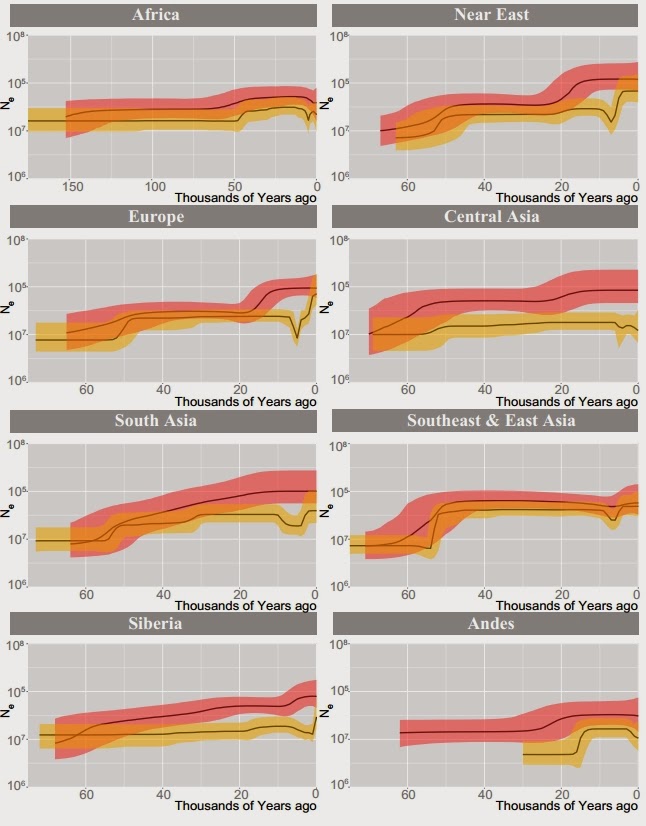
The contrast (left) between mtDNA (red) and Y-chromosome (yellow) coalescences is quite noticeable. The little "dip" in the yellow curve in many regions on the right of the various regional plots corresponds to a the second bottleneck event (that was really not "one" event, but rather shows that many modern men descend from a small number of "patriarchs" of the Neolithic and Bronze Age worlds. The "when" of the dip is important:

Most human mythologies contain stories of "first men" and eponymous founders of nations; these were often ridiculed in recent times as invented stories whose purpose was to engender social cohesion through a story of shared descent. But, now it seems that these stories were at least in part true, and such ultra-prolific patriarchs do indeed stand at the beginning of many later lines of descent.

The split between DT and B2'5 is placed at around ~100 thousand years ago. This corresponds perfectly (in my opinion) to the Out-of-Africa event from which most Eurasian men are probably descended. For the next thirty thousand years, Eurasians were probably confined to Arabia and the Middle East. The next major event is the foundation of the unambiguously Eurasian CT lineage ~70 thousand years ago (coinciding with the Toba eruption and the onset of super arid conditions at the onset of MIS 4). And, the final event of the "grand picture" of Eurasian prehistory was the Upper Paleolithic at ~50 thousand years ago, when Eurasians finally got the "tech" to exhibit complex behavior, invent new tools, conquer diverse environments and ultimately colonize the entire planet while driving Eurasian archaics to extinction.
An important detail in this grand picture is the fact that the authors estimate the coalescence date between D and E1'4 to ~70,000 years, coinciding with the C/GT split from the same time. These lineages are all found in Eurasia, but only E1'4 is found in Africa. I think this points clearly to back-migration of Eurasians into Africa, perhaps as environmental refugees following the c. 70kya Arabian ecological catastrophe. In any case, the fact that two separate Eurasian-specific lineages (CT and D) coalesce to ~70kya destroys the theory that the spread of modern humans into Eurasia happened together with UP-related technologies, a theory that was already on its last legs given the evidence that pre-UP admixture with Neandertals had taken place (as such admixture would have been impossible if pre-UP Eurasians were not already present outside of Africa at that time).
Genome Research doi:10.1101/gr.186684.114
A recent bottleneck of Y chromosome diversity coincides with a global change in culture
Monika Karmin et al.
It is commonly thought that human genetic diversity in non-African populations was shaped primarily by an out-of-Africa dispersal 50–100 thousand yr ago (kya). Here, we present a study of 456 geographically diverse high-coverage Y chromosome sequences, including 299 newly reported samples. Applying ancient DNA calibration, we date the Y-chromosomal most recent common ancestor (MRCA) in Africa at 254 (95% CI 192–307) kya and detect a cluster of major non-African founder haplogroups in a narrow time interval at 47–52 kya, consistent with a rapid initial colonization model of Eurasia and Oceania after the out-of-Africa bottleneck. In contrast to demographic reconstructions based on mtDNA, we infer a second strong bottleneck in Y-chromosome lineages dating to the last 10 ky. We hypothesize that this bottleneck is caused by cultural changes affecting variance of reproductive success among males.
Link
January 28, 2015
~55 thousand year old modern human from Manot cave in Israel

We will have to wait until tomorrow to see exactly what they compared it against. The abstract contrasts it with "other early AMH" from the Levant, which I presume means the Skhul/Qafzeh specimens of ~50ka earlier than Manot. But, they also say that it is similar to UP Europeans and recent Africans, which suggests that they did not find any particular similarities to old African skulls of which there are many.
UPDATE: The paper is now online
UPDATE I: The authors write:
Manot 1 could also have been a direct descendant of early AMH populations (such as Skhul/Qafzeh), but the differences in morphology between Manot 1 and the majority of fossils from these sites render this possibility unlikely (Supplementary InformationC).However, it should be noted that within- and between-group morphological variations in these populations are extremely large18, rendering any conclusion based exclusively on morphology as tentative. Nevertheless, the absence of
otherAMHspecimens in the Levant between the Skhul/Qafzeh material (,120–90 kyr ago) and the later appearing Manot 1 (,55 kyr ago) does not support the hypothesis of continuous representation and local evolution of AMHs in the Levant.
On the other hand, the considerably fluctuating climatic conditions during MIS 5 and 4 (favouring an alteration of differently adapted populations), the unequivocal presence of Neanderthals in the region in the time gap between early AMHs and the Manot population, and the continuing evolution of AMHs in Africa19 advocate for the most parsimonious explanation, which is that theManot people re-colonized the Levant from Africa, rather than evolved in situ.I don't buy this explanation. The key phrase is "the majority of fossils". In Figure 3 is it is clear that Qafzeh 9 is completely modern. Moreover, UP Europeans like Cro-Magnon 3, Mladec 6/5 are close to AMH Levantine specimens such as Skhul-5 and Qafzeh-6. Indeed, the late Neandertals such as Shanidar and Amud are already moving towards "modern" humans.
African samples like Omo-2, LH18, and and Jebel Irhoud 1/2 don't look anything like modern humans. It is quite strange that the authors interpret this evidence as discontinuity between ~100ka humans from the Levant and replacement by a fresh Out-of-Africa wave, when in fact all the Qafzeh/Skhul remains (and a couple of Neandertals) look much more plausible relatives of Manot than any of the ancient African samples. Not single sample has been found in Africa from the mysterious hypothetical ancestral population of modern humans that supposedly colonized Eurasia ~60ka. As far as I can tell, this theory has nothing to support it, except, perhaps, (i) some misinterpretation of old genetic data based on the now discredited "fast" mutation rate, and (ii) the belief that behavioral modernity first arose in Africa and coincided with the spread of modern humans from that continent into Eurasia.
Nature advance online publication 28 January 2015. doi:10.1038/nature14134
Levantine cranium from Manot Cave (Israel) foreshadows the first European modern humans
Authors: Israel Hershkovitz, Ofer Marder, Avner Ayalon, Miryam Bar-Matthews, Gal Yasur, Elisabetta Boaretto, Valentina Caracuta, Bridget Alex, Amos Frumkin, Mae Goder-Goldberger, Philipp Gunz, Ralph L. Holloway, Bruce Latimer, Ron Lavi, Alan Matthews, Viviane Slon, Daniella Bar-Yosef Mayer, Francesco Berna, Guy Bar-Oz, Reuven Yeshurun, Hila May, Mark G. Hans, Gerhard W. Weber & Omry Barzilai
A key event in human evolution is the expansion of modern humans of African origin across Eurasia between 60 and 40 thousand years (kyr) before present (bp), replacing all other forms of hominins. Owing to the scarcity of human fossils from this period, these ancestors of all present-day non-African modern populations remain largely enigmatic. Here we describe a partial calvaria, recently discovered at Manot Cave (Western Galilee, Israel) and dated to 54.7 ± 5.5 kyr bp (arithmetic mean ± 2 standard deviations) by uranium–thorium dating, that sheds light on this crucial event. The overall shape and discrete morphological features of the Manot 1 calvaria demonstrate that this partial skull is unequivocally modern. It is similar in shape to recent African skulls as well as to European skulls from the Upper Palaeolithic period, but different from most other early anatomically modern humans in the Levant. This suggests that the Manot people could be closely related to the first modern humans who later successfully colonized Europe. Thus, the anatomical features used to support the ‘assimilation model’ in Europe might not have been inherited from European Neanderthals, but rather from earlier Levantine populations. Moreover, at present, Manot 1 is the only modern human specimen to provide evidence that during the Middle to Upper Palaeolithic interface, both modern humans and Neanderthals contemporaneously inhabited the southern Levant, close in time to the likely interbreeding event with Neanderthals.
Link
January 14, 2015
SpaceMix preprint
bioRxiv http://dx.doi.org/10.1101/013474
A Spatial Framework for Understanding Population Structure and Admixture.
Gideon Bradburd, Peter L. Ralph, Graham Coop
Geographic patterns of genetic variation within modern populations, produced by complex histories of migration, can be difficult to infer and visually summarize. A general consequence of geographically limited dispersal is that samples from nearby locations tend to be more closely related than samples from distant locations, and so genetic covariance often recapitulates geographic proximity. We use genome-wide polymorphism data to build “geogenetic maps”, which, when applied to stationary populations, produces a map of the geographic positions of the populations, but with distances distorted to reflect historical rates of gene flow. In the underlying model, allele frequency covariance is a decreasing function of geogenetic distance, and nonlocal gene flow such as admixture can be identified as anomalously strong covariance over long distances. This admixture is explicitly co-estimated and depicted as arrows, from the source of admixture to the recipient, on the geogenetic map. We demonstrate the utility of this method on a circum-Tibetan sampling of the greenish warbler (Phylloscopus trochiloides), in which we find evidence for gene flow between the adjacent, terminal populations of the ring species. We also analyze a global sampling of human populations, for which we largely recover the geography of the sampling, with support for significant histories of admixture in many samples. This new tool for understanding and visualizing patterns of population structure is implemented in a Bayesian framework in the program SpaceMix.
Link
A Spatial Framework for Understanding Population Structure and Admixture.
Gideon Bradburd, Peter L. Ralph, Graham Coop
Geographic patterns of genetic variation within modern populations, produced by complex histories of migration, can be difficult to infer and visually summarize. A general consequence of geographically limited dispersal is that samples from nearby locations tend to be more closely related than samples from distant locations, and so genetic covariance often recapitulates geographic proximity. We use genome-wide polymorphism data to build “geogenetic maps”, which, when applied to stationary populations, produces a map of the geographic positions of the populations, but with distances distorted to reflect historical rates of gene flow. In the underlying model, allele frequency covariance is a decreasing function of geogenetic distance, and nonlocal gene flow such as admixture can be identified as anomalously strong covariance over long distances. This admixture is explicitly co-estimated and depicted as arrows, from the source of admixture to the recipient, on the geogenetic map. We demonstrate the utility of this method on a circum-Tibetan sampling of the greenish warbler (Phylloscopus trochiloides), in which we find evidence for gene flow between the adjacent, terminal populations of the ring species. We also analyze a global sampling of human populations, for which we largely recover the geography of the sampling, with support for significant histories of admixture in many samples. This new tool for understanding and visualizing patterns of population structure is implemented in a Bayesian framework in the program SpaceMix.
Link
September 04, 2014
Everything you ever wanted to know about mutation rate in humans
Annual Review of Genomics and Human Genetics
Vol. 15: 47-70 (Volume publication date August 2014)
Determinants of Mutation Rate Variation in the Human Germline
Laure Ségurel, Minyoung J. Wyman, and Molly Przeworski
Because germline mutations are the source of all evolutionary adaptations and heritable diseases, characterizing their properties and the rate at which they arise across individuals is of fundamental importance for human genetics. After decades during which estimates were based on indirect approaches, notably on inferences from evolutionary patterns, it is now feasible to count de novo mutations in transmissions from parents to offspring. Surprisingly, this direct approach yields a mutation rate that is twofold lower than previous estimates, calling into question our understanding of the chronology of human evolution and raising the possibility that mutation rates have evolved relatively rapidly. Here, we bring together insights from studies of human genetics and molecular evolution, focusing on where they conflict and what the discrepancies tell us about important open questions. We begin by outlining various methods for studying the properties of mutations in humans. We review what we have learned from their applications about genomic factors that influence mutation rates and the effects of sex, age, and other sources of interindividual variation. We then consider the mutation rate as a product of evolution and discuss how and why it may have changed over time in primates.
Link
Determinants of Mutation Rate Variation in the Human Germline
Laure Ségurel, Minyoung J. Wyman, and Molly Przeworski
Because germline mutations are the source of all evolutionary adaptations and heritable diseases, characterizing their properties and the rate at which they arise across individuals is of fundamental importance for human genetics. After decades during which estimates were based on indirect approaches, notably on inferences from evolutionary patterns, it is now feasible to count de novo mutations in transmissions from parents to offspring. Surprisingly, this direct approach yields a mutation rate that is twofold lower than previous estimates, calling into question our understanding of the chronology of human evolution and raising the possibility that mutation rates have evolved relatively rapidly. Here, we bring together insights from studies of human genetics and molecular evolution, focusing on where they conflict and what the discrepancies tell us about important open questions. We begin by outlining various methods for studying the properties of mutations in humans. We review what we have learned from their applications about genomic factors that influence mutation rates and the effects of sex, age, and other sources of interindividual variation. We then consider the mutation rate as a product of evolution and discuss how and why it may have changed over time in primates.
Link
August 21, 2014
Neandertal demise followed contact with modern humans (but not immediately)

Southern Iberia has been held to represent an exception to a wider European pattern21, with late survival of Neanderthals previously argued at sites such as Gorham’s Cave, Gibraltar22. We could not reproduce any of the late dates from sites in this region15 (Supplementary Methods) and it is apparent that many previous determinations underestimate the real age. It is unclear how long Neanderthals persisted in southern Iberia15.
Nature 512, 306–309 (21 August 2014) doi:10.1038/nature13621

Tom Higham et al.
The timing of Neanderthal disappearance and the extent to which they overlapped with the earliest incoming anatomically modern humans (AMHs) in Eurasia are key questions in palaeoanthropology1, 2. Determining the spatiotemporal relationship between the two populations is crucial if we are to understand the processes, timing and reasons leading to the disappearance of Neanderthals and the likelihood of cultural and genetic exchange. Serious technical challenges, however, have hindered reliable dating of the period, as the radiocarbon method reaches its limit at ~50,000 years ago3. Here we apply improved accelerator mass spectrometry 14C techniques to construct robust chronologies from 40 key Mousterian and Neanderthal archaeological sites, ranging from Russia to Spain. Bayesian age modelling was used to generate probability distribution functions to determine the latest appearance date. We show that the Mousterian ended by 41,030–39,260 calibrated years BP (at 95.4% probability) across Europe. We also demonstrate that succeeding ‘transitional’ archaeological industries, one of which has been linked with Neanderthals (Châtelperronian)4, end at a similar time. Our data indicate that the disappearance of Neanderthals occurred at different times in different regions. Comparing the data with results obtained from the earliest dated AMH sites in Europe, associated with the Uluzzian technocomplex5, allows us to quantify the temporal overlap between the two human groups. The results reveal a significant overlap of 2,600–5,400 years (at 95.4% probability). This has important implications for models seeking to explain the cultural, technological and biological elements involved in the replacement of Neanderthals by AMHs. A mosaic of populations in Europe during the Middle to Upper Palaeolithic transition suggests that there was ample time for the transmission of cultural and symbolic behaviours, as well as possible genetic exchanges, between the two groups.
Link
July 29, 2014
Lethal mutations quantified
A very interesting new preprint on the arXiv (so it can be freely read). The founder population is the Hutterites. The key sentence:
arXiv:1407.7518 [q-bio.PE]
An estimate of the average number of recessive lethal mutations carried by humans
Ziyue Gao, Darrel Waggoner, Matthew Stephens, Carole Ober, Molly Przeworski
The effects of inbreeding on human health depend critically on the number and severity of recessive, deleterious mutations carried by individuals. In humans, existing estimates of these quantities are based on comparisons between consanguineous and non-consanguineous couples, an approach that confounds socioeconomic and genetic effects of inbreeding. To circumvent this limitation, we focused on a founder population with almost complete Mendelian disease ascertainment and a known pedigree. By considering all recessive lethal diseases reported in the pedigree and simulating allele transmissions, we estimated that each haploid set of human autosomes carries on average 0.29 (95% credible interval [0.10, 0.83]) autosomal, recessive alleles that lead to complete sterility or severe disorders at birth or before reproductive age when homozygous. Comparison to existing estimates of the deleterious effects of all recessive alleles suggests that a substantial fraction of the burden of autosomal, recessive variants is due to single mutations that lead to death between birth and reproductive age. In turn, the comparison to estimates from other eukaryotes points to a surprising constancy of the average number of recessive lethal mutations across organisms with markedly different genome sizes.
Link
Our approach indicates that on average, one in every two humans carries a recessive lethal allele on the autosomes that lead to lethality after birth and before reproductive age or to complete sterility.
arXiv:1407.7518 [q-bio.PE]
An estimate of the average number of recessive lethal mutations carried by humans
Ziyue Gao, Darrel Waggoner, Matthew Stephens, Carole Ober, Molly Przeworski
The effects of inbreeding on human health depend critically on the number and severity of recessive, deleterious mutations carried by individuals. In humans, existing estimates of these quantities are based on comparisons between consanguineous and non-consanguineous couples, an approach that confounds socioeconomic and genetic effects of inbreeding. To circumvent this limitation, we focused on a founder population with almost complete Mendelian disease ascertainment and a known pedigree. By considering all recessive lethal diseases reported in the pedigree and simulating allele transmissions, we estimated that each haploid set of human autosomes carries on average 0.29 (95% credible interval [0.10, 0.83]) autosomal, recessive alleles that lead to complete sterility or severe disorders at birth or before reproductive age when homozygous. Comparison to existing estimates of the deleterious effects of all recessive alleles suggests that a substantial fraction of the burden of autosomal, recessive variants is due to single mutations that lead to death between birth and reproductive age. In turn, the comparison to estimates from other eukaryotes points to a surprising constancy of the average number of recessive lethal mutations across organisms with markedly different genome sizes.
Link
July 17, 2014
More selection on the X than in autosomes in humans
Mol Biol Evol (2014)
doi: 10.1093/molbev/msu166
Evidence for Increased Levels of Positive and Negative Selection on the X Chromosome versus Autosomes in Humans
Krishna R. Veeramah et al.
Partially recessive variants under positive selection are expected to go to fixation more quickly on the X chromosome as a result of hemizygosity, an effect known as faster-X. Conversely, purifying selection is expected to reduce substitution rates more effectively on the X chromosome. Previous work in humans contrasted divergence on the autosomes and X chromosome, with results tending to support the faster-X effect. However, no study has yet incorporated both divergence and polymorphism to quantify the effects of both purifying and positive selection, which are opposing forces with respect to divergence. In this study, we develop a framework that integrates previously developed theory addressing differential rates of X and autosomal evolution with methods that jointly estimate the level of purifying and positive selection via modeling of the distribution of fitness effects (DFE). We then utilize this framework to estimate the proportion of nonsynonymous substitutions fixed by positive selection (α) using exome sequence data from a West African population. We find that varying the female to male breeding ratio (β) has minimal impact on the DFE for the X chromosome, especially when compared with the effect of varying the dominance coefficient of deleterious alleles (h). Estimates of α range from 46% to 51% and from 4% to 24% for the X chromosome and autosomes, respectively. While dependent on h, the magnitude of the difference between α values estimated for these two systems is highly statistically significant over a range of biologically realistic parameter values, suggesting faster-X has been operating in humans.
Link
Evidence for Increased Levels of Positive and Negative Selection on the X Chromosome versus Autosomes in Humans
Krishna R. Veeramah et al.
Partially recessive variants under positive selection are expected to go to fixation more quickly on the X chromosome as a result of hemizygosity, an effect known as faster-X. Conversely, purifying selection is expected to reduce substitution rates more effectively on the X chromosome. Previous work in humans contrasted divergence on the autosomes and X chromosome, with results tending to support the faster-X effect. However, no study has yet incorporated both divergence and polymorphism to quantify the effects of both purifying and positive selection, which are opposing forces with respect to divergence. In this study, we develop a framework that integrates previously developed theory addressing differential rates of X and autosomal evolution with methods that jointly estimate the level of purifying and positive selection via modeling of the distribution of fitness effects (DFE). We then utilize this framework to estimate the proportion of nonsynonymous substitutions fixed by positive selection (α) using exome sequence data from a West African population. We find that varying the female to male breeding ratio (β) has minimal impact on the DFE for the X chromosome, especially when compared with the effect of varying the dominance coefficient of deleterious alleles (h). Estimates of α range from 46% to 51% and from 4% to 24% for the X chromosome and autosomes, respectively. While dependent on h, the magnitude of the difference between α values estimated for these two systems is highly statistically significant over a range of biologically realistic parameter values, suggesting faster-X has been operating in humans.
Link
Craniofacial feminization and the origin of behavioral modernity
Current Anthropology Vol. 55, No. 4, August 2014
Robert L. Cieri et al.
Abstract:
The past 200,000 years of human cultural evolution have witnessed the persistent establishment of behaviors involving innovation, planning depth, and abstract and symbolic thought, or what has been called “behavioral modernity.” Demographic models based on increased human population density from the late Pleistocene onward have been increasingly invoked to understand the emergence of behavioral modernity. However, high levels of social tolerance, as seen among living humans, are a necessary prerequisite to life at higher population densities and to the kinds of cooperative cultural behaviors essential to these demographic models. Here we provide data on craniofacial feminization (reduction in average brow ridge projection and shortening of the upper facial skeleton) in Homo sapiens from the Middle Pleistocene to recent times. We argue that temporal changes in human craniofacial morphology reflect reductions in average androgen reactivity (lower levels of adult circulating testosterone or reduced androgen receptor densities), which in turn reflect the evolution of enhanced social tolerance since the Middle Pleistocene.
Link
Robert L. Cieri et al.
Abstract:
The past 200,000 years of human cultural evolution have witnessed the persistent establishment of behaviors involving innovation, planning depth, and abstract and symbolic thought, or what has been called “behavioral modernity.” Demographic models based on increased human population density from the late Pleistocene onward have been increasingly invoked to understand the emergence of behavioral modernity. However, high levels of social tolerance, as seen among living humans, are a necessary prerequisite to life at higher population densities and to the kinds of cooperative cultural behaviors essential to these demographic models. Here we provide data on craniofacial feminization (reduction in average brow ridge projection and shortening of the upper facial skeleton) in Homo sapiens from the Middle Pleistocene to recent times. We argue that temporal changes in human craniofacial morphology reflect reductions in average androgen reactivity (lower levels of adult circulating testosterone or reduced androgen receptor densities), which in turn reflect the evolution of enhanced social tolerance since the Middle Pleistocene.
Link
June 15, 2014
Chimp mutation rate is equal to human mutation rate but driven more by males
This is important because (a) it shows evidence for the "slow" mutation rate in a species related to humans, (b) it shows that chimp and human mutation rates are equal and so using the human mutation rate in studies of divergence with chimps is justified, and (c) it is driven differently by males/females than in humans.
Science 13 June 2014: Vol. 344 no. 6189 pp. 1272-1275
DOI: 10.1126/science.344.6189.1272
Strong male bias drives germline mutation in chimpanzees
Oliver Venn
ABSTRACT
Germline mutation determines rates of molecular evolution, genetic diversity, and fitness load. In humans, the average point mutation rate is 1.2 × 10⁻⁸ per base pair per generation, with every additional year of father’s age contributing two mutations across the genome and males contributing three to four times as many mutations as females. To assess whether such patterns are shared with our closest living relatives, we sequenced the genomes of a nine-member pedigree of Western chimpanzees, Pan troglodytes verus. Our results indicate a mutation rate of 1.2 × 10⁻⁸ per base pair per generation, but a male contribution seven to eight times that of females and a paternal age effect of three mutations per year of father’s age. Thus, mutation rates and patterns differ between closely related species.
Link
Science 13 June 2014: Vol. 344 no. 6189 pp. 1272-1275
DOI: 10.1126/science.344.6189.1272
Strong male bias drives germline mutation in chimpanzees
Oliver Venn
ABSTRACT
Germline mutation determines rates of molecular evolution, genetic diversity, and fitness load. In humans, the average point mutation rate is 1.2 × 10⁻⁸ per base pair per generation, with every additional year of father’s age contributing two mutations across the genome and males contributing three to four times as many mutations as females. To assess whether such patterns are shared with our closest living relatives, we sequenced the genomes of a nine-member pedigree of Western chimpanzees, Pan troglodytes verus. Our results indicate a mutation rate of 1.2 × 10⁻⁸ per base pair per generation, but a male contribution seven to eight times that of females and a paternal age effect of three mutations per year of father’s age. Thus, mutation rates and patterns differ between closely related species.
Link
May 24, 2014
High genetic differentiation between populations often driven by classic selective sweeps
bioRxiv doi: http://dx.doi.org/10.1101/005462
Human genomic regions with exceptionally high or low levels of population differentiation identified from 911 whole-genome sequences
Vincenza Colonna et al.
Background: Population differentiation has proved to be effective for identifying loci under geographically-localized positive selection, and has the potential to identify loci subject to balancing selection. We have previously investigated the pattern of genetic differentiation among human populations at 36.8 million genomic variants to identify sites in the genome showing high frequency differences. Here, we extend this dataset to include additional variants, survey sites with low levels of differentiation, and evaluate the extent to which highly differentiated sites are likely to result from selective or other processes. Results: We demonstrate that while sites of low differentiation represent sampling effects rather than balancing selection, sites showing extremely high population differentiation are enriched for positive selection events and that one half may be the result of classic selective sweeps. Among these, we rediscover known examples, where we actually identify the established functional SNP, and discover novel examples including the genes ABCA12, CALD1 and ZNF804, which we speculate may be linked to adaptations in skin, calcium metabolism and defense, respectively. Conclusions: We have identified known and many novel candidate regions for geographically restricted positive selection, and suggest several directions for further research.
Link
Human genomic regions with exceptionally high or low levels of population differentiation identified from 911 whole-genome sequences
Vincenza Colonna et al.
Background: Population differentiation has proved to be effective for identifying loci under geographically-localized positive selection, and has the potential to identify loci subject to balancing selection. We have previously investigated the pattern of genetic differentiation among human populations at 36.8 million genomic variants to identify sites in the genome showing high frequency differences. Here, we extend this dataset to include additional variants, survey sites with low levels of differentiation, and evaluate the extent to which highly differentiated sites are likely to result from selective or other processes. Results: We demonstrate that while sites of low differentiation represent sampling effects rather than balancing selection, sites showing extremely high population differentiation are enriched for positive selection events and that one half may be the result of classic selective sweeps. Among these, we rediscover known examples, where we actually identify the established functional SNP, and discover novel examples including the genes ABCA12, CALD1 and ZNF804, which we speculate may be linked to adaptations in skin, calcium metabolism and defense, respectively. Conclusions: We have identified known and many novel candidate regions for geographically restricted positive selection, and suggest several directions for further research.
Link
May 22, 2014
MSMC preprint (Schiffels and Durbin)

In particular, the early beginning of the drop would be consistent with an initial formation of distinct populations prior to 150kya, while the late end of the decline would be consistent with a final split around 50kya. This suggests a long period of partial divergence with ongoing genetic exchange between Yoruban and Non-African ancestors that began beyond 150kya, with population structure within Africa, and lasted for over 100,000 years, with a median point around 60-80kya at which time there was still substantial genetic exchange, with half the coalescences between populations and half within (see Discussion). We also observe that the rate of genetic divergence is not uniform but can be roughly divided into two phases. First, up until about 100kya, the two populations separated more slowly, while after 100kya genetic exchange dropped faster.If divergence between Yoruba and non-Africans began 150kya, then I wonder when divergence between Bushmen or the non-farmer ancestors of Pygmies and the Yoruba started. These dates are well within the time period when anatomical modernity was already in existence, but well before the time period when behavioral modernity first appears. This is important, as some people imagine that humans lived together for most of the time period since their first appearance ~200kya and only split recently at ~50kya, but this is obviously wrong. ~50kya seems to be the time for cessation of gene flow, with 100ky more of impeded gene flow.
Also:
As expected, the oldest split amongst out-of-Africa populations is between European and East Asian (CHB and MXL) populations, most of which occurs between 20-40kya (Figure 4b). Intriguingly there may be a small component (10% or less) of this separation extending much further back towards 100kya, not compatible with a single out-of-Africa event around 50kya.This is the most intriguing part of this preprint as it suggests that European/East Asian genetic differentiation may not only be due to the their post-UP divergence, but also to older strands of ancestry. Such deep differentiation may be related to the ~100kya settlement of the Near East (but not East Asia) by anatomically modern humans and the recent evidence for a deep "Basal Eurasian" lineage in Europeans but not East Asians.
bioRxiv, doi: http://dx.doi.org/10.1101/005348
Inferring human population size and separation history from multiple genome sequences
Stephan Schiffels, Richard Durbin
The availability of complete human genome sequences from populations across the world has given rise to new population genetic inference methods that explicitly model their ancestral relationship under recombination and mutation. So far, application of these methods to evolutionary history more recent than 20-30 thousand years ago and to population separations has been limited. Here we present a new method that overcomes these shortcomings. The Multiple Sequentially Markovian Coalescent (MSMC) analyses the observed pattern of mutations in multiple individuals, focusing on the first coalescence between any two individuals. Results from applying MSMC to genome sequences from nine populations across the world suggest that the genetic separation of non-African ancestors from African Yoruban ancestors started long before 50,000 years ago, and give information about human population history as recently as 2,000 years ago, including the bottleneck in the peopling of the Americas, and separations within Africa, East Asia and Europe.
Link
May 03, 2014
Did Men cause the demise of the Hobbits?
An interesting tidbit from an interview with Chris Stringer:
There was also a population of a very small human-like species on the island of Flores in Indonesia—often called "hobbits." It had been thought they were around until about 17,000 years ago, but unpublished evidence suggests they could have disappeared earlier, in which case the spread of modern humans might correlate with their demise.and:
My model is that modern humans came out of Africa 60,000 years ago and moved very quickly into the territory of the Neanderthals, later into the territory of the Denisovans, and soon after that into the territory of the "hobbits." Within 20,000 years, as far as we can tell, those other populations have gone, all of them.
May 02, 2014
Human STR variation (Willems et al. 2014)
bioRxiv doi: 10.1101/004671
The Landscape of Human STR Variation
Thomas F. Willems et al.
Short Tandem Repeats are among the most polymorphic loci in the human genome. These loci play a role in the etiology of a range of genetic diseases and have been frequently utilized in forensics, population genetics, and genetic genealogy. Despite this plethora of applications, little is known about the variation of most STRs in the human population. Here, we report the largest-scale analysis of human STR variation to date. We collected information for nearly 700,000 STR loci across over 1,000 individuals in phase 1 of the 1000 Genomes Project. This process nearly saturated common STR variations. After employing a series of quality controls, we utilize this call set to analyze determinants of STR variation, assess the human reference genome?s representation of STR alleles, find STR loci with common loss-of-function alleles, and obtain initial estimates of the linkage disequilibrium between STRs and common SNPs. Overall, these analyses further elucidate the scale of genetic variation beyond classical point mutations. The resource is publicly available at http://strcat.teamerlich.org/ both in raw format and via a graphical interface.
Link
The Landscape of Human STR Variation
Thomas F. Willems et al.
Short Tandem Repeats are among the most polymorphic loci in the human genome. These loci play a role in the etiology of a range of genetic diseases and have been frequently utilized in forensics, population genetics, and genetic genealogy. Despite this plethora of applications, little is known about the variation of most STRs in the human population. Here, we report the largest-scale analysis of human STR variation to date. We collected information for nearly 700,000 STR loci across over 1,000 individuals in phase 1 of the 1000 Genomes Project. This process nearly saturated common STR variations. After employing a series of quality controls, we utilize this call set to analyze determinants of STR variation, assess the human reference genome?s representation of STR alleles, find STR loci with common loss-of-function alleles, and obtain initial estimates of the linkage disequilibrium between STRs and common SNPs. Overall, these analyses further elucidate the scale of genetic variation beyond classical point mutations. The resource is publicly available at http://strcat.teamerlich.org/ both in raw format and via a graphical interface.
Link
Subscribe to:
Posts (Atom)