
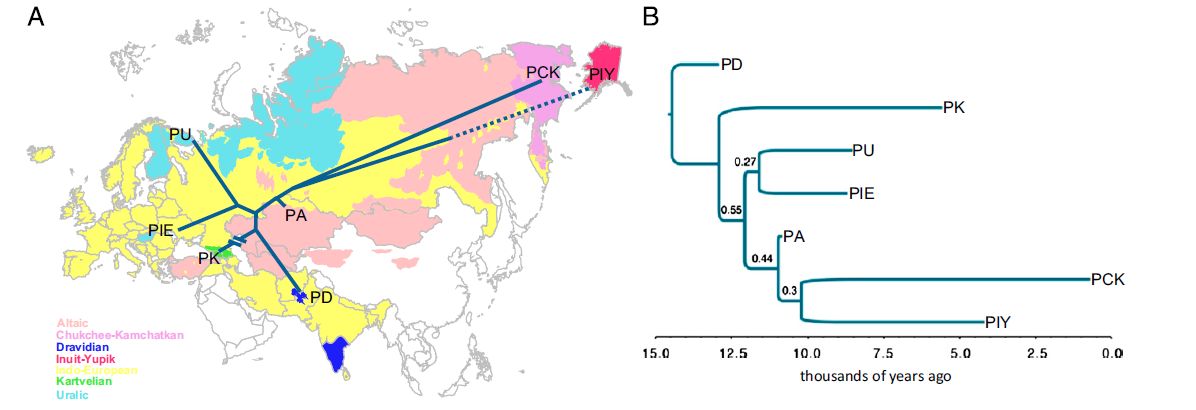
Posterior support at internal nodes of the tree is low, as we might expect of a linguistic tree of this age, but all exceed chance expectations (SI Text) and the internal topology does not affect our estimates of the age of the superfamily. All inferred ages must be treated with caution but our estimates are consistent with proposals linking the near concomitant spread of the language families that comprise this group to the retreat of glaciers in Eurasia at the end of the last ice age ~15 kya (4, 17). The 95% CIs around the root-age are consistent with the initial separation of these families occurring before the development of agriculture beginning ~11 kya (26).
A few comments:
- The common ancestry of Inuit-Yupik with Chukchee-Kamchatkan lends some support to the idea of Old/New World contacts postdating the initial colonization of the Americas
- (Note that the superimposition of the tree on the map does not indicate migratory paths)
- The deep divergence of Proto-Dravidian from the rest of the tree raises the issue of the genetic identity of the Proto-Dravidians. Today, Dravidian speakers are concentrated on the southern parts of India -with the notable Brahui exception in Pakistan- so one is tempted to associate them with the long diverged "Ancestral South Indian" genetic component whose closest living relatives live in the Indian Ocean. On the other hand, hypothesized relationships between Dravidian and extra-Indian languages, such as those postulated here might suggest that Proto-Dravidian was spoken by people more closely related to other Eurasians.
- More generally, the hypothesis of post-glacial contacts between diverse parts of Eurasia might suggest that differentiation between Eurasian peoples did not proceed in isolation after the initial Out-of-Africa settlement. And, if there were indeed post-glacial movements, of people spreading "Proto-Eurasiatic" languages, these may be detectable by archaeogenetic means.
With the two earliest offshoots being Proto-Dravidian and Proto-Kartvelian, it would be tempting to seek some Central Asian proto-homeland for these languages; the remaining languages seem to occupy (mostly) areas that were substantially glaciated. There was of course large-scale language replacement during the Neolithic and even later time periods, so one can hypothesize that other extinct languages may also have belonged to this greater family, and it would be interesting to see if membership could be supported for any of them.
ScienceNOW has a fairly good high-level discussion. The paper is open access.
PNAS May 6, 2013, doi: 10.1073/pnas.1218726110
Ultraconserved words point to deep language ancestry across Eurasia
Mark Pagel et al.
The search for ever deeper relationships among the World’s languages is bedeviled by the fact that most words evolve too rapidly to preserve evidence of their ancestry beyond 5,000 to 9,000 y. On the other hand, quantitative modeling indicates that some “ultraconserved” words exist that might be used to find evidence for deep linguistic relationships beyond that time barrier. Here we use a statistical model, which takes into account the frequency with which words are used in common everyday speech, to predict the existence of a set of such highly conserved words among seven language families of Eurasia postulated to form a linguistic superfamily that evolved from a common ancestor around 15,000 y ago. We derive a dated phylogenetic tree of this proposed superfamily with a time-depth of ∼14,450 y, implying that some frequently used words have been retained in related forms since the end of the last ice age. Words used more than once per 1,000 in everyday speech were 7- to 10-times more likely to show deep ancestry on this tree. Our results suggest a remarkable fidelity in the transmission of some words and give theoretical justification to the search for features of language that might be preserved across wide spans of time and geography.
Link


