There have been a few papers on the topic of Etruscan origins that argue in favor or against the Anatolian origin hypothesis. Two main lines of evidence exist on the topic: discontinuity between Etruscans and modern Tuscans (except some isolates); (perceived) similarity between Etrsucans' mtDNA and that of modern-day Turks.
Personally, I am not convinced either way, because I don't find it likely that a sample of modern-day Turks has much to tell us about the prehistoric relatives of the Etruscans. After all, modern-day Turks are descended from a a few dozen ancient Anatolian ethne plus a few extra-Anatolian influences from both west and east (and perhaps north and south) plus Central Asian Turkic influence minus Christian populations. We see evidence of genetic discontinuity in places with much simpler histories than Anatolia, so to claim that modern Turks have much of anything to tell us about Iron Age Etruscans is a not-so-believable proposition.
A similar complaint is that the specificity of the Etruscan gene pool can only be established by looking at their geographical neighbors. If Etruscans were intrusive to Italy, then, presumably, they would have retained differences from the surrounding Anatolian peoples.
A third (and perhaps more subtle) caveat is that "Etruscan" is polysemous. To the archaeologist and historian, it might mean a specific culture known from its remains and the texts of Romans and Greeks with which this culture interacted. To the linguist it might mean the language spoken by this culture when it attained literacy. To the geneticist it might mean the gene pool of individuals identified by archaeologists as "Etruscan".
These categories are not necessarily congruent. My favorite example is that of "Bulgarians" or "Croats", peoples who bear the name of a Turkic and Iranic people respectively, even though today they are geographically, culturally, and linguistically completely divorced from these antecedents. Or, the more controversial example of "Romans" themselves, whose nation spoke in historical times Latin, but whose histories preserved a memory of diverse origins, including, critically, an Anatolian genealogy for their eponymous ancestor.
So, the tale of Herodotus might be true (or false) on different levels. It might turn out that Etruscans did, in fact, form an isle of ancient west Anatolian genetics in Italy. Or, it might turn out that -as in the case of the Bulgarians- both language and genes are mostly native Italian, but the founding of the Etruscan nation can still be attributed to an extraneous influence. Or, perhaps Herodotus was 100% wrong, and Tyrrhenus never sailed to Italy.
Of course, I don't expect ancient DNA from all over Italy and all over Anatolia to materialize overnight, so studies such as this do help us constrain the space of possible solutions to the problem, i.e., a model with (i) substantial female participation in Etruscan colonization, (ii) genetic continuity in Anatolia to present-day Turks, and (iii) substantial contribution of Anatolian colonists to Etruscan gene pool may be falsified. But, assumptions (i-iii) describe only a small part of the space of models consistent with the Herodotean narrative.
Am J Phys Anthropol DOI: 10.1002/ajpa.22319
Genetic evidence does not support an etruscan origin in Anatolia
Francesca Tassi et al.
The debate on the origins of Etruscans, documented in central Italy between the eighth century BC and the first century AD, dates back to antiquity. Herodotus described them as a group of immigrants from Lydia, in Western Anatolia, whereas for Dionysius of Halicarnassus they were an indigenous population. Dionysius' view is shared by most modern archeologists, but the observation of similarities between the (modern) mitochondrial DNAs (mtDNAs) of Turks and Tuscans was interpreted as supporting an Anatolian origin of the Etruscans. However, ancient DNA evidence shows that only some isolates, and not the bulk of the modern Tuscan population, are genetically related to the Etruscans. In this study, we tested alternative models of Etruscan origins by Approximate Bayesian Computation methods, comparing levels of genetic diversity in the mtDNAs of modern and ancient populations with those obtained by millions of computer simulations. The results show that the observed genetic similarities between modern Tuscans and Anatolians cannot be attributed to an immigration wave from the East leading to the onset of the Etruscan culture in Italy. Genetic links between Tuscany and Anatolia do exist, but date back to a remote stage of prehistory, possibly but not necessarily to the spread of farmers during the Neolithic period.
Link

Showing posts with label Herodotus. Show all posts
Showing posts with label Herodotus. Show all posts
August 01, 2013
February 08, 2013
Etruscan mtDNA origins (Ghirotto et al. 2013)
From the paper:
 If Etruscans did originate in Anatolia then presumably the historical Etruscans were not descended entirely from them but from a mixture of pre-Etruscans with the incoming population. So, it would seem that the inferred dates are incompatible with a folk migration model of Etruscan origins, but not necessarily with a model that accommodates admixture (e.g., initial mtDNA gene pool separation c. 8,000 years ago with the onset of the Neolithic + later admixture during the Bronze Age). On the other hand, the close similarity between Etruscan and Central European Neolithic mtDNA is a good argument for (mostly) continuity in this case.
That things did happen in Italy in the last 5,000 years can be inferred on the basis of the Iceman's genome. It will certainly be interesting to extract Y chromosomes and/or autosomal DNA from some of these Etruscan samples.
A different issue that may bias dates upwards is the occurrence of East Eurasian mtDNA in current Anatolian Turks. It is not clear by how much this would affect age estimates (this admixture is low, sub-10%, but from a population that split off from West Eurasians perhaps more than 40kya); it would nonetheless be useful to repeat the experiment after either (i) purging the Anatolian sample of lineages likely to have introgressed into the population in medieval times, or (ii) using a different West Asian sample other than that of Anatolian Turks.
In any case, it's great to finally have the genetic characterization of a historical European people, and hopefully more samples will follow both from Italy (at least from those who practiced inhumation) and elsewhere.
PLoS ONE 8(2): e55519. doi:10.1371/journal.pone.0055519
Origins and Evolution of the Etruscans’ mtDNA
Silvia Ghirotto et al.
The Etruscan culture is documented in Central Italy (current Tuscany and Northern Latium, formerly known as Etruria) between the 8th and the 1st century BC. Questions about the Etruscans’ origins and fate have been around for millennia. Herodotus and Livy regarded them as immigrants, respectively from Lydia, i.e. Western Anatolia, or from North of the Alps, whereas for Dionysius of Halicarnassus they were an autochthonous population [1]. Previous DNA studies, far from settling the issue, have raised further questions. The Etruscans’ mitochondrial DNAs (mtDNAs) appear similar, but seldom identical, to those currently observed in Tuscany [2], [3]. Assuming reasonable effects of genetic drift and mutation, these levels of resemblance proved incompatible with the notion that modern Tuscans are descended from Etruscan ancestors [4], [5]. Explanations for this result include the (extreme) possibility that the Etruscans became extinct, but also that their modern descendants are few and geographically dispersed, or that the ancient sample studied represents a small social elite rather than the entire population [4]. As for the Etruscans’ origins, ancient DNA is of little use, because pre-Etruscan dwellers of Central Italy, of the Villanovan culture, cremated their dead [1], and hence their genetic features are unknown. DNAs from modern humans and cattle in Tuscany show affinities with Near Eastern DNAs, which was interpreted as supporting Herodotus’ narrative [2], [6], but in these studies modern Tuscans were assumed to be descended from Etruscan ancestors, in contrast with ancient DNA evidence [5]. The claim that systematic errors in the Etruscan DNA sequences led to flawed genealogical inference [2], [7] is not supported by careful reanalysis of the data [8].
Link
A model of genealogical continuity across 2,500 years thus proved to best fit the observed data for Volterra, and especially Casentino, but not for another community dwelling in an area also rich with Etruscan archaeological remains (Murlo), nor (as expected) for the bulk of the current Tuscan population, here represented by a forensic sample of the inhabitants of Florence.and:
As for the second question, the IM analysis shows that indeed there might have been a genealogical link between modern Tuscans and the inhabitants of what Herodotus considered the Etruscans’ homeland, Western Anatolia. However, even under the unrealistic assumption of complete reciprocal isolation for millennia, the likely separation of the Tuscan and Anatolian gene pools must be placed long before the onset of the Etruscan culture, at least in Neolithic times; if isolation was incomplete, the estimated separation must be placed further back in time. Consistent with this view is the observation that Etruscan and Neolithic mtDNAs are close to each other in the two-dimensional plot of Figure S4C; however, a formal test would be necessary to draw firm conclusions from the simple observation of a genetic similarity. Separation times were very close when estimated both using a sample from Western Anatolia, and an expanded sample including individuals from much of Anatolia, and so the choice of the Anatolian population does not seem to affect the results of this analysis.As always with estimates in years, the choice of mutation rate may affect results, but I am reasonably confident that this particular result does not depend on such issues. From the paper:
For these tests we chose the mutation rate (μ) estimated from the data in the previous ABC analyses (very close to the figure accounting for the time-dependency of the mitochondrial molecular clock [13], μ = 0.003). Tests were also run using the value incorporating a correction for the effects of purifying selection [23] (μ = 0.0014), always finding that it results in a further increase of the estimated separation times (Figure S7B). Only assuming very high mutation rates, at least twice as large as estimated in Henn et al. [13], was it possible to obtain separation times less than 5,000 years (Figure S7B). With both Anatolian samples, any degree of gene flow after separation between the ancestors of Tuscans and Anatolians resulted in more remote separation times.A couple of observations:

That things did happen in Italy in the last 5,000 years can be inferred on the basis of the Iceman's genome. It will certainly be interesting to extract Y chromosomes and/or autosomal DNA from some of these Etruscan samples.
A different issue that may bias dates upwards is the occurrence of East Eurasian mtDNA in current Anatolian Turks. It is not clear by how much this would affect age estimates (this admixture is low, sub-10%, but from a population that split off from West Eurasians perhaps more than 40kya); it would nonetheless be useful to repeat the experiment after either (i) purging the Anatolian sample of lineages likely to have introgressed into the population in medieval times, or (ii) using a different West Asian sample other than that of Anatolian Turks.
In any case, it's great to finally have the genetic characterization of a historical European people, and hopefully more samples will follow both from Italy (at least from those who practiced inhumation) and elsewhere.
PLoS ONE 8(2): e55519. doi:10.1371/journal.pone.0055519
Origins and Evolution of the Etruscans’ mtDNA
Silvia Ghirotto et al.
The Etruscan culture is documented in Central Italy (current Tuscany and Northern Latium, formerly known as Etruria) between the 8th and the 1st century BC. Questions about the Etruscans’ origins and fate have been around for millennia. Herodotus and Livy regarded them as immigrants, respectively from Lydia, i.e. Western Anatolia, or from North of the Alps, whereas for Dionysius of Halicarnassus they were an autochthonous population [1]. Previous DNA studies, far from settling the issue, have raised further questions. The Etruscans’ mitochondrial DNAs (mtDNAs) appear similar, but seldom identical, to those currently observed in Tuscany [2], [3]. Assuming reasonable effects of genetic drift and mutation, these levels of resemblance proved incompatible with the notion that modern Tuscans are descended from Etruscan ancestors [4], [5]. Explanations for this result include the (extreme) possibility that the Etruscans became extinct, but also that their modern descendants are few and geographically dispersed, or that the ancient sample studied represents a small social elite rather than the entire population [4]. As for the Etruscans’ origins, ancient DNA is of little use, because pre-Etruscan dwellers of Central Italy, of the Villanovan culture, cremated their dead [1], and hence their genetic features are unknown. DNAs from modern humans and cattle in Tuscany show affinities with Near Eastern DNAs, which was interpreted as supporting Herodotus’ narrative [2], [6], but in these studies modern Tuscans were assumed to be descended from Etruscan ancestors, in contrast with ancient DNA evidence [5]. The claim that systematic errors in the Etruscan DNA sequences led to flawed genealogical inference [2], [7] is not supported by careful reanalysis of the data [8].
Link
November 14, 2009
Cambyses' army found in Egypt
VANISHED PERSIAN ARMY SAID FOUND IN DESERT
Video on the Lost Army of Cambyses. Another video.
UPDATE: Rogue Classicism is skeptical.
Bones, jewelry and weapons found in Egyptian desert may be the remains of Cambyses' army that vanished 2,500 years ago.
The remains of a mighty Persian army said to have drowned in the sands of the western Egyptian desert 2,500 years ago might have been finally located, solving one of archaeology's biggest outstanding mysteries, according to Italian researchers.
Bronze weapons, a silver bracelet, an earring and hundreds of human bones found in the vast desolate wilderness of the Sahara desert have raised hopes of finally finding the lost army of Persian King Cambyses II. The 50,000 warriors were said to be buried by a cataclysmic sandstorm in 525 B.C.
"We have found the first archaeological evidence of a story reported by the Greek historian Herodotus," Dario Del Bufalo, a member of the expedition from the University of Lecce, told Discovery News.
According to Herodotus (484-425 B.C.), Cambyses, the son of Cyrus the Great, sent 50,000 soldiers from Thebes to attack the Oasis of Siwa and destroy the oracle at the Temple of Amun after the priests there refused to legitimize his claim to Egypt.
After walking for seven days in the desert, the army got to an "oasis," which historians believe was El-Kharga. After they left, they were never seen again.
"A wind arose from the south, strong and deadly, bringing with it vast columns of whirling sand, which entirely covered up the troops and caused them wholly to disappear," wrote Herodotus.
A century after Herodotus wrote his account, Alexander the Great made his own pilgrimage to the oracle of Amun, and in 332 B.C. he won the oracle's confirmation that he was the divine son of Zeus, the Greek god equated with Amun.
Video on the Lost Army of Cambyses. Another video.
UPDATE: Rogue Classicism is skeptical.
September 24, 2009
560K SNP study reveals dual rigin of Indian populations (Reich et al. 2009)
In lieu of a prologue, Herodotus and Arrian on the two groups inhabiting ancient India:
The Indians wore cotton dresses, and carried bows of cane, and arrows also of cane with iron at the point. Such was the equipment of the Indians, and they marched under the command of Pharnazathres the son of Artabates. [...] The eastern Ethiopians- for two nations of this name served in the army- were marshalled with the Indians. They differed in nothing from the other Ethiopians, save in their language, and the character of their hair. For the eastern Ethiopians have straight hair, while they of Libya are more woolly-haired than any other people in the world.The appearance of the inhabitants, too, is not so far different in India and Ethiopia; the southern Indians resemble the Ethiopians a good deal, and, are black of countenance, and their hair black also, only they are not as snub-nosed or so woolly-haired as the Ethiopians; but the northern Indians are most like the Egyptians in appearance.
The paper establishes a number of different facts, that have been hinted at in previous autosomal studies, and studies based on Y chromosomes and mtDNA:
- Modern Indians are derived from two ancestral populations. The first one, termed Ancestral North Indians (ANI) were Caucasoids, the other, Ancestral South Indians (ASI) were distinct from both Caucasoids and Mongoloids in a Eurasian context.
- The ASI no longer exist in non-admixed form, but in various degrees of admixtures with ANI; the closest living population to the ASI are the Andaman Islanders.
- Upper castes are higher in ANI ancestry than middle and lower castes. ANI percentages of ancestry are correlated with Western Eurasian Y chromosomes (P=0.04) and mtDNA (P=0.08).
- Indo-European speakers are higher in ANI ancestry than Dravidian speakers.
However, the fact that ANI is correlated with caste status and language does suggest that the Indo-Aryan migration who brought Indo-European languages to India has not been totally wiped out genetically. Indo-European populations have maintained a higher degree of ancestry from the ANI component, and upper caste Indo-Europeans have maintained an even higher degree of such ancestry.
The beauty of this study is that it does not consider either a simple mixture model (like STRUCTURE does) in which populations are derived from 2 or more ancestral ones, or a simple branching model, in which populations are derived tree-like from a common root with no admixture between them. Rather, they consider both tree-like divergence of populations followed by admixture. The following figure from the paper illustrates this:
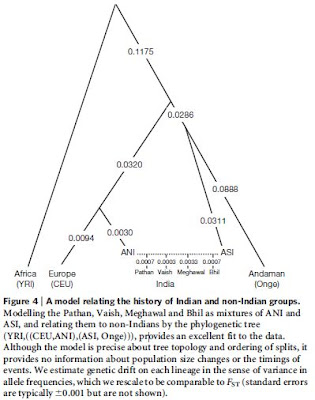 We can see that (i) the relationship between Andaman Islanders and ASI is not particularly close, although they do form a clade in relation to the other populations, (ii) the relationship between CEU and ANI is fairly close (in this context). The authors further determine (in the supplement) that CEU and ANI do form a clade separate from the non-IE speaking Adygei from the Caucasus.
 We can see that (i) the relationship between Andaman Islanders and ASI is not particularly close, although they do form a clade in relation to the other populations, (ii) the relationship between CEU and ANI is fairly close (in this context). The authors further determine (in the supplement) that CEU and ANI do form a clade separate from the non-IE speaking Adygei from the Caucasus.
What is now needed is to calculate the genetic distances between ANI and a wide assortment of Western Eurasian populations. Indeed, as these populations have undergone their own processes of admixture (e.g., Near Eastern populations with Arabs, Turks with Central Asians, Russians with Finns, Central Asian Iranians with Turks and Mongols, and so on), we cannot generally infer that the source population(s) of the ANI component are extant in non-admixed form. Nonetheless, the discovery of a strong relationship of ANI with a West Eurasian population may help us pinpoint the geographical origin of ANI outside India.
The paper does demolish some theories that have been popular in some circles:
There is no evidence of caste as simply social division of labor. This thesis is inconsistent with differential ANI admixture (and distance from Western Eurasians) across the caste hierarchy.
There is no evidence that Indo-Aryan and Dravidian speakers differ only in language. It is now clear that they are different from each other genetically as well, and this difference is not an "internal affair" of India, but is related to populations outside it. Indo-Aryan speakers differ precisely in having a larger ANI component.
There is no evidence that Indo-European languages originated in India. Let us consider what this would entail:
- Suppose postulated ancient Indian PIE speakers had a similar genetic makeup as modern Indians (i.e., a mix of ANI and ASI). Then, the absence of the ASI component outside South Asia cannot be explained.
- If ancient Indian PIE speakers had a purely ANI makeup, then the absence of the ASI component outside South Asia -as in (1)- can be explained. However, this would entail that sharply differentiated populations (ANI and ASI) co-existed in India without mixing for thousands of years; ANI-like PIEs spread from India with their languages; ANI and ASI admixed afterwards. To say that this scenario is not parsimonious would be charitable.
- The only way in which PIE languages may have originated in India would be if they spread without the spread of people. However, before the advent of writing and modern means of transportation and communication, the only way to spread languages was by migration of people.
From a related Nature story:
The researchers also found that Indian populations were much more highly subdivided than European populations. But whereas European ancestry is mostly carved up by geography, Indian segregation was driven largely by caste. "There are populations that have lived in the same town and same village for thousands of years without exchanging genes," says Reich.
The paper has plentiful (and free) supplementary information.
Related posts by Gene Expression and John Hawks.
Nature 461, 489-494 doi:10.1038/nature08365
Reconstructing Indian population history
David Reich et al.
Abstract
India has been underrepresented in genome-wide surveys of human variation. We analyse 25 diverse groups in India to provide strong evidence for two ancient populations, genetically divergent, that are ancestral to most Indians today. One, the 'Ancestral North Indians' (ANI), is genetically close to Middle Easterners, Central Asians, and Europeans, whereas the other, the 'Ancestral South Indians' (ASI), is as distinct from ANI and East Asians as they are from each other. By introducing methods that can estimate ancestry without accurate ancestral populations, we show that ANI ancestry ranges from 39–71% in most Indian groups, and is higher in traditionally upper caste and Indo-European speakers. Groups with only ASI ancestry may no longer exist in mainland India. However, the indigenous Andaman Islanders are unique in being ASI-related groups without ANI ancestry. Allele frequency differences between groups in India are larger than in Europe, reflecting strong founder effects whose signatures have been maintained for thousands of years owing to endogamy. We therefore predict that there will be an excess of recessive diseases in India, which should be possible to screen and map genetically.
Link
August 25, 2009
John Hawks on historical trends in length of life
John Hawks has a post on Human lifespans have not been constant for the last 2000 years, in which he criticizes the idea that there has not been a substantial change in length of life in the last 2,000 years:
Fortunately, there has been a study of the length of life in ancient Greece, that shows, that Socrates was not a unique case:
Of course, the lifespan of "men of renown" should be correlated with that of the general population, but with a higher mean, since men require time to achieve "renown". But, certainly the figure of 71 years does not seem too different from that of more recent men of renown, which is perhaps more surprising if one accounts for the high levels of violence in ancient Greece.
UPDATE I
John also writes:
We do have some fairly secure dates for at least some ancient individuals. Strabo died at 88. Sophocles died at 90. Democritus' life span was said to be anything from 90-109. Alexis, the comic poet reached the age of 100, Isocrates, 98. So, there were probably centenarians in ancient times, although what the maximum was is anyone's guess.
UPDATE II
Psalm 90:10 gives the length of life as 70.
Herodotus (1.32) has Solon give the "limit of life" at 70.
UPDATE V (Aug 31)
A reader writes in the comments:
120 years as a length of exceptionally long-lived people is also mentioned by Herodotus:
Of course we can't take the veracity of this story at face value, but the choice of number may suggest that it is as great as it could be without becoming unbelievable to the audience.
Syllogistically speaking, Socrates didn't die of natural causes, therefore the Greeks had lifespans the same as ours. Or something.
...
But there's no doubt that Romans, Egyptians, and Greeks were dropping dead at age 30, 40, 50 and 60 -- at much higher age-specific mortality rates than today. Estimating the overall age profile is difficult and requires models.
Fortunately, there has been a study of the length of life in ancient Greece, that shows, that Socrates was not a unique case:
In a study of all men of renown, living in the 5th and 4th century in Greece, we identified 83 whose date of birth and death have been recorded with certainty. Their mean +/- SD and median lengths of life were found to be 71.3+/-13.4 and 70 years, respectively.
Of course, the lifespan of "men of renown" should be correlated with that of the general population, but with a higher mean, since men require time to achieve "renown". But, certainly the figure of 71 years does not seem too different from that of more recent men of renown, which is perhaps more surprising if one accounts for the high levels of violence in ancient Greece.
UPDATE I
John also writes:
More important, we don't have a clue what the maximum lifespan may have been 200, 500, or 2000 years ago. Such a tiny fraction of people make it above age 100 today that we could hardly expect to find any of them at all from skeletal samples. Nor can we expect accurate ages from historical records -- Methuseleh, anyone?
We do have some fairly secure dates for at least some ancient individuals. Strabo died at 88. Sophocles died at 90. Democritus' life span was said to be anything from 90-109. Alexis, the comic poet reached the age of 100, Isocrates, 98. So, there were probably centenarians in ancient times, although what the maximum was is anyone's guess.
UPDATE II
Psalm 90:10 gives the length of life as 70.
The days of our years are three score years and ten; and if by reason of strength they be fourscore years, yet is their strength labor and sorrow; for it is soon cut off, and we fly away.
Herodotus (1.32) has Solon give the "limit of life" at 70.
Croesus, you ask me about human affairs, and I know that the divine is entirely grudging and troublesome to us. [2] In a long span of time it is possible to see many things that you do not want to, and to suffer them, too. I set the limit of a man's life at seventy years;This suggests to me that a length of life of 70 was formulaic in the ancient Mediterranean, and corresponds quite well with the average recorded length for prominent Greeks.
UPDATE III
Plato, in the Laws introduces a law that the guardians should rule from age 50 to at most the age of 70. Since the Laws is a work of political reform, we can assume that common Greek practice of the day (which is corroborated by historical knowledge about old-age statesmen) allowed for much older rulers, and, hence, such individuals existed in fairly substantial numbers -so that their rulership would become the object of a formal prohibition.
Aristotle, comments (in the History of Animals) that:
In a famous passage of the Politics, after noting that male and female generation length is at most 50 and 70, he prescribes the ideal marriage age:The reproductive function in men usually continues active till they are sixty years old; if they pass beyond this period, till they are seventy; and some men have had children at seventy years old.
Women should marry when they are about eighteen years of age, and men at seven and thirty.The prescription to marry at 37, suggests that early death must not have been too common; otherwise, it would be difficult to maintain the population's numbers, a topic which clearly occupied Aristotle, who commented on Sparta's oligandria in the same work.
UPDATE IV:
Lucian's Macrobii is dedicated to the topic of long-lived men, after listing the ages of various ancient and semi-mythical people, gives the ages at death of several historical individuals, including some fairly reliable ones:
Gorgias, 108
Of the orators, Gorgias, whom some call a sophist, lived to be one hundred and eight, and starved himself to death. They say that when he was asked the reason for his great age, sound in all his faculties, he replied that he had never accepted other peoples invitations to dinner!
Ctesibius, 104
Of the historians, Ctesibius died at the age of one hundred and four while taking a walk, according to Apollodorus in his Chronology.
Hieronymus, 104
Hieronymus, who went to war and stood much toil and many wounds, lived one hundred and four years, as Agatharchides says in the ninth book of his History of Asia; and he expresses his amazement at the man, because up to his last day he was still vigorous in his marital relations and in all his faculties, lacking none of the symptoms of health.
A reader writes in the comments:
The maximum life expectancy for humans seems to have been about 120years throughout recorded history.
"My Spirit will not strive with man forever, for he is indeed flesh; yet his days shall be one hundred and twenty years." Genesis 6:3
"From Cicero’s death to our day is a hundred and twenty years, one man’s life-time." Tacitus, "A Dialogue on Oratory", 17. Tacitus writes of seeing a 120 year old man in Britain in the 1st century A.D.
120 years as a length of exceptionally long-lived people is also mentioned by Herodotus:
The Icthyophagi then in their turn questioned the king concerning the term of life, and diet of his people, and were told that most of them lived to be a hundred and twenty years old, while some even went beyond that age- they ate boiled flesh, and had for their drink nothing but milk.
Of course we can't take the veracity of this story at face value, but the choice of number may suggest that it is as great as it could be without becoming unbelievable to the audience.
July 15, 2009
Andreas Willi on Macedonia
Andreas Willi has written a rebuttal of sorts (pdf) to the letter of the Macedonia Evidence Initiative. It is an extremely interesting piece of doublethink, and as such, it is useful to address in some detail.
Willi (henceforth W.) writes:
Thus, we know that Alexander affirmed his Hellenicity --by choosing to compete at the Olympic games-- and this affirmation (and that of his successors who also competed) were affirmed by the other Greeks. We have both a proclamation and an acceptance of his Hellenicity.
W. writes:
Languages are spread by people, and Empires spread the languages of their peoples. What wondrous miracle would result in myriads of Macedonians settling throughout Asia not to leaving a single trace of their non-Hellenic presence? Did the Macedonians decide to abandon their language at precisely the time of their own triumph? A simpler explanation is that they did not.
But, here comes the doublethink, as W. writes of the ancient Paionians:
But, if feelings sufficed, then how can W. deny the feelings of the Macedonian kings to be Hellenes? If Paionians may be Macedonians since they may have considered themselves to be such, how can W. simultaneously cast doubt to the claims of the Macedonian kings to be Hellenes, when they certainly did consider themselves to be such.
W. continues:
But, then, in Byzantine times, the Macedonian theme, consisted of a completely different region, in Thrace. So, whatever, "Macedonian" identity may have formed, it was no lasting thing, having disappeared by medieval times, and transferred to Thrace. Thus, the argument that FYROM Slavs can be seen as inheritors of a distinctive "Macedonian" identity from antiquity collapses. Their only relationship to Macedonia is that they happen to live in what was the Ottoman province of Macedonia.
W. writes:
Thus, there were non-Macedonians within the Kingdom of Macedonia, and none of the independent self-governing Macedonians listed by Thucydides lived in present-day FYROM.
W. writes:
According to W. the conquered Paionians became Macedonians on account of them being conquered, but Cleopatra, the descendant of the conquerors of Egypt became a non-Macedonian, and, presumably, an Egyptian.
In W's strange world of doublethink, it appears that conquerors become the conquered (Cleopatra becomes an Egyptian), and the conquered become the conquerors (Paionians become Macedonians).
W. continues the JFK analogy:
But, for the sake of argument, let's accept that the Slavs after several centuries, and because they live in part of Ottoman Macedonia, have some reason to consider themselves some kind of Macedonian. If this was all they did, no Greek would mind; after all, Greeks speak of Turkocretans, or Turkocypriots, or Slavomacedonians.
No, the real issue is that the Slavs of FYROM want to usurp the rights to the use of Macedonians exclusively for Slavs. Consider the official FYROM state policy about the existence of a "Macedonian" minority in Greece, which is -supposedly- oppressed by Greeks.
Going back to the Irish immigrants example, imagine if Irish immigrants not only started calling themselves Americans, but also started speaking about an American minority (by which they meant Americans of Irish origin) oppressed by "Anglos." That is, they tried to dispossess the original bearers of the name and take it as their property. Yet, this is precisely what FYROM Slavs are attempting to do.
W. writes:
Also, what can one make of the statement about sharing the "fate and fortune"? Was a Macedonian Greek in any case closer to a Skopje Slav because they both happened to live in a territory that Ottoman Sultans claimed to be Macedonia? Was he not closer --Ottoman borders notwithstanding-- to a Thessalian or Thracian Greek? If we abandon the "blood-and-soil ideology", should we replace it with a "borders-and-history ideology", whereby an annexation of Paionia 23 centuries ago has forever marked the territory as Macedonia?
FYROM Slavs may, of course, feel pride that the ancient Paionians were conquered by Philip and Alexander a thousand years before their linguistic ancestors came to Macedonia. I don't feel particular pride that Greece was conquered by the Romans or the Ottomans or the Nazis, but there's no accounting for taste.
One cannot fail to notice, however, how thoroughly un-Macedonian this attitude is. Philip and Alexander loved Greek culture, and proudly proclaimed their Greekness, while these modern "Macedonians" despise Greeks, and proudly proclaim their non-Greekness. I submit this as exhibit A in the case that they are not, indeed, Macedonians at all.
Willi (henceforth W.) writes:
The internet documentation which is referred to in the letter may be right when it sees nothing but “a personal grudge” behind Demosthenes’ calling Philip II a “barbarian,” but to cite Herodotus 5.22 as conclusive evidence that Alexander the Great was “thoroughly and indisputably Greek” is seriously misleading, since Herodotus’ statement “I happen to know that [the forefathers of Alexander] are Greek” is triggered precisely by the existence of a dispute over the matter, long before the age of Demosthenes.Indeed, there was a dispute over the matter, but the key point is that the dispute was resolved in favor of the Macedonian claims of Hellenicity. So, if the Hellanodikai of ancient Olympia accepted the Macedonian king as a Hellene, what reason does W. have to doubt them? Indeed, this acceptance occurred a century and a half at least before the ascent of Macedonians as a great power, so there is no reason to think that the judges' acceptance was the result of pressure.
Thus, we know that Alexander affirmed his Hellenicity --by choosing to compete at the Olympic games-- and this affirmation (and that of his successors who also competed) were affirmed by the other Greeks. We have both a proclamation and an acceptance of his Hellenicity.
W. writes:
As for (b), the question “Why was Greek the lingua franca all over Alexander’s empire if he was a ‘Macedonian’?” cannot be adequately answered with the words “[Because] Alexander the Great was Greek,” given that we have numerous examples of ancient empires in which the lingua franca was not the language of the ruler.The unnamed examples of "ancient empires" notwithstanding, it is the case that Empires usually spread their own language. The Romans much esteemed Greek as a language of learning, but they spread Latin, not Greek to most of their Empire. Centuries later, the Europeans, who much esteemed Latin, spread Spanish or English to their empires.
Languages are spread by people, and Empires spread the languages of their peoples. What wondrous miracle would result in myriads of Macedonians settling throughout Asia not to leaving a single trace of their non-Hellenic presence? Did the Macedonians decide to abandon their language at precisely the time of their own triumph? A simpler explanation is that they did not.
But, here comes the doublethink, as W. writes of the ancient Paionians:
What is at the core of the letter is a mistaken and unhealthy notion of historical identity. “While it is true that the Paionians were subdued by Philip II, father of Alexander, in 358 B.C. they were not Macedonians and did not live in Macedonia”—but is that really so? How many Paionians did we ask about it, and at what point in history?Thus, W. questions the letter's statement that the Paionians were not Macedonians. None of the ancient sources ever confuse the two people, or assert that the Paionians were Macedonians. But, let us grant, for the sake of argument, that at some point in their history, the Paionians felt like Macedonians.
But, if feelings sufficed, then how can W. deny the feelings of the Macedonian kings to be Hellenes? If Paionians may be Macedonians since they may have considered themselves to be such, how can W. simultaneously cast doubt to the claims of the Macedonian kings to be Hellenes, when they certainly did consider themselves to be such.
W. continues:
The comparison with Egypt is awkward, for at least after the incorporation of “Paionia” under Antigonos Gonatas (249 BCE) a territorially continuous political unity had come into being which survived as such in the Roman provincial administration. That the case of Egypt is rather different in this respect need hardly be stressed.Suppose that Paionians did start feeling like Macedonians during Roman times. Certainly, in Strabo's time, who lived after the Roman conquest, the Paionians continue to be reckoned as a different people, while Macedonia is reckoned as part of Hellas. But, let's suppose that indeed a "Macedonian identity" formed.
But, then, in Byzantine times, the Macedonian theme, consisted of a completely different region, in Thrace. So, whatever, "Macedonian" identity may have formed, it was no lasting thing, having disappeared by medieval times, and transferred to Thrace. Thus, the argument that FYROM Slavs can be seen as inheritors of a distinctive "Macedonian" identity from antiquity collapses. Their only relationship to Macedonia is that they happen to live in what was the Ottoman province of Macedonia.
W. writes:
Moreover, to use an ancient but immediately relevant analogy, are we really to think that Thucydides got it all wrong when he wrote that, decades before the conquest of Paionia, the term “Macedonia” also applied to lands not inhabited by “ethnic” Macedonians (Thuc. 2.99)?But, Thucydides statement actually opposes W's argument:
Assembling in Doberus, they prepared for descending from the heights upon Lower Macedonia, where the dominions of Perdiccas lay; [2] for the Lyncestae, Elimiots, and other tribes more inland, though Macedonians by blood and allies and, dependents of their kindred, still have their own separate governments. [3] The country on the sea coast, now called Macedonia, was first acquired by Alexander, the father of Perdiccas, and his ancestors, originally Temenids from Argos. This was effected by the expulsion from Pieria of the Pierians, who afterwards inhabited Phagres and other places under Mount Pangaeus, beyond the Strymon (indeed the country between Pangaeus and the sea is still called the Pierian gulf) of the Bottiaeans, at present neighbors of the Chalcidians, from Bottia, [4] and by the acquisition in Paeonia of a narrow strip along the river Axius extending to Pella and the sea; the district of Mygdonia, between the Axius and the Strymon, being also added by the expulsion of the Edonians. [5] From Eordia also were driven the Eordians, most of whom perished, though a few of them still live round Physca, and the Almopians from Almopia. [6] These Macedonians also conquered places belonging to the other tribes, which are still theirs--Anthemus, Crestonia, Bisaltia, and much of Macedonia proper. The whole is now called Macedonia, and at the time of the invasion of Sitalces, Perdiccas, Alexander's son, was the reigning king.It is clear from this passage that Macedonians e.g., the Lyncestae) existed outside the Macedonian state, while some people who lived within it were not reckoned as Macedonians. Macedonians and the "Kingdom of Macedonia" are not conterminous entities. Thucydides does not assert that the non-Macedonians within the Macedonian state become, by reason of their inclusion in this state, Macedonians.
Thus, there were non-Macedonians within the Kingdom of Macedonia, and none of the independent self-governing Macedonians listed by Thucydides lived in present-day FYROM.
W. writes:
But to call Cleopatra a “Macedonian” gives away what constitutes true identity in the eyes of the letter’s authors: to them, identity seems defined by ancestry and blood-lines, by the past more than the present. Are we then to conclude that, for example, John F. Kennedy—or George W. Bush or Barack Obama, for that matter—were never real Americans? And if John F. Kennedy’s ancestors spoke Irish at one point, is it preposterous for all English-speaking Americans to use him today in their construction of a national identity because of that?On what basis was Cleopatra not a Macedonian? She was a Macedonian by blood, and indeed by a fairly inbred pedigree full of Macedonians. But, suppose we discount, for the sake of argument, the importance of ancestry. Why, still, was Cleopatra not a Macedonian?
According to W. the conquered Paionians became Macedonians on account of them being conquered, but Cleopatra, the descendant of the conquerors of Egypt became a non-Macedonian, and, presumably, an Egyptian.
In W's strange world of doublethink, it appears that conquerors become the conquered (Cleopatra becomes an Egyptian), and the conquered become the conquerors (Paionians become Macedonians).
W. continues the JFK analogy:
By coming to America John F. Kennedy’s ancestors chose to become Americans (with Irish roots); but why could the Slavs coming to Macedonia then not become Macedonians (with Slavic roots)?The analogy is false, for several reasons. First of all, JFK's ancestors came to the US as peaceful immigrants while the Slavs came to Macedonia as enemies of the local inhabitants. One needs to read the Miracula Sancti Demetrii to see what the local Macedonians thought of Slavs during the time of their arrival.
But, for the sake of argument, let's accept that the Slavs after several centuries, and because they live in part of Ottoman Macedonia, have some reason to consider themselves some kind of Macedonian. If this was all they did, no Greek would mind; after all, Greeks speak of Turkocretans, or Turkocypriots, or Slavomacedonians.
No, the real issue is that the Slavs of FYROM want to usurp the rights to the use of Macedonians exclusively for Slavs. Consider the official FYROM state policy about the existence of a "Macedonian" minority in Greece, which is -supposedly- oppressed by Greeks.
Going back to the Irish immigrants example, imagine if Irish immigrants not only started calling themselves Americans, but also started speaking about an American minority (by which they meant Americans of Irish origin) oppressed by "Anglos." That is, they tried to dispossess the original bearers of the name and take it as their property. Yet, this is precisely what FYROM Slavs are attempting to do.
W. writes:
No matter what its ethnic mix was—and what serious scholar would nowadays want to argue that the only “good” states are ethnically “pure” states, in which everyone must speak the same language?—the tendentiously-labeled “pseudo-greater Macedonia,” far from being a recent invention, did exist as a real recent invention, did exist as a real identitarian concept well before the 20th century. And in a sense its roots can be traced back to the conquests of Philip II, Alexander the Great and their successors in “Paionia”; for if those conquests had never taken place, the history of the region would have looked different and the territory of “Paionia” might not have shared the fate and fortune of “Aegean” Macedonia for long stretches of its history. Thus, unless one subscribes to a dangerous “blood-and-soil ideology,” there is no reason why the modern Slavic Macedonians should not be allowed to continue to call their country “Macedonia” and to pride themselves in Alexander the Great just as much as the modern Hellenic Greeks do. What does it matter if Alexander “was Greek, not Slavic,” as long as no one claims the opposite?This is a truly peculiar argument. Alexander's conquests influenced the history of much of the known world, so, should they all be called Macedonians on account of being conquered by the actual Macedonians?
Also, what can one make of the statement about sharing the "fate and fortune"? Was a Macedonian Greek in any case closer to a Skopje Slav because they both happened to live in a territory that Ottoman Sultans claimed to be Macedonia? Was he not closer --Ottoman borders notwithstanding-- to a Thessalian or Thracian Greek? If we abandon the "blood-and-soil ideology", should we replace it with a "borders-and-history ideology", whereby an annexation of Paionia 23 centuries ago has forever marked the territory as Macedonia?
FYROM Slavs may, of course, feel pride that the ancient Paionians were conquered by Philip and Alexander a thousand years before their linguistic ancestors came to Macedonia. I don't feel particular pride that Greece was conquered by the Romans or the Ottomans or the Nazis, but there's no accounting for taste.
One cannot fail to notice, however, how thoroughly un-Macedonian this attitude is. Philip and Alexander loved Greek culture, and proudly proclaimed their Greekness, while these modern "Macedonians" despise Greeks, and proudly proclaim their non-Greekness. I submit this as exhibit A in the case that they are not, indeed, Macedonians at all.
May 20, 2009
Review paper on Y-chromosome haplogroup E-M35 (Lancaster 2009)
This is quite useful as a reference for those interested in E-M35 and its many subclades.
A quick comment on p. 53 where Sicily is discussed and the prevalence of R1b and I1 in the West is mentioned in the context of Phoenicians who settled in West Sicily.
Haplogroup I1 is probably to a large degree due to the Normans whose capital was in Palermo (NW Sicily). R1b on the other hand may have been added by the Normans, but may also be due to the pre-Greek populations of Sicily, such as the Sicani who were (after Herodotus) of Iberian origin.
Journal of Genetic Genealogy Volume 5, Number 1, Spring, 2009
Y Haplogroups, Archaeological Cultures and Language Families: A Review of the Possibility of Multidisciplinary Comparisons Using the Case of Haplogroup E-M35
Andrew Lancaster
Abstract
Archaeology, comparative linguistics and population genetics all have something to add to speculation about early human migrations, and the three disciplines often make reference to each other in broad terms. But, in reality, the results are often disappointingly indecisive. This article explores the case of Y haplogroup E-M35 (E1b1b1), which has so far mainly only been mentioned in a passing way in archaeological and linguistic debate, but which, it shall be shown, shows great promise as more detailed about it's phylogenetic structure, and its regional distribution becomes available each year.
Link (pdf)
A quick comment on p. 53 where Sicily is discussed and the prevalence of R1b and I1 in the West is mentioned in the context of Phoenicians who settled in West Sicily.
Haplogroup I1 is probably to a large degree due to the Normans whose capital was in Palermo (NW Sicily). R1b on the other hand may have been added by the Normans, but may also be due to the pre-Greek populations of Sicily, such as the Sicani who were (after Herodotus) of Iberian origin.
Journal of Genetic Genealogy Volume 5, Number 1, Spring, 2009
Y Haplogroups, Archaeological Cultures and Language Families: A Review of the Possibility of Multidisciplinary Comparisons Using the Case of Haplogroup E-M35
Andrew Lancaster
Abstract
Archaeology, comparative linguistics and population genetics all have something to add to speculation about early human migrations, and the three disciplines often make reference to each other in broad terms. But, in reality, the results are often disappointingly indecisive. This article explores the case of Y haplogroup E-M35 (E1b1b1), which has so far mainly only been mentioned in a passing way in archaeological and linguistic debate, but which, it shall be shown, shows great promise as more detailed about it's phylogenetic structure, and its regional distribution becomes available each year.
Link (pdf)
May 19, 2009
More on prehistoric South Siberians (Keyser et al. 2009)
This seems like a compendium of these authors' previous work (see here and links therein) which had appeared in forensic journals so far; there seems to be more material in this paper than in the previous shorter papers, but as far as I can tell, no new genetic results.
There is also supplementary data in the article.
From the paper:
More from the paper:
The mtDNA results:
Human Genetics doi:10.1007/s00439-009-0683-0
Ancient DNA provides new insights into the history of south Siberian Kurgan people.
Keyser C. et al.
Abstract
To help unravel some of the early Eurasian steppe migration movements, we determined the Y-chromosomal and mitochondrial haplotypes and haplogroups of 26 ancient human specimens from the Krasnoyarsk area dated from between the middle of the second millennium BC. to the fourth century AD. In order to go further in the search of the geographic origin and physical traits of these south Siberian specimens, we also typed phenotype-informative single nucleotide polymorphisms. Our autosomal, Y-chromosomal and mitochondrial DNA analyses reveal that whereas few specimens seem to be related matrilineally or patrilineally, nearly all subjects belong to haplogroup R1a1-M17 which is thought to mark the eastward migration of the early Indo-Europeans. Our results also confirm that at the Bronze and Iron Ages, south Siberia was a region of overwhelmingly predominant European settlement, suggesting an eastward migration of Kurgan people across the Russo-Kazakh steppe. Finally, our data indicate that at the Bronze and Iron Age timeframe, south Siberians were blue (or green)-eyed, fair-skinned and light-haired people and that they might have played a role in the early development of the Tarim Basin civilization. To the best of our knowledge, no equivalent molecular analysis has been undertaken so far.
Link
There is also supplementary data in the article.
From the paper:
The additional analysis performed on Xiongnu specimens revealed that whereas none of the specimens from the Egyin Gol valley bore this haplogroup, the Scytho-Siberian skeleton from the Sebÿstei site exhibited R1a1 haplogroup.A previous study on Egyin Gol from Mongolia by Keyser et al.
More from the paper:
A search in the YHRD database as well as in our own databank revealed that none of the Y-STR haplotypes obtained from the south Siberian samples perfectly matched (at 17 loci) those included in the databases. Nevertheless, when not all loci were scored, matches were found for all samples except two (S07 and S32) for which even the search based on the 9-loci minimal haplotype was fruitless (Table 4).The article includes fairly comprehensive searches of the discovered Y-chromosome and mtDNA types in modern populations.
The mtDNA results:
Twenty samples were found to belong to west Eurasian haplogroups (U2, U4,Interestingly:
U5a1, T1, T3, T4, H5a, H6, HV, K, and I), whereas the 6 remaining samples were attributed to east Eurasian haplogroups (Z, G2a, C, F1b and N9a).
Moreover, it is likely that some mtDNA lineages were carried to southern Siberia from the Volga–Ural region. Incidentally, in the fifth century BC, Herodotus mentioned transit trade occurring in Central Asia along a route that stretched from the Urals in the west to the Altai and the Minusinsk Basin in the east (Hemphill and Mallory 2004). In Altai, the presence of the R1a1 haplogroup in the middle of the fifth century BC is confirmed by the sample SEB 96K2 of Ricaut et al. (2004) which was found to belong to this Y-haplogroup. The boundary of the eastern European influence seems to be fixed at the peri-Baikal area since no R1a1 haplogroup was found in the Xiongnu specimens of the Northern border of Mongolia.Link to Ricaut et al. (2004). This is in good agreement with the anthropological picture by Alexeev:
"The boundary of the Europeoid movement is clearly fixed at Lake Baikal. To the east of Baikal no palaeoanthropological find bears any traces of Europeoid admixture."See also my compendium on ancient Y-chromosome studies.
Human Genetics doi:10.1007/s00439-009-0683-0
Ancient DNA provides new insights into the history of south Siberian Kurgan people.
Keyser C. et al.
Abstract
To help unravel some of the early Eurasian steppe migration movements, we determined the Y-chromosomal and mitochondrial haplotypes and haplogroups of 26 ancient human specimens from the Krasnoyarsk area dated from between the middle of the second millennium BC. to the fourth century AD. In order to go further in the search of the geographic origin and physical traits of these south Siberian specimens, we also typed phenotype-informative single nucleotide polymorphisms. Our autosomal, Y-chromosomal and mitochondrial DNA analyses reveal that whereas few specimens seem to be related matrilineally or patrilineally, nearly all subjects belong to haplogroup R1a1-M17 which is thought to mark the eastward migration of the early Indo-Europeans. Our results also confirm that at the Bronze and Iron Ages, south Siberia was a region of overwhelmingly predominant European settlement, suggesting an eastward migration of Kurgan people across the Russo-Kazakh steppe. Finally, our data indicate that at the Bronze and Iron Age timeframe, south Siberians were blue (or green)-eyed, fair-skinned and light-haired people and that they might have played a role in the early development of the Tarim Basin civilization. To the best of our knowledge, no equivalent molecular analysis has been undertaken so far.
Link
March 25, 2009
Slavopaionian propaganda video + Stephen Miller's excellent letter to Archaeology magazine
Last year, when the "Macedonian issue" was in the news, due to FYROM's NATO candidacy I proposed that the issue could be resolved if FYROM accepted a compromise in the "name issue" that would qualify "Macedonia" with an appropriate geographical disambiguating adjective.
Events since that time have further strengthened my belief that no compromise is possible any more with our neighbors to the north, who refuse to budge even to the slightest degree in their stubborn adherence to their invented identity.
If you are in doubt of the degree of irrationality present in FYROM, this official video in state TV will change your mind:
The part at 04:25 is especially strange, where the narrator announces that one of the three races of mankind are the "Whites-Macedonoids" who spread to the "Sea of Japan", but the whole thing has a lunatic vibe to it.
On a more positive note, Prof. Stephen G. Miller's letter to Archaeology magazine is a welcome scholarly demolition of the Slavomacedonians' invented history.
Events since that time have further strengthened my belief that no compromise is possible any more with our neighbors to the north, who refuse to budge even to the slightest degree in their stubborn adherence to their invented identity.
If you are in doubt of the degree of irrationality present in FYROM, this official video in state TV will change your mind:
The part at 04:25 is especially strange, where the narrator announces that one of the three races of mankind are the "Whites-Macedonoids" who spread to the "Sea of Japan", but the whole thing has a lunatic vibe to it.
On a more positive note, Prof. Stephen G. Miller's letter to Archaeology magazine is a welcome scholarly demolition of the Slavomacedonians' invented history.
I opened the January/February issue of Archaeology today and eagerly turned to “A Letter from Macedonia” only to discover that it was actually a letter from ancient Paionia – the land north of Mt. Barmous and Mt. Orbelos. Livy’s account of the creation of the Roman province of Macedonia (45.29.7 and 12) makes clear that the Paionians lived north of those mountains (which form today the geographically natural northern limits of Greece) and south of the Dardanians who were in today’s Kosovo. Strabo (7. frag 4) is even more succinct in saying that Paionia was north of Macedonia and the only connection from one to the other was (and is today) through the narrow gorge of the Axios (or Vardar) River. In other words, the land which is described by Matthew Brunwasser in his “Owning Alexander” was Paionia in antiquity.My only disagreement with the good professor, is that the Slavs of FYROM do not merit either the name of Macedonians or of Paionians, since they have no ethnic link to either ancient people. They are in fact, largely Bulgarians, but since some of them don't like (or are afraid) to be called such, they should be called Slavopaionians, as is appropriate for Slavs inhabiting the ancient region of Paionia.
While it is true that those people were subdued by Philip II, father of Alexander, in 359 B.C. (Diodorus Siculus 16.4.2), they were never Macedonians and never lived in Macedonia. Indeed, Demosthenes (Olynthian 1.23) tells us that they were “enslaved” by the Macedonian Philip and clearly, therefore, not Macedonians. Isokrates (5.23) makes the same point. Likewise, for example, the Egyptians who were subdued by Alexander may have been ruled by Macedonians, including the famous Cleopatra, but they were never Macedonians themselves, and Egypt was never called Macedonia (and so far as I can tell does not seek that name today).
Certainly, as Thucydides (2.99) tells us, the Macedonians had taken over “a narrow strip of Paionia extending along the Axios river from the interior to Pella and the sea”. One might therefore understand if the people in the modern republic centered at Skopje called themselves Paionians and claimed as theirs the land described by Thucydides.
But why, instead, would the modern people of ancient Paionia try to call themselves Macedonians and their land Macedonia? Mr. Brunwasser (p. 55) touches on the Greek claims “that it implies ambitions over Greek territory” and he notes that “the northern province of Greece is also called Macedonia.” Leaving aside the fact that the area of that northern province of modern Greece has been called Macedonia for more than 2,500 years (see, inter alios, Herodotus 5.17; 7.128, et alibi), more recent history shows that the Greek concerns are legitimate. For example, a map produced in Skopje in 1992 (Figure 1) shows clearly the claim that Macedonia extends from there to Mt. Olympus in the south; that is, combining the ancient regions of Paionia and Macedonia into a single entity. The same claim is explicit on a pseudo-bank note of the Republic of Macedonia which shows, as one of its monuments, the White Tower of Thessalonike, in Greece (Figure 2). There are many more examples of calendars, Christmas cards, bumper-stickers, etc., that all make the same claim.
Further, Mr. Brunwasser has reported with approval (International Herald Tribune 10/1/08) the work of the “Macedonian Institute for Strategic Research 16:9”, the name of which refers “to Acts 16:9, a verse in the New Testament in which a Macedonian man appears to the Apostle Paul begging him: ‘Come over into Macedonia, and help us.’” But where did Paul go in Macedonia? Neapolis (Kavala), Philippi, Amphipolis, Apollonia, Thessaloniki, and Veroia (Acts 16:11-17:10) all of which are in the historic Macedonia, none in Paionia. What claim is being made by an Institute based in Skopje that names itself for a trip through what was Macedonia in antiquity and what is the northern province of Greece today?
I wonder what we would conclude if a certain large island off the southeast coast of the United States started to call itself Florida, and emblazoned its currency with images of Disney World and distributed maps showing the Greater Florida.
Certainly there was no doubt of the underlying point of “Macedonia” in the mind of U.S. Secretary of State Edward Stettinius on December 26, 1944, when he wrote:“The Department [of State] has noted with considerable apprehension increasing propaganda rumors and semi-official statements in favor of an autonomous Macedonia, emanating principally from Bulgaria, but also from Yugoslav Partisan and other sources, with the implication that Greek territory would be included in the projected state. This government considers talk of Macedonian ”nation”, Macedonian “Fatherland”, or Macedonian “national consciousness” to be unjustified demagoguery representing no ethnic nor political reality, and sees in its present revival a possible cloak for aggressive intentions against Greece.”
[Source: U.S. State Department, Foreign Relations vol viii, Washington, D.C., Circular Airgram (868.014/26Dec1944)]
Mr. Brunwasser (a resident of Bulgaria), however, goes on to state, with apparent distain, that Greece claims “Alexander III of Macedon (Alexander the Great) . . . as Greek.”
This attitude mystifies me. What is there to “claim”? Alexander’s great-great-great grandfather, Alexander I, was certified as Greek at Olympia and, in the words of the father of history “I happen to know that [the forefathers of Alexander] are Greek” (Herodotus 5.22). Alexander’s father, Philip, won several equestrian victories at Olympia and Delphi (Plutarch, Alexander 4.9; Moralia 105A), the two most Hellenic of all the sanctuaries in ancient Greece where non-Greeks were not allowed to compete. If Philip was Greek, wasn’t his son also Greek?
When Euripides – who died and was buried in Macedonia (Thucydides apud Pal. Anth. 7.45; Pausanias 1.2.2; Diodorus Siculus 13.103) – wrote his play Archelaos in honor of the great-uncle of Alexander, did he write it in Slavic? When he wrote the Bacchai while at the court of Archelaos did he not write it in Greek even as it has survived to us? Or should we imagine that Euripides was a “Macedonian” who wrote in Slavic (at a date when that language is not attested) which was translated into Greek?
What was the language of instruction when Aristotle taught Alexander? What language was carried by Alexander with him on his expedition to the East? Why do we have ancient inscriptions in Greek in settlements established by Alexander as far away as Afghanistan, and none in Slavic? Why did Greek become the lingua franca in Alexander’s empire if he was actually a “Macedonian”? Why was the New Testament written in Greek rather than Slavic?
On page 57 of the so-called “Letter from Macedonia” there is a photograph of the author standing “before a bronze statue of Alexander the Great in the city of Prilep.” The statue is patently modern, but the question is whether the real historic Alexander could have read the Slavic inscription beneath his feet. Given the known historic posterity of Slavic to Greek, the answer is obvious.
While Mr. Brunwasser’s reporting of the archaeological work in Paionia is welcome, his adoption and promotion of the modern political stance of its people about the use of the name Macedonia is not only unwelcome, it is a disservice to the readers of Archaeology who are, I imagine, interested in historic fact. But then, the decision to propagate this historical nonsense by Archaeology – a publication of the Archaeological Institute of America - is a disservice to its own reputation.
Let it be said once more: the region of ancient Paionia was a part of the Macedonian empire. So were Ephesos and Tyre and Palestine and Memphis and Babylon and Taxila and dozens more. They may thus have become “Macedonian” temporarily, but none was ever “Macedonia”.
Allow me to end this exegesis by making a suggestion to resolve the question of the modern use of the name “Macedonia.” Greece should annex Paionia – that is what Philip II did in 359 B.C. And that would appear to be acceptable to the modern residents of that area since they claim to be Greek by appropriating the name Macedonia and its most famous man. Then the modern people of this new Greek province could work on learning to speak and read and write Greek, hopefully even as well as Alexander did.
Sincerely,
Stephen G. Miller
Professor Emeritus,
University of California, Berkeley
PS: For a more complete examination of the ancient evidence regarding Paionia, see I. L. Merker,“The Ancient Kingdom of Paionia,” Balkan Studies 6 (1965) 35-54
December 18, 2008
Huge Greek necropolis from Himera, Sicily
 The discovery of such a large number of burials is a rare opportunity for an ancient DNA study of the Greeks of Sicily. The age of the samples, and the fact that they are from freshly excavated graves will make it relatively easy to extract useful DNA from them. Let's hope that we see some results in the next few years.
Ancient Mass Graves of Soldiers, Babies, Found in Italy
More than 10,000 graves containing ancient amphorae, "baby bottles," and the bodies of soldiers who fought the Carthaginians were found near the ancient Greek colony of Himera, in Italy, archaeologists announced recently.
"It's probably the largest Greek necropolis in Sicily," said Stefano Vassallo, the lead archaeologist of the team that made the discoveries, in September.
The ancient burial ground was uncovered during the construction of a railway extension.
"The remains of Himera's buildings had been known and studied for a long time, and we knew there should be some graves. We didn't expect so many graves", said Vassallo, who works for the Italian province of Palermo's government.
"Each [mass grave] contains from 15 to 25 skeletons. They were all young healthy men and they all died a violent death. Some of the skeletons have broken skulls and in some cases we found the tips of the arrows that killed them," Vassallo said.
He thinks the human remains are from soldiers who died fighting the Carthaginians in a famous 480 B.C. battle described by Greek historian Herodotus of Halicarnassus.
December 02, 2007
ESHG 2007 abstracts
I had previously posted about a presentation in this year's ESHG conference about the Y chromosomes of Etruscans. At that time, there was no abstract online, but I noticed that the book of abstracts is available (pdf). The conference took place last June and there will be probably publications coming out of the presentations there.
Some interesting abstracts; you will probably find many more in the volume's 396 pages.
Related to the abstract below about ACTN in Finnish athletes.
P1206. ACTN and ACE genotypes in Greek elite athletes
I. D. Papadimitriou et al.
Only a few attempts have been made to shed light upon the influence of genes in making an Olympic champion. The aim of our study is to elucidate the genetic differences among a group of 101 elite Greek power-oriented track and field athletes and a random representative sample (181) of the Greek population by analyzing ACTN3 and ACE genotypes. Athletes were defined as elite and included to the sample if they had represented Greece at the international level. Standard molecular genetic methodologies were followed. Genotype and allele frequencies were compared between elite athletes and controls by the Chi-squared test using the statistical package GENEPOP V. 3.4. Preliminary results for ACE locus indicated that the gene frequencies in the Greek elite athletes are similar to other northern European populations. Furthermore, concerning the ACTN3 locus, it was showed that ACTN3 genotype and allele frequencies in the top power-oriented athletes were statistically significantly different from those in the random
sample of the Greek population: the frequency of the RR ACTN3 genotype in power-oriented athletes vs. the general population was 47.94% vs. 25.97%. The difference was even more prominent for comparison of the subgroup of sprinters to controls. The results suggest an overall
strong association between the presence of the RR genotype and elite power performance. Therefore, the ACTN3 gene might be used as a molecular genetic marker to at least partially predict an athlete’s ability to achieve peak power and sprinting performance.
C17. Origin of the Etruscans: novel clues from the Y chromosome lineages
A. Piazza et al.
Three hypotheses have been proposed on the origin of the distinctive Etruscan civilization and language that flourished ca. 3,000 years before present (BP) in Central Italy: 1) an external Anatolian source (Lydia and Lemnos) as claimed by Herodotus, 2) an autochthonous
process of formation from the preceding Villanovan society as firstly proposed by Dionysius of Halicarnassus and 3) an influence from Northern Europe. A synthetic geographical map summarizing 34 classical genetic markers in Italy differentiates a genetically homogeneous
Central Italian region between the Arno and Tiber rivers (ancient Etruria) from the rest of Italy. While this fact was tentatively interpreted as a genetic footprint of the Etruscans, its verification remained a challenge due to lack of data on differentiation of such markers and its calibration
with time. Here we show the genetic relationships of modern Etrurians, who mostly settled in Tuscany, with other Italian, Near Eastern and Aegean peoples by comparing the Y-chromosome DNA variation in 1,264 unrelated healthy males from: Tuscany-Italy (n=263), North Italy (n=306), South Balkans (n=359), Lemnos island (n=60), Sicily and Sardinia (n=276). The Tuscany samples were collected in Volterra (n=116), Murlo (n=86) and Casentino Valley (n=61).
We found traces of recent Near Eastern gene flow still present in Tuscany, especially in the archaeologically important village of Murlo. The samples from Tuscany show eastern haplogroups E3b1-M78, G2*-P15, J2a1b*-M67 and K2-M70 with frequencies very similar to those observed in Turkey and surrounding areas, but significantly different from those of neighbouring Italian regions. The microsatellite haplotypes associated to these haplogroups allow inference of ancestor lineages for Etruria and Near East whose time to the most recent common ancestors is relatively recent (about 3,500 years BP) and supports a possible non autochthonous post-Neolithic signal associated with the Etruscans.
P1135. Y chromosome analysis in subpopulations of Bashkirs from Russia
A. S. Lobov et al.
The Volga-Ural region which is located between Europe and Asia has been the arena of permanent genetic exchanges among Siberian, Central Asian, Eastern European populations. We have sampled seven Bashkir subpopulations from different parts of the Volga-Ural region and neighboring areas of Russia: Orenburg (N=79), Perm (N=72), Samara and Saratov (N=51), and from Bashkortostan Republic: Abzelilovskiy (N=152), Sterlibashevskiy (N=54), Baimakskiy (N=95), and Burzaynskiy area (N=82). These samples are currently being analyzed using 24 diallelic markers of Y-chromosome (M89, M9, M20, M48, M73, M130, M170, M172, M175, M201, M207, M214, M217, M231, M253, M269, M306(M173), P15, P37, P43, SRY1532, Tat, 92R7(M74), 12f2). According to our preliminary findings Turkic speaking Bashkirs are characterized by prevalence of R1b3 and R1a lineages. Among all subpopulations, Perm and Baimakskiy area represent with hight frequency (0.748 0.769,).It indicate there closeness with West European populations. Haplogroup R1a have frequency value 0.486 in Samara and Saratov’s Bashkirs and frequency value 0.370 Bashkirs from Sterlibashevskiy area. The N3 characterize for subpopulation Bashkirs from Sterlibashevskiy area (0.537), Orenburg (0.342). Bashkirs from Abzelilovskiy area have main frequency (0.474). These differences possibly indicate that different subpopulations of Bashkirs have different origin. We found that Bashkirs from Perm district were characterized by relatively low genetic diversity, which could be explained by founder effect. Bashkirs from Orenburg region which are anthropologically closer to Ugro-Finnic populations are characterized by high frequency of N3 haplogroup. We will try to compare our results with archeologycal, historycal and anthropological data in discussed about of origin of different groups Bashkir
P1191. Analysis of mitochondrial DNA polymorphism in four Siberian ethnic groups
M. V. Golubenko et al.
Mitochondrial DNA polymorphism was studied in 1130 individuals from 12 populations of the most numerous Siberian peoples - Altaians (4 populations), Tivinians (3 populations), Yakuts (2 populations) and Buryats (3 populations). 308 different HVS1 haplotypes were revealed
in total which belong to 34 different mtDNA haplogroups, mainly of East-Eurasian origin. Portion of “West-Eurasian” mtDNA haplogroups was the highest in Altaians (up to 46%) and Buryats (up to 20%). AMOVA analysis has shown that 95,78% of HVSI variation was within populations, 2.09% could be explained by inter-population differentiation and 2.09% was variability between ethnic groups. Test on differentiation of polymorphism in population pairs has shown that in all cases except the pair of Yakut samples the differentiation was significant. AMOVA analysis for separate ethnic groups revealed the highest degree of intraethnic differentiation for Altaians (3.78%), followed by Tuvinians (2.61%) and then Buryats (0.43%). Comparison of spectrum of
haplogroups and individual haplotypes in the populations under investigation also shows significant differentiation of native Siberian populations. Only two haplotypes from haplogroup C and one haplotype from D could be considered as common for all four ethnicities. One more
haplotype from C was abundant in Tuvinians, Yakuts and Buryats but rare in Altaians. Substantial number of haplotypes was population-specific. Analysis of migrations and interethnic marriages revealed various effects of these factors depending both on ethnicity and particular
population. The results suggest considerable ethnic differentiation in the studied Siberian peoples, as well as geographic differentiation.
P1192. Paleomolecular genetic analyses (mitochondrial and nuclear DNA polymorphisms) on some Thracian populations from Romania, dating from the Bronze and Iron Age
G. M. Cardos et al.
We have performed this study on the skeletal remains of some old Thracian populations from Romania, dating from the Bronze and Iron Age. Therefore, within our research we analysed mtDNA (HVR I and HVR II regions) and nuclear DNA (vWA31A Microsatellite) polymorphisms
in order to show the degree of their genetic kinship with other old and modern European populations, especially with nowadays Romanian population. We also amplified the Amelogenin gene to identify the genetic sex of old individuals. We have used three methods for DNA-extraction from human fossils and adapted them on the degradation
state of the biological material: the phenol-chloroform DNA extraction method, the DNA extraction method with guanidine-tiocianate and silica-particles, and the DNA-extraction method with Invisorb Forensic After amplifying by PCR, the mtDNA sequences were sequenced
by the Sanger method. The nuclear vWA31A Microsatellite polymorphisms and the Amelogenin gene sequences were demonstrated on PAA gel, Ag-stained.
We have compared the mtDNA sequences of 50 old Thracian individuals with mtDNA sequences of the present-day Romanian population and other European, Asian and African modern and old populations. The frequencies of vWA31A Microsatellite were compared with similar genetic data of other modern populations from all over the world. Our results suggest that the old Thracian populations might have made an important contribution to the foundation of the modern genetic Romanian pool and also reflect an evident genetic similarity between the old Thracian populations and other modern populations from South-East Europe.
P1193. Analyses of mitochondrial and Y-chromosomal lineages in modern Hungarian, Szekler and ancient Hungarian populations
B. Csányi et al.
Hungarian population belongs linguistically to the Finno-Ugric branch of the Uralic language family. High-resolution mtDNA analysis of 27 ancient samples (10th-11th centuries), 101 modern Hungarian, and 76 modern Hungarian-speaking Szekler samples was performed. Only two of 27 ancient Hungarian samples are unambiguously Asian: the rest belong to one of the western Eurasian haplogroups. Statistical analyses, including 57 European and Asian populations, revealed that some Asian affinities and the genetic effect of populations who came into contact with ancient Hungarians during their migrations are seen. Though strong differences appear when the ancient Hungarian samples are analyzed according to apparent social status, as judged by grave goods. mtDNA results demonstrate that significant genetic differences exist between the ancient and recent Hungarian-speaking populations. The Y-chromosomal base substitution ”Tat”, proved to be a valuable marker in the Finno-Ugric context. The Tat C allele is widespread in many Uralic-speaking populations, while it is virtually absent in recent Hungarians. To further elucidate this finding we studied this polymorphism on 100 modern Hungarian, 97 Szekler and 4 ancient Hungarian samples. Our data revealed that only one Szekler men carries the C allele among the modern individuals, whereas out of the four skeletal remains two possess the mutation. Furthermore we examined 22 Y-chromosomal binary markers to analyze the paternal genetic diversity of the two recent populations.
Our results show that Hungarians and Szeklers share basically the same genetic components found in other European populations, genetically closely related and close to other populations from Central Europe and the Balkan.
P1219. Possible common origin for the Tibeto-Burman and Austro-Asiatic speaking populations of India: a Y-chromosome study
Some interesting abstracts; you will probably find many more in the volume's 396 pages.
Related to the abstract below about ACTN in Finnish athletes.
P1206. ACTN and ACE genotypes in Greek elite athletes
I. D. Papadimitriou et al.
Only a few attempts have been made to shed light upon the influence of genes in making an Olympic champion. The aim of our study is to elucidate the genetic differences among a group of 101 elite Greek power-oriented track and field athletes and a random representative sample (181) of the Greek population by analyzing ACTN3 and ACE genotypes. Athletes were defined as elite and included to the sample if they had represented Greece at the international level. Standard molecular genetic methodologies were followed. Genotype and allele frequencies were compared between elite athletes and controls by the Chi-squared test using the statistical package GENEPOP V. 3.4. Preliminary results for ACE locus indicated that the gene frequencies in the Greek elite athletes are similar to other northern European populations. Furthermore, concerning the ACTN3 locus, it was showed that ACTN3 genotype and allele frequencies in the top power-oriented athletes were statistically significantly different from those in the random
sample of the Greek population: the frequency of the RR ACTN3 genotype in power-oriented athletes vs. the general population was 47.94% vs. 25.97%. The difference was even more prominent for comparison of the subgroup of sprinters to controls. The results suggest an overall
strong association between the presence of the RR genotype and elite power performance. Therefore, the ACTN3 gene might be used as a molecular genetic marker to at least partially predict an athlete’s ability to achieve peak power and sprinting performance.
C17. Origin of the Etruscans: novel clues from the Y chromosome lineages
A. Piazza et al.
Three hypotheses have been proposed on the origin of the distinctive Etruscan civilization and language that flourished ca. 3,000 years before present (BP) in Central Italy: 1) an external Anatolian source (Lydia and Lemnos) as claimed by Herodotus, 2) an autochthonous
process of formation from the preceding Villanovan society as firstly proposed by Dionysius of Halicarnassus and 3) an influence from Northern Europe. A synthetic geographical map summarizing 34 classical genetic markers in Italy differentiates a genetically homogeneous
Central Italian region between the Arno and Tiber rivers (ancient Etruria) from the rest of Italy. While this fact was tentatively interpreted as a genetic footprint of the Etruscans, its verification remained a challenge due to lack of data on differentiation of such markers and its calibration
with time. Here we show the genetic relationships of modern Etrurians, who mostly settled in Tuscany, with other Italian, Near Eastern and Aegean peoples by comparing the Y-chromosome DNA variation in 1,264 unrelated healthy males from: Tuscany-Italy (n=263), North Italy (n=306), South Balkans (n=359), Lemnos island (n=60), Sicily and Sardinia (n=276). The Tuscany samples were collected in Volterra (n=116), Murlo (n=86) and Casentino Valley (n=61).
We found traces of recent Near Eastern gene flow still present in Tuscany, especially in the archaeologically important village of Murlo. The samples from Tuscany show eastern haplogroups E3b1-M78, G2*-P15, J2a1b*-M67 and K2-M70 with frequencies very similar to those observed in Turkey and surrounding areas, but significantly different from those of neighbouring Italian regions. The microsatellite haplotypes associated to these haplogroups allow inference of ancestor lineages for Etruria and Near East whose time to the most recent common ancestors is relatively recent (about 3,500 years BP) and supports a possible non autochthonous post-Neolithic signal associated with the Etruscans.
P1135. Y chromosome analysis in subpopulations of Bashkirs from Russia
A. S. Lobov et al.
The Volga-Ural region which is located between Europe and Asia has been the arena of permanent genetic exchanges among Siberian, Central Asian, Eastern European populations. We have sampled seven Bashkir subpopulations from different parts of the Volga-Ural region and neighboring areas of Russia: Orenburg (N=79), Perm (N=72), Samara and Saratov (N=51), and from Bashkortostan Republic: Abzelilovskiy (N=152), Sterlibashevskiy (N=54), Baimakskiy (N=95), and Burzaynskiy area (N=82). These samples are currently being analyzed using 24 diallelic markers of Y-chromosome (M89, M9, M20, M48, M73, M130, M170, M172, M175, M201, M207, M214, M217, M231, M253, M269, M306(M173), P15, P37, P43, SRY1532, Tat, 92R7(M74), 12f2). According to our preliminary findings Turkic speaking Bashkirs are characterized by prevalence of R1b3 and R1a lineages. Among all subpopulations, Perm and Baimakskiy area represent with hight frequency (0.748 0.769,).It indicate there closeness with West European populations. Haplogroup R1a have frequency value 0.486 in Samara and Saratov’s Bashkirs and frequency value 0.370 Bashkirs from Sterlibashevskiy area. The N3 characterize for subpopulation Bashkirs from Sterlibashevskiy area (0.537), Orenburg (0.342). Bashkirs from Abzelilovskiy area have main frequency (0.474). These differences possibly indicate that different subpopulations of Bashkirs have different origin. We found that Bashkirs from Perm district were characterized by relatively low genetic diversity, which could be explained by founder effect. Bashkirs from Orenburg region which are anthropologically closer to Ugro-Finnic populations are characterized by high frequency of N3 haplogroup. We will try to compare our results with archeologycal, historycal and anthropological data in discussed about of origin of different groups Bashkir
P1191. Analysis of mitochondrial DNA polymorphism in four Siberian ethnic groups
M. V. Golubenko et al.
Mitochondrial DNA polymorphism was studied in 1130 individuals from 12 populations of the most numerous Siberian peoples - Altaians (4 populations), Tivinians (3 populations), Yakuts (2 populations) and Buryats (3 populations). 308 different HVS1 haplotypes were revealed
in total which belong to 34 different mtDNA haplogroups, mainly of East-Eurasian origin. Portion of “West-Eurasian” mtDNA haplogroups was the highest in Altaians (up to 46%) and Buryats (up to 20%). AMOVA analysis has shown that 95,78% of HVSI variation was within populations, 2.09% could be explained by inter-population differentiation and 2.09% was variability between ethnic groups. Test on differentiation of polymorphism in population pairs has shown that in all cases except the pair of Yakut samples the differentiation was significant. AMOVA analysis for separate ethnic groups revealed the highest degree of intraethnic differentiation for Altaians (3.78%), followed by Tuvinians (2.61%) and then Buryats (0.43%). Comparison of spectrum of
haplogroups and individual haplotypes in the populations under investigation also shows significant differentiation of native Siberian populations. Only two haplotypes from haplogroup C and one haplotype from D could be considered as common for all four ethnicities. One more
haplotype from C was abundant in Tuvinians, Yakuts and Buryats but rare in Altaians. Substantial number of haplotypes was population-specific. Analysis of migrations and interethnic marriages revealed various effects of these factors depending both on ethnicity and particular
population. The results suggest considerable ethnic differentiation in the studied Siberian peoples, as well as geographic differentiation.
P1192. Paleomolecular genetic analyses (mitochondrial and nuclear DNA polymorphisms) on some Thracian populations from Romania, dating from the Bronze and Iron Age
G. M. Cardos et al.
We have performed this study on the skeletal remains of some old Thracian populations from Romania, dating from the Bronze and Iron Age. Therefore, within our research we analysed mtDNA (HVR I and HVR II regions) and nuclear DNA (vWA31A Microsatellite) polymorphisms
in order to show the degree of their genetic kinship with other old and modern European populations, especially with nowadays Romanian population. We also amplified the Amelogenin gene to identify the genetic sex of old individuals. We have used three methods for DNA-extraction from human fossils and adapted them on the degradation
state of the biological material: the phenol-chloroform DNA extraction method, the DNA extraction method with guanidine-tiocianate and silica-particles, and the DNA-extraction method with Invisorb Forensic After amplifying by PCR, the mtDNA sequences were sequenced
by the Sanger method. The nuclear vWA31A Microsatellite polymorphisms and the Amelogenin gene sequences were demonstrated on PAA gel, Ag-stained.
We have compared the mtDNA sequences of 50 old Thracian individuals with mtDNA sequences of the present-day Romanian population and other European, Asian and African modern and old populations. The frequencies of vWA31A Microsatellite were compared with similar genetic data of other modern populations from all over the world. Our results suggest that the old Thracian populations might have made an important contribution to the foundation of the modern genetic Romanian pool and also reflect an evident genetic similarity between the old Thracian populations and other modern populations from South-East Europe.
P1193. Analyses of mitochondrial and Y-chromosomal lineages in modern Hungarian, Szekler and ancient Hungarian populations
B. Csányi et al.
Hungarian population belongs linguistically to the Finno-Ugric branch of the Uralic language family. High-resolution mtDNA analysis of 27 ancient samples (10th-11th centuries), 101 modern Hungarian, and 76 modern Hungarian-speaking Szekler samples was performed. Only two of 27 ancient Hungarian samples are unambiguously Asian: the rest belong to one of the western Eurasian haplogroups. Statistical analyses, including 57 European and Asian populations, revealed that some Asian affinities and the genetic effect of populations who came into contact with ancient Hungarians during their migrations are seen. Though strong differences appear when the ancient Hungarian samples are analyzed according to apparent social status, as judged by grave goods. mtDNA results demonstrate that significant genetic differences exist between the ancient and recent Hungarian-speaking populations. The Y-chromosomal base substitution ”Tat”, proved to be a valuable marker in the Finno-Ugric context. The Tat C allele is widespread in many Uralic-speaking populations, while it is virtually absent in recent Hungarians. To further elucidate this finding we studied this polymorphism on 100 modern Hungarian, 97 Szekler and 4 ancient Hungarian samples. Our data revealed that only one Szekler men carries the C allele among the modern individuals, whereas out of the four skeletal remains two possess the mutation. Furthermore we examined 22 Y-chromosomal binary markers to analyze the paternal genetic diversity of the two recent populations.
Our results show that Hungarians and Szeklers share basically the same genetic components found in other European populations, genetically closely related and close to other populations from Central Europe and the Balkan.
P1219. Possible common origin for the Tibeto-Burman and Austro-Asiatic speaking populations of India: a Y-chromosome study
February 14, 2007
Asian Origins of Etruscan cattle
From the New Scientist:
The mystery of Etruscan origins: novel clues from Bos taurus mitochondrial DNA
Marco Pellecchia et al.
The Etruscan culture developed in Central Italy (Etruria) in the first millennium BC and for centuries dominated part of the Italian Peninsula, including Rome. The history of the Etruscans is at the roots of Mediterranean culture and civilization, but their origin is still debated: local or Eastern provenance? To shed light on this mystery, bovine and human mitochondrial DNAs (mtDNAs) have been investigated, based on the well-recognized strict legacy which links human and livestock populations.
In the region corresponding to ancient Etruria (Tuscany, Central Italy), several Bos taurus breeds have been reared since historical times. These breeds have a strikingly high level of mtDNA variation, which is found neither in the rest of Italy nor in Europe. The Tuscan bovines are genetically closer to Near Eastern than to European gene pools and this Eastern genetic signature is paralleled in modern human populations from Tuscany, which are genetically close to Anatolian and Middle Eastern ones.
The evidence collected corroborates the hypothesis of a common past migration: both humans and cattle reached Etruria from the Eastern Mediterranean area by sea. Hence, the Eastern origin of Etruscans, first claimed by the classic historians Herodotus and Thucydides, receives strong independent support. As the Latin philosopher Seneca wrote: Asia Etruscos sibi vindicat (Asia claims the Etruscans back).
Link
The team found that almost 60% of the mitochondrial DNA in cows in the central Tuscan region of the country - where the Etruscan civilisation is thought to have arisen - was the same as that in cows from Anatolia and the Middle East. There was little or no genetic convergence between cows from the north and south of Italy and those from Turkey and the Middle East, the researchers say.Proceedings of the Royal Society B: Biological Sciences (online early)
The mystery of Etruscan origins: novel clues from Bos taurus mitochondrial DNA
Marco Pellecchia et al.
The Etruscan culture developed in Central Italy (Etruria) in the first millennium BC and for centuries dominated part of the Italian Peninsula, including Rome. The history of the Etruscans is at the roots of Mediterranean culture and civilization, but their origin is still debated: local or Eastern provenance? To shed light on this mystery, bovine and human mitochondrial DNAs (mtDNAs) have been investigated, based on the well-recognized strict legacy which links human and livestock populations.
In the region corresponding to ancient Etruria (Tuscany, Central Italy), several Bos taurus breeds have been reared since historical times. These breeds have a strikingly high level of mtDNA variation, which is found neither in the rest of Italy nor in Europe. The Tuscan bovines are genetically closer to Near Eastern than to European gene pools and this Eastern genetic signature is paralleled in modern human populations from Tuscany, which are genetically close to Anatolian and Middle Eastern ones.
The evidence collected corroborates the hypothesis of a common past migration: both humans and cattle reached Etruria from the Eastern Mediterranean area by sea. Hence, the Eastern origin of Etruscans, first claimed by the classic historians Herodotus and Thucydides, receives strong independent support. As the Latin philosopher Seneca wrote: Asia Etruscos sibi vindicat (Asia claims the Etruscans back).
Link
January 17, 2006
Some more random (?) facts
A sequel to the previous post, with some more random (?) facts.
"The Lycians are in good truth anciently from Crete; which island, in former days, was wholly peopled with barbarians. A quarrel arising there between the two sons of Europa, Sarpedon and Minos, as to which of them should be king, Minos, whose party prevailed, drove Sarpedon and his followers into banishment. The exiles sailed to Asia, and landed on the Milyan territory. Milyas was the ancient name of the country now inhabited by the Lycians: the Milyae of the present day were, in those times, called Solymi. So long as Sarpedon reigned, his followers kept the name which they brought with them from Crete, and were called Termilae, as the Lycians still are by those who live in their neighbourhood. But after Lycus, the son of Pandion, banished from Athens by his brother Aegeus had found a refuge with Sarpedon in the country of these Termilae, they came, in course of time, to be called from him Lycians. Their customs are partly Cretan, partly Carian. They have, however, one singular custom in which they differ from every other nation in the world. They take the mother's and not the father's name. Ask a Lycian who he is, and he answers by giving his own name, that of his mother, and so on in the female line. Moreover, if a free woman marry a man who is a slave, their children are full citizens; but if a free man marry a foreign woman, or live with a concubine, even though he be the first person in the State, the children forfeit all the rights of citizenship."
Herodotus, Histories, 1.173
"Lycian, a language of SW Anatolia for which there are written records dated from about the 5th to 4th cent. B.C., may have been a continuation of Luwian."
Anatolian Languages in The Columbia Encyclopedia
"As in the Bronze Age syllabary more certainly evolved for the recording of Luvian, the so-called Hittite hieroglyphs, the sound values of the Linear A signary seem designed to represent exactly the Luvian phonetic system having 3 long vowels, 3 short. And like its Anatolian counterpart, where certain of the syllabograms demonstrably match the sound of the first syllable in Luvian of the object that inspired its sign-shapes, the Linear A signary too would appear to have been built on the acrophonic principle. So far, some three dozen matches between Ventris' Linear B sound values (slightly altered to reflect the Greek 5-vowel system) and the Luvian name for the object often still identifiable in the Linear A sign--e.g., AB40/L28: WI as in WIdula-, the Hittite (and likely Luvian) term for 'chariot box'."
Edwin L. Brown faculty page
"The Lycians are in good truth anciently from Crete; which island, in former days, was wholly peopled with barbarians. A quarrel arising there between the two sons of Europa, Sarpedon and Minos, as to which of them should be king, Minos, whose party prevailed, drove Sarpedon and his followers into banishment. The exiles sailed to Asia, and landed on the Milyan territory. Milyas was the ancient name of the country now inhabited by the Lycians: the Milyae of the present day were, in those times, called Solymi. So long as Sarpedon reigned, his followers kept the name which they brought with them from Crete, and were called Termilae, as the Lycians still are by those who live in their neighbourhood. But after Lycus, the son of Pandion, banished from Athens by his brother Aegeus had found a refuge with Sarpedon in the country of these Termilae, they came, in course of time, to be called from him Lycians. Their customs are partly Cretan, partly Carian. They have, however, one singular custom in which they differ from every other nation in the world. They take the mother's and not the father's name. Ask a Lycian who he is, and he answers by giving his own name, that of his mother, and so on in the female line. Moreover, if a free woman marry a man who is a slave, their children are full citizens; but if a free man marry a foreign woman, or live with a concubine, even though he be the first person in the State, the children forfeit all the rights of citizenship."
Herodotus, Histories, 1.173
"Lycian, a language of SW Anatolia for which there are written records dated from about the 5th to 4th cent. B.C., may have been a continuation of Luwian."
Anatolian Languages in The Columbia Encyclopedia
"As in the Bronze Age syllabary more certainly evolved for the recording of Luvian, the so-called Hittite hieroglyphs, the sound values of the Linear A signary seem designed to represent exactly the Luvian phonetic system having 3 long vowels, 3 short. And like its Anatolian counterpart, where certain of the syllabograms demonstrably match the sound of the first syllable in Luvian of the object that inspired its sign-shapes, the Linear A signary too would appear to have been built on the acrophonic principle. So far, some three dozen matches between Ventris' Linear B sound values (slightly altered to reflect the Greek 5-vowel system) and the Luvian name for the object often still identifiable in the Linear A sign--e.g., AB40/L28: WI as in WIdula-, the Hittite (and likely Luvian) term for 'chariot box'."
Edwin L. Brown faculty page
January 02, 2006
Some random (?) facts
"The Phrygians had an equipment very like that of the Paphlagonians with some slight difference. Now the Phrygians, as the Macedonians say, used to be called Brigians during the time that they were natives of Europe and dwelt with the Macedonians; but after they had changed into Asia, with their country they changed also their name and were called Phrygians. The Armenians were armed just like the Phrygians, being settlers from the Phrygians. Of these two together the commander was Artochmes, who was married to a daughter of Dareios." Herodotus, vii, 73
"Phrygia is the Greek name of an ancient state in western-central Anatolia (modern Turkey), extending from the Eskishehir area east to (perhaps) Bogazköy and Alishar Hüyük within the Halys River bend. The Assyrians, a powerful state in northern Mesopotamia to the south, called the state Mushki; what its own people called it is unknown. We know from their inscriptions that the Phrygians spoke an Indo-European language. Judging from historical records supported by ceramic evidence, settlers migrating from the Balkans in Europe first settled here a hundred or more years following the destruction of the Hittite empire (ca. 1200 BC)." The Metropolitan Museum of Art: 'Phrygia, Gordion, and King Midas in the Late Eighth Century B.C.'
"There is evidence that in ancient times a distinct subfamily of Indo-European languages existed that is now called Thraco-Phrygian. To it belonged Phrygian (an ancient and now extinct Indo-European language of Anatolia) and Thracian (a now dead Indo-European tongue of the Balkans in antiquity). Modern Armenian may well be a direct descendant of Phrygian." The Columbia Encyclopedia: 'Armenian language'
"All the unrooted trees agree that there are four supergroups of IE languages (Balto-Slavonic, Romano-Germano-Celtic, Armenian-Greek, and Indo-Iranian)" Rexova K. (2003) Cladistic analysis of languages: Indo-European classification based on lexicostatistical data, Cladistics 19(2)
Interpolated map of haplogroup J2a frequency. Extracted from Sengupta et al. (in press).

Ancient Phrygia, map extracted from Ancient Anatolia web site.

Subscribe to:
Posts (Atom)