
The full report has more data.

Providing the strongest evidence yet that humans are still evolving, researchers have detected some 700 regions of the human genome where genes appear to have been reshaped by natural selection, a principal force of evolution, within the last 5,000 to 15,000 years.From the new paper:
The genes that show this evolutionary change include some responsible for the senses of taste and smell, digestion, bone structure, skin color and brain function.
Many of these instances of selection may reflect the pressures that came to bear as people abandoned their hunting and gathering way of life for settlement and agriculture, a transition well under way in Europe and East Asia some 5,000 years ago.
A fully rigorous estimation of the ages of the candidate sweeps is difficult with the current data. However, making the simplistic assumption of a star-shaped genealogy for the favored haplotypes and assuming a generation time of 25 y, suggests average ages of ≍6,600 years and ≍10,800 years in the non-African, and African populations, respectively (Materials and Methods).
...
Some of the strongest signals of recent selection appear in various types of genes related to morphology. For example, four genes involved in skin pigmentation show clear evidence of selection in Europeans (OCA2, MYO5A, DTNBP1, TYRP1). All four genes are associated with Mendelian disorders that cause lighter pigmentation or albinism, and all are in different genomic locations, indicating the action of separate selective events. One of these genes, OCA2, is associated with the third longest haplotype on a high frequency SNP anywhere in the genome for Europeans. A fifth gene, SLC24A5, has recently been shown by another group to impact skin pigmentation and to have a derived, selected allele near fixation in Europeans [45]. Though iHS has reduced power for alleles near fixation, SNPs near this gene also show strong iHS signals in Europeans (Table S2).
Various genes involved in skeletal development have also been targets of recent selection. Three related proteins involved in bone morphogenesis show signals of selection in Europeans (BMP3 and BMPR2) and in East Asians (BMP5). In addition, GDF5, a gene in which mutations cause skeletal malformations, shows strong signals of selection in both Europeans and East Asians. Other morphological features also appear to be targets of selection, including hair formation and patterning in Yoruba (the keratin cluster near 17q12; and FZD6).
An important type of selective pressure that has confronted modern humans is the transition to novel food sources with the advent of agriculture and the colonization of new habitats [19,21]. As noted above, we see a strong signal of selection in the alcohol dehydrogenase (ADH) cluster in East Asians, including the third longest haplotype around a high frequency allele in East Asians. A variety of genes involved in carbohydrate metabolism have evidence for recent selection, including genes involved in metabolizing mannose (MAN2A1 in Yoruba and East Asians), sucrose (SI in East Asians), and lactose (LCT in Europeans). Processing of dietary fatty acids is another system with signals of strong selection, including uptake (SLC27A4 and PPARD in Europeans), oxidation (SLC25A20 in East Asians) and regulation (NCOA1 in Yoruba and LEPR in East Asians). The latter gene (LEPR) is the leptin receptor and plays an important role in regulating adipose tissue mass.
Recent articles have proposed that genes involved in brain development and function may have been important targets of selection in recent human evolution [8,9]. While we do not find evidence for selection in the two genes reported in those studies (MCPH1 and ASPM), we do find signals in two other microcephaly genes, namely, CDK5RAP2 in Yoruba, and CENPJ in Europeans and East Asians [46]. Though there is not an overall enrichment for neurological genes in our gene ontology analysis, several other important brain genes also have signals of selection, including the primary inhibitory neurotransmitter GABRA4, an Alzheimer's susceptibility gene PSEN1, and SYT1 in Yoruba; the serotonin transporter SLC6A4 in Europeans and East Asians; and the dystrophin binding gene SNTG1 in all populations.
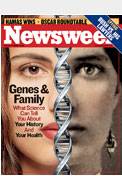
The research led Skorecki's team to Africa, where they tested members of the Lemba tribe, a group that believed they were descended from the Biblical land of Judea. Some of their DNA matched the Cohan signature. "We share a common paternal ancestry," says Skorecki. In 2001, Father Bill Sanchez, a Roman Catholic priest in Albuquerque, N.M., discovered he closely matched the Cohan signature, too. Sanchez's Jewish roots go back to Spain (his mother's heritage is Native American). Today he keeps pictures of his Christian and Jewish ancestors on his wall; in November he traveled to Israel. Now his niece Jessica Gonzales, 24, wants to go. Raised Catholic, she wants to learn more about her family roots. "I've been reading a lot about Judaism," she says.I don't know the specifics of Father Sanchez family origins, but I have to wonder when Skorecki et al. will finally decide to come clean about the significance of their "Cohen signature" and the little-known fact that it is neither a Jewish nor a Cohen-specific signature. I have a feeling that there are quite a lot of people out there who've been "reading about Judaism" based on false beliefs created by dubious science.
Last fall, Wells packed up 500 blood-collection tubes, needles, alcohol wipes and cheek swabs and headed off to Chad, one of the project's first testing sites, where he took 300 DNA samples from towns and villages around the country. Thirty-five to 40 came from members of the isolated Laal community, whose population, at fewer than 750, is declining. Wells fears that this community will die out within the next 10 to 30 years, taking with it valuable DNA and cultural traditions and an ancient language—information that could provide critical insights into the first people to live in Central Africa more than 40,000 years ago. "We can use DNA to figure out some of these great mysteries, to make sense of the past," says Wells.I guess I was right about Dr. Wells' activities in my New Year's predictions... and their name is Laal. Now, let's hope that Dr. Wells and his team will find some time to devote to the other 6,000,000,000-750 of us.