(Last Update: Jun 10)
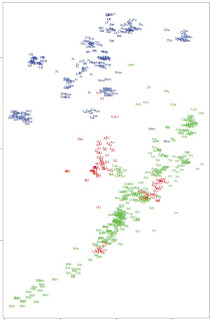
On the left, PCA from Supplementary Figure 3, shows clearly at least three different Jewish clusters. Note the main Ashkenazi/Sephardi cluster halfway between Tuscans and Near Eastern populations, a Yemeni Jewish cluster coinciding with Bedouins and Saudi Arabians, and a West Asian cluster encompassing Georgian, Iranian, Iraqi, etc. Jews.
Below is ADMIXTURE analysis in the global context.
There is a ton of information in the above figure, for Jews and non-Jews alike. Some observations:

- Ethiopians and Ethiopian Jews look identical, between Sub-Saharan Africans and West Asians .
- Sub-Saharan admixture in Egyptians and Yemenites is quite evident; lack of such admixture in Europe and non-Arabs from West Asia.
- A little Caucasoid admixture in Mongols
- Split of Mongoloids into two clusters, which appear to be "northern" and "southern"
- Central Asian Turkic speakers (Uygur, Uzbek) derived from both Mongoloid sub-clusters; their Caucasoid components are mainly West Asian (light green) rather than north European (dark blue)
- Non-European components in Russians are resolved into Caucasoid light green and "north Mongoloid" (see above)
- A little of the "north Mongoloid" component in Turks and some populations from the Caucasus, not much elsewhere in West Eurasia
- South Asian (green) component in Cambodians
- Russians and Lithuanians lack south European (light blue) component but have some west Asian (light green)
- Cypriots are split between West Asia and Southern European components, with minority Semitic (Phoenicians or Syrian Christians?) and northern European ones.
- French Basque and Sardinians lack West Asian component (light green)
The regional ADMIXTURE analysis is also quite enlightening.
UPDATE I (Jun 10):
What does this study actually tell us about the origins of modern Jews? Are they descended from ancient Jews, and to what degree did they admix with non-Jewish populations either in West Asia or elsewhere?
The smoking gun of an ancestral Jewish gene pool is still missing. Note, for example, the emergence of a "purple" Mozabite cluster in the global ADMIXTURE analysis, or of three distinct Palestinian- Druze- and Bedouin- centered clusters in the regional analysis.
If modern Jews are descended from an ancient Jewish population, we would expect the emergence of such a Jewish-centered component in the ADMIXTURE analysis. Such a component would be centered on Jews but might also spill out to some degree to other populations.
Rather, Jews appear to be variable mixtures of three components (in the regional figure): pink, which is shared by them and Arab speakers; very light blue, which is shared by them and non-Arab West Asians and south Europeans; medium blue, which is centered on southern Europe.
The lack of a Jewish-centered cluster could be either due to a lack of a common core of shared ancestry in various Jewish groups, or to a lack of sufficient resolution in the genetic markers used. There is a common thread among Jewish groups (the pink element), but it is not specific to them.
Nonetheless, we can credit the two new studies with shrinking our universe of viable hypotheses: Ashkenazic Jews don't appear to be either Khazar or converted Slavs/Germans; Iraqi Jews don't appear to have any noticeable Arab-specific ancestry; the Jewish origin of Ethiopian Jews is a fable; Ashkenazic and Sephardic Jews appear to be closely related; and so on.
UPDATE II (Jun 10):
Supplementary Table 4 (
pdf) has Y chromosome data for a wide assortment of populations. I find quite interesting the lack of E-M35 chromosomes in Georgian Jews (N=62) and Azerbaijani (N=57) Jews.
UPDATE III (Jun 10):
Notice how different Russians look in the global and regional analyses. In the former, they break down into three components (N/E European dark blue, W/C/S Asian light green, north Mongoloid), while in the latter they appear to have some of the S European light blue.
This should be useful as a cautionary tale to what happens when the full range of parental populations are not present: spurious results can appear.
UPDATE IV (Jun 10):
Consider Figure 2 from the paper:
Jews form three major clusters: one between West Asia and Europe (Ashkenazim and Sephardim); one right in the middle of West Asia (Caucasus Jews and Iranian Jews), and one in the middle of Arabs (Yemenite Jews).
The authors write:
This study further uncovers genetic structure that partitions most Jewish samples into Ashkenazi–north African– Sephardi, Caucasus–Middle Eastern, and Yemenite subclusters (Fig. 2). There are several mutually compatible explanations for the observed pattern: a splintering of Jewish populations in the early Diaspora period, an underappreciated level of contact between members of each of these subclusters, and low levels of admixture with Diaspora host populations.
It is difficult to see how splintering of Jewish populations in the early Diaspora period would result in the observed pattern. In such a scenario, we would expect European Jews to form a separate cluster from Yemenite and Middle Eastern Jews, but we would not expect the differences to be in the direction of the host populations.
It is also not clear why there should be "an underappreciated level of contact" between these subclusters: the fact that they are distinct suggests that there was not much contact, otherwise we would see "intermediate individuals" between the various clusters, which is not the case. Whatever the historical intermarriage across Jewish subgroup boundaries, it must've been low: both the distinctiveness of the three clusters, and the absence of individual variation in ancestral proportions within subgroups suggests that each of the three groups did not admix heavily (recently) with either Jews from elsewhere or non-Jewish host populations.
The evidence as it stands is indicative of relative isolation of three distinct subgroups of Jews in Western Eurasia. What the original makeup of these subgroups was (the Jewish-native mix), prior to isolation, is still up for grabs.
UPDATE V (Jun 10):
It would be tempting to see an Arab-Persian distinction in the neat arraying of West Asian populations in the PCA figure of the previous update with Bedouins and Persian-Caucasian populations occupying the different ends of the spectrum. However, that would be erroneous, I think, as it omits the crucial parameter of Sub-Saharan admixture.
Here is a magnification of the West Eurasian portion of the global PCA (Figure 1 from the paper):
"South" is towards Sub-Saharans and "East" is towards East Asians. Just as the ADMIXTURE analysis suggests, Arabs deviate towards the Sub-Saharan direction. Thus, Persian-Arab distinctions are not necessarily an indication only of differences between these two groups, but also of the presence of variable Sub-Saharan admixture in Arabs.
The global ADMIXTURE indicates why this is the case: Iranians have very little "Semitic" pink and no visible Sub-Saharan admixture, while Arabs have a little Sub-Saharan admixture, which, because of the great genetic distance between Sub-Saharan Africans and West Eurasians, pulls them apart substantially from the Caucasoid cluster.
Indeed, Arabians are intermediate between Caucasoids and East Africans, while the latter are intermediate between Arabians and Sub-Saharan Africans.
Nature doi:10.1038/nature09103
The genome-wide structure of the Jewish peopleDoron M. Behar et al.
Contemporary Jews comprise an aggregate of ethno-religious communities whose worldwide members identify with each other through various shared religious, historical and cultural traditions
1, 2. Historical evidence suggests common origins in the Middle East, followed by migrations leading to the establishment of communities of Jews in Europe, Africa and Asia, in what is termed the Jewish Diaspora
3, 4, 5. This complex demographic history imposes special challenges in attempting to address the genetic structure of the Jewish people
6. Although many genetic studies have shed light on Jewish origins and on diseases prevalent among Jewish communities, including studies focusing on uniparentally and biparentally inherited markers
7, 8, 9,10, 11, 12, 13, 14, 15, 16, genome-wide patterns of variation across the vast geographic span of Jewish Diaspora communities and their respective neighbours have yet to be addressed. Here we use high-density bead arrays to genotype individuals from 14 Jewish Diaspora communities and compare these patterns of genome-wide diversity with those from 69 Old World non-Jewish populations, of which 25 have not previously been reported. These samples were carefully chosen to provide comprehensive comparisons between Jewish and non-Jewish populations in the Diaspora, as well as with non-Jewish populations from the Middle East and north Africa. Principal component and structure-like analyses identify previously unrecognized genetic substructure within the Middle East.
Most Jewish samples form a remarkably tight subcluster that overlies Druze and Cypriot samples but not samples from other Levantine populations or paired Diaspora host populations. In contrast, Ethiopian Jews (Beta Israel) and Indian Jews (Bene Israel and Cochini) cluster with neighbouring autochthonous populations in Ethiopia and western India, respectively, despite a clear paternal link between the Bene Israel and the Levant. These results cast light on the variegated genetic architecture of the Middle East, and trace the origins of most Jewish Diaspora communities to the Levant.
Link


