
Showing posts with label Sports. Show all posts
Showing posts with label Sports. Show all posts
June 17, 2012
March 23, 2012
African American athletes have more European mtDNA than the general AA population
Does anyone have a theory why this is the case?
American Journal of Physical Anthropology DOI: 10.1111/j.1600-0838.2010.01289.x
Importance of mitochondrial haplotypes and maternal lineage in sprint performance among individuals of West African ancestry
M. Deason et al.
Mitochondrial DNA (mtDNA) is inherited solely along the matriline, giving insight into both ancestry and prehistory. Individuals of sub-Saharan ancestry are overrepresented in sprint athletics, suggesting a genetic advantage. The purpose of this study was to compare the mtDNA haplogroup data of elite groups of Jamaican and African-American sprinters against respective controls to assess any differences in maternal lineage. The first hypervariable region of mtDNA was haplogrouped in elite Jamaican athletes (N=107) and Jamaican controls (N=293), and elite African-American athletes (N=119) and African-American controls (N=1148). Exact tests of total population differentiation were performed on total haplogroup frequencies. The frequency of non-sub-Saharan haplogroups in Jamaican athletes and Jamaican controls was similar (1.87% and 1.71%, respectively) and lower than that of African-American athletes and African-American controls (21.01% and 8.19%, respectively). There was no significant difference in total haplogroup frequencies between Jamaican athletes and Jamaican controls (P=0.551 ± 0.005); however, there was a highly significant difference between African-American athletes and African-American controls (P less than 0.001). The finding of statistically similar mtDNA haplogroup distributions in Jamaican athletes and Jamaican controls suggests that elite Jamaican sprinters are derived from the same source population and there is neither population stratification nor isolation for sprint performance. The significant difference between African-American sprinters and African-American controls suggests that the maternal admixture may play a role in sprint performance.
Link
American Journal of Physical Anthropology DOI: 10.1111/j.1600-0838.2010.01289.x
Importance of mitochondrial haplotypes and maternal lineage in sprint performance among individuals of West African ancestry
M. Deason et al.
Mitochondrial DNA (mtDNA) is inherited solely along the matriline, giving insight into both ancestry and prehistory. Individuals of sub-Saharan ancestry are overrepresented in sprint athletics, suggesting a genetic advantage. The purpose of this study was to compare the mtDNA haplogroup data of elite groups of Jamaican and African-American sprinters against respective controls to assess any differences in maternal lineage. The first hypervariable region of mtDNA was haplogrouped in elite Jamaican athletes (N=107) and Jamaican controls (N=293), and elite African-American athletes (N=119) and African-American controls (N=1148). Exact tests of total population differentiation were performed on total haplogroup frequencies. The frequency of non-sub-Saharan haplogroups in Jamaican athletes and Jamaican controls was similar (1.87% and 1.71%, respectively) and lower than that of African-American athletes and African-American controls (21.01% and 8.19%, respectively). There was no significant difference in total haplogroup frequencies between Jamaican athletes and Jamaican controls (P=0.551 ± 0.005); however, there was a highly significant difference between African-American athletes and African-American controls (P less than 0.001). The finding of statistically similar mtDNA haplogroup distributions in Jamaican athletes and Jamaican controls suggests that elite Jamaican sprinters are derived from the same source population and there is neither population stratification nor isolation for sprint performance. The significant difference between African-American sprinters and African-American controls suggests that the maternal admixture may play a role in sprint performance.
Link
September 14, 2010
Magnus Carlsen vs. the World or the shortcomings of representative democracy
 I participated in the G-STAR RAW World Chess Challenge last Friday, in which top-rated Norwegian chess player Magnus Carlsen played against the "World", eventually winning the game after 44 moves.
The game started going downhill for the "World" early on, and, as I was waiting to see how the inevitable 1-0 would play out, it dawned on me how closely the whole experience paralleled what goes on in a modern representative democracy.
Carlsen (C): a "challenge" facing the public; the crisis, or problem, that needs to be addressed
Lagrave, Nakamura, Polgar (LNP): the "politicians", suggesting what needs to be done to address C, one move at a time
The public (P): the "electorate", choosing from the moves suggested by LNP
The game itself was good evidence in favor of two assertions about democracy:
1. The sum of mediocre minds does not create a genius
2. Crowds do not plan long-term and are not consistent
1) The sum of mediocre minds does not create a genius
In many situations, combining mediocre elements produces a superior result. This is true when tasks can be broken down to components that are easy to handle. A regular person would die of boredom before he could sum up a thousand numbers, but a hundred people could achieve it with a handful of additions each.
It is also true when mediocre participants are unbiased and independent, and there is a simple way to combine their output. For example, I can't guess another person's height with any great accuracy, but if twenty people take a guess, the average of their guesses may be quite close to the truth.
In the Carlsen vs. the World match, neither of these two conditions held: different individuals did not think about different aspects of the game. In short, there was no co-operation, no strength in numbers. The result was that the World did not play as a massively parallel machine, but rather as one amateur player picking between alternatives sugested by three really strong ones. Nor did they combine their thoughts in any interesting way, but simply with the basic rule of majority voting.
2) Crowds do not plan long-term
Long-term planning with many participants is difficult to achieve. This is not only due to the unpredictability of the future, or people's inability to think ahead except in the vaguest of terms, but also due to the difficulty of maintaining a consensus.
Consider a group of people deciding to reach the end of a maze. Each person has an idea of how to achieve this goal, but there are different ways in which the people can achieve their goal:
In a democracy there is a vote at each intersection, in monarchy the crowd follows a leader, in anarchy everyone goes their own way, while in aristocracy (in the original sense of the word, which is "rule by the best") the crowd follows leader(s) chosen for their ability in maze-navigation.
In the Carlsen vs. the World match it could be argued that there were aristocratic elements at play (as LNP, who led the people, are definitely chess experts) but also a democratic principle, as the leaders did not decide, but the people did.
If someone (say one of LNP) came up with a good plan, he could not carry it through, because midway through the plan's execution, the public, who did not understand the plan, and the other two leaders, who may not have guessed it, or may have preferred a different one, changed course.
Moves that were suggested early on, ended up played much later, when their "bite" was gone. The crowd flocked alternatively to displays of bravado and early counter-attack, followed quickly by overdefensive moves that created an uncomfortable cramped position that was impossible to defend.
The parallels to democracy
The world's failure is impressive, because it had so many good things going for it: the "leaders" were part of the chess elite, and both them, and the public had a clearly defined common interest: to win the game.
In a real democracy, not only do politicians and citizens have different and conflicting agendas (e.g., raise or lower taxes, increase or decrease immigration, regulate or liberalize markets, etc.) but the quality of politicians is generally low: LNP were selected largely because of merit, putting their plans to democratic scrutiny; in a real representative democracy, both leaders and plans are subject to a vote.
Not to mention the media, composed to a large extent of opinionated ignorami who have to sink to the level of the lowest common denominator of the populace in order to achieve circulation or viewership targets, rather than inform the public about the issues at hand, and the different political parties' plans.
It could be argued that the Carlsen was too smart, so we should not make too much out of the World's failure to defeat him; yet, it can also be argued that the real-world challenges that face societies are even more complex, whether they are climate change, the organization of financial markets, the decision to go to war, domestic and foreign enemies, and so on.
Conclusion
The main advantage of democracy, compared to other political systems is its adaptiveness. In a monarchy, you either get a good ruler or a bad one, for long periods of time. You have the advantage of long-term planning, but the disadvantage that the long-term plan may lead to ruin. In a typical representative democracy, you get a series of average rulers. Constancy and long-term planning go out the window, but course correction is built into the system.
Experiences like the Carlsen vs. the World match should, however, bring into our attention how suboptimal as a governing system representative democracy really is. It's difficult to see how democracy would evolve in a more efficient direction, but it is definitely worth thinking about.
June 13, 2010
Composite Greek player (FIFA 2010 World Cup)
Here is a composite of the 23 players on the Greek squad in this year's FIFA World Cup.


Created with Sqirlz Morph 2.0.
Related:
December 19, 2008
mtDNA haplogroup L0 in elite Kenyan distance runners
Med Sci Sports Exerc. 2008 Dec 11.
The maternal inheritance of mitochondrial DNA (mtDNA) has enabled construction of detailed phylogenies. Analysis of key polymorphisms from these phylogenies allows mtDNA to be assigned to haplogroups, which have been associated with elite endurance performance. PURPOSE:: To compare the frequencies of mtDNA haplogroups found in elite Kenyan athletes with those in the general Kenyan population. METHODS:: DNA samples were obtained from 221 national level Kenyan athletes (N), 70 international Kenyan athletes (I), and 85 members of the general Kenyan population (C). mtDNA haplogroups were classified by sequencing 340 bases of hypervariable section (HVS I) and by genotyping known restriction sites. Frequency differences between groups were assessed using exact tests of population differentiation. RESULTS:: The haplogroup distribution of national (P = 0.023) and international athletes (P less than 0.001) differed significantly from controls, with international athletes showing a greater proportion of L0 haplogroups (C = 15%, N = 18%, I = 30%) and lower proportion of L3* haplogroups (C = 48%, N = 36%, I = 26%). Although a high number of international athletes originated from the Rift Valley province relative to controls (C = 20%, N = 65%, I = 81%), subjects from this province did not differ in haplogroup distribution from other regions (P = 0.23). Nor did Bantu subjects differ from Nilotic (P = 0.12) despite an overrepresentation of Nilotic languages among the athletes. CONCLUSIONS:: International athletes differed in their mtDNA haplogroup distribution relative to the general Kenyan population. They displayed an excess of L0 haplogroups and a dearth of L3* haplogroups. These findings suggest that mtDNA haplogroups are influential in elite Kenyan distance running, although population stratification cannot be ruled out.
Link
Mitochondrial Haplogroups Associated with Elite Kenyan Athlete Status.
Scott RA, Fuku N, Onywera VO, Boit M, Wilson RH, Tanaka M, H Goodwin W, Pitsiladis YP.
Scott RA, Fuku N, Onywera VO, Boit M, Wilson RH, Tanaka M, H Goodwin W, Pitsiladis YP.
The maternal inheritance of mitochondrial DNA (mtDNA) has enabled construction of detailed phylogenies. Analysis of key polymorphisms from these phylogenies allows mtDNA to be assigned to haplogroups, which have been associated with elite endurance performance. PURPOSE:: To compare the frequencies of mtDNA haplogroups found in elite Kenyan athletes with those in the general Kenyan population. METHODS:: DNA samples were obtained from 221 national level Kenyan athletes (N), 70 international Kenyan athletes (I), and 85 members of the general Kenyan population (C). mtDNA haplogroups were classified by sequencing 340 bases of hypervariable section (HVS I) and by genotyping known restriction sites. Frequency differences between groups were assessed using exact tests of population differentiation. RESULTS:: The haplogroup distribution of national (P = 0.023) and international athletes (P less than 0.001) differed significantly from controls, with international athletes showing a greater proportion of L0 haplogroups (C = 15%, N = 18%, I = 30%) and lower proportion of L3* haplogroups (C = 48%, N = 36%, I = 26%). Although a high number of international athletes originated from the Rift Valley province relative to controls (C = 20%, N = 65%, I = 81%), subjects from this province did not differ in haplogroup distribution from other regions (P = 0.23). Nor did Bantu subjects differ from Nilotic (P = 0.12) despite an overrepresentation of Nilotic languages among the athletes. CONCLUSIONS:: International athletes differed in their mtDNA haplogroup distribution relative to the general Kenyan population. They displayed an excess of L0 haplogroups and a dearth of L3* haplogroups. These findings suggest that mtDNA haplogroups are influential in elite Kenyan distance running, although population stratification cannot be ruled out.
Link
July 09, 2006
Les Bleus vs. Squadra Azzurra
World Cup 2006 will be decided soon...
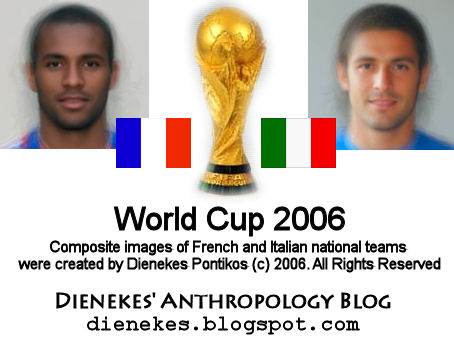
See also, The geography of European phenotypical variation and Composites of Greek and European Female Athletes for more facial composites.
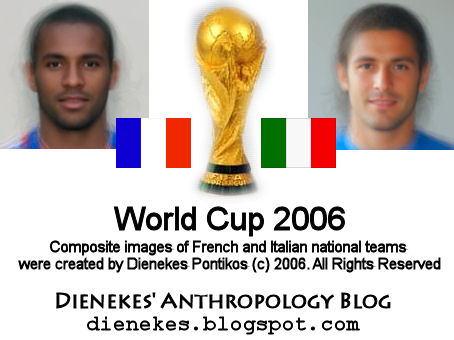
See also, The geography of European phenotypical variation and Composites of Greek and European Female Athletes for more facial composites.
Subscribe to:
Posts (Atom)