More studies like this ought to be done. While a causal link between mtDNA and craniofacial features seems unlikely, it is expected that in admixed populations of relatively recent origin there will be correlation between phenotypical attributes and mtDNA or Y chromosomes.
See also: mtDNA of Chad Basin populations, Inferring the population of origin of DNA evidence within the UK by allele-specific hybridization of Y-SNPs
Am J Hum Biol. 2008 Apr 28 [Epub ahead of print]
Mitochondrial DNA and craniofacial covariability of Chad Basin females indicate past population events.
Hájek M, Cerný V, Brůžek J.
The Chad Basin lies in the middle of the Sudanic African belt between the Sahara and the tropical rain forests. Its present-day settlement is a result of Holocene climatic changes and human immigrations from different parts of Africa. This study presents a statistical analysis of the relationships of physical features (stature and five main craniofacial measurements) and mitochondrial (mtDNA) haplogroup classifications in a sample of 282 adult individuals belonging to seven populations of different ethno-linguistic groups living in the Chad Basin. Drawing on the analysis of variance, we identified a female-specific DNA association between mtDNA haplogroup assignment and facial height. More specifically, the mtDNA haplogroups of East-African origin occur more frequently in females with relatively longer faces and, conversely, the mtDNA of West-African origin are found more frequently in females with lower faces. Interestingly, this kind of association is not found in the males of the same populations. Our interpretation refers mainly to population history; we suggest that facial height and mtDNA haplogroup co-variance in Chad Basin females reflects a long-term east-west population distribution in the past that made the facial differentiation possible.
Link

Showing posts with label Chad. Show all posts
Showing posts with label Chad. Show all posts
April 30, 2008
April 02, 2007
Spencer Wells Interview
Via GNXP a link to an interview by Spencer Wells. The interesting bits:
The data are sent to a central database created by IBM. They supplied the server, which is sitting in the basement of National Geographic. They have given everybody laptops with biometric [i.e., fingerprint] recognition so that only the PIs can access to the database. We are working closely with their computational biology team on analyzing the data. So some of our first publications, which are starting to go into the journals now, are coming through that group.
...
We are expanding the survey of whole mitochondria genomes in Africa. We've doubled the size of that database and it's revealing interesting mitochondrial patterns. That effort has been spearheaded by Doron Behar in Haifa.
People tend to ignore what went on within Africa. There is this inherent bias in European and Asian scientists that we've “done” Africa and then things got interesting when we [humans] left, but of course there was still a lot going on within Africa. We're looking at routes people might have taken out of Africa and back migration into Africa. Information that is coming out, in part, from an expedition I organized in 2005 to the Tibesti mountains in Chad, up on the Libyan border.
...
We've gotten some fascinating results and a lot of e-mails. For example, a Hungarian woman wrote in and said, “You've got to redo my test. You told me I'm native American or Siberian, and I know my ancestors came from Hungary—I can tell you the village they were living in in the sixteenth century.” The Hungarian language, Magyar, is actually related to languages spoken in Siberia, and this is one of the first cases where we've actually seen Siberian lineages showing up in the Hungarian population. They are there at very low frequency. We now through this project have over 350 people who are of Hungarian descent and we see these [Siberian] lineages at four to five percent on both male and female sides.
March 30, 2007
Divergent X chromosome haplotype in Eurasians and East Africans
Yet another piece of evidence in favor of my idea that ancestral Africans were subdivided and did not form a single population. A widely divergent haplotype of the X chromosome was found in Eurasians and East Africans but not at all in the Sub-Saharan Africans of the CEPH Panel. If there was no population structure in Africa, then we would expect to see this hX haplotype in different African locations.
From the paper:
Molecular Biology and Evolution
Divergent Haplotypes and Human History as Revealed in a Worldwide Survey of X-Linked DNA Sequence Variation
Makoto K. Shimada et al.
The population genetic history of a 10.1-kbp noncoding region of the human X chromosome was studied using the males of the HGDP-CEPH Human Genome Diversity Panel (672 individuals from 52 populations). The geographic distribution of patterns of variation was roughly consistent with previous studies, with the major exception that 1 highly divergent haplotype (haplotype X, hX) was observed at low frequency in widely scattered non-African populations and not at all observed in sub-Saharan African populations. Microsatellite (short tandem repeat) variation within the sequenced region was low among copies of hX, even though the estimated time of ancestry of hX and other sequences was 1.44 Myr. The estimated age of the common ancestor of all hX copies was 5,230 years (95% consistency index: 2,000–75,480 years). To further address the presence of hX in Africa, additional samples from Chad and Tanzania were screened. Five additional copies of hX were observed, consistent with a history in which hX was present in Africa prior to the migration of modern humans out of Africa and with eastern Africa being the source of non-African modern human populations. Taken together, these features of hX—that it is much older than other haplotypes and uncommon and patchily distributed throughout Africa, Europe, and Asia—present a cautionary tale for interpretations of human history.
Link
From the paper:
Designated hX, this haplotype was found once in Melanesia (Oceania) and 8 times in widespread locations in Eurasia, including the Orkney Islands, Pakistan, Algeria, Israel, and France. Contrary to the typical pattern found in many genes, in which the variation in non-African populations is a subset of the variation in sub-Saharan Africa, hX was not observed among the HGDP-CEPH males from sub-Saharan Africa (98 individuals).
...
One possible historical model that could generate this pattern supposes that differences between hX and other haplotypes arose in the presence of population structure that allowed for the divergence among Xp11.22 haplotypes. Even if we discount the possibility of a non-African archaic human population as the source of hX, the age and low frequency of the haplotype does suggest a history in which hX persisted and diverged in a separate refugium population (either a separate modern human population or possibly an archaic human population). Models of this type, which suppose the presence of old population strutcture among African populations, have been suggested based on evidence from other regions of the genome (Tishkoff et al. 1996Go; Harding et al. 1997Go; Labuda et al. 2000Go; Tishkoff et al. 2000Go; Zietkiewicz et al. 2003Go; Garrigan, Mobesher, Kingan, et al. 2005Go).
Molecular Biology and Evolution
Divergent Haplotypes and Human History as Revealed in a Worldwide Survey of X-Linked DNA Sequence Variation
Makoto K. Shimada et al.
The population genetic history of a 10.1-kbp noncoding region of the human X chromosome was studied using the males of the HGDP-CEPH Human Genome Diversity Panel (672 individuals from 52 populations). The geographic distribution of patterns of variation was roughly consistent with previous studies, with the major exception that 1 highly divergent haplotype (haplotype X, hX) was observed at low frequency in widely scattered non-African populations and not at all observed in sub-Saharan African populations. Microsatellite (short tandem repeat) variation within the sequenced region was low among copies of hX, even though the estimated time of ancestry of hX and other sequences was 1.44 Myr. The estimated age of the common ancestor of all hX copies was 5,230 years (95% consistency index: 2,000–75,480 years). To further address the presence of hX in Africa, additional samples from Chad and Tanzania were screened. Five additional copies of hX were observed, consistent with a history in which hX was present in Africa prior to the migration of modern humans out of Africa and with eastern Africa being the source of non-African modern human populations. Taken together, these features of hX—that it is much older than other haplotypes and uncommon and patchily distributed throughout Africa, Europe, and Asia—present a cautionary tale for interpretations of human history.
Link
January 18, 2007
mtDNA of Chad Basin populations
Annals of Human Genetics (OnlineEarly Articles)
A Bidirectional Corridor in the Sahel-Sudan Belt and the Distinctive Features of the Chad Basin Populations: A History Revealed by the Mitochondrial DNA Genome
V. Černý et al.
Summary
The Chad Basin was sparsely inhabited during the Stone Age, and its continual settlement began with the Holocene. The role played by Lake Chad in the history and migration patterns of Africa is still unclear. We studied the mitochondrial DNA (mtDNA) variability in 448 individuals from 12 ethnically and/or economically (agricultural/pastoral) different populations from Cameroon, Chad, Niger and Nigeria. The data indicate the importance of this region as a corridor connecting East and West Africa; however, this bidirectional flow of people in the Sahel-Sudan Belt did not erase features peculiar to the original Chad Basin populations. A new sub-clade, L3f2, is described, which together with L3e5 is most probably autochthonous in the Chad Basin. The phylogeography of these two sub-haplogroups seems to indicate prehistoric expansion events in the Chad Basin around 28,950 and 11,400 Y.B.P., respectively. The distribution of L3f2 is virtually restricted to the Chad Basin alone, and in particular to Chadic speaking populations, while L3e5 shows evidence for diffusion into North Africa at about 7,100 Y.B.P. The absence of L3f2 and L3e5 in African-Americans, and the limited number of L-haplotypes shared between the Chad Basin populations and African-Americans, indicate the low contribution of the Chad region to the Atlantic slave trade.
Link
A Bidirectional Corridor in the Sahel-Sudan Belt and the Distinctive Features of the Chad Basin Populations: A History Revealed by the Mitochondrial DNA Genome
V. Černý et al.
Summary
The Chad Basin was sparsely inhabited during the Stone Age, and its continual settlement began with the Holocene. The role played by Lake Chad in the history and migration patterns of Africa is still unclear. We studied the mitochondrial DNA (mtDNA) variability in 448 individuals from 12 ethnically and/or economically (agricultural/pastoral) different populations from Cameroon, Chad, Niger and Nigeria. The data indicate the importance of this region as a corridor connecting East and West Africa; however, this bidirectional flow of people in the Sahel-Sudan Belt did not erase features peculiar to the original Chad Basin populations. A new sub-clade, L3f2, is described, which together with L3e5 is most probably autochthonous in the Chad Basin. The phylogeography of these two sub-haplogroups seems to indicate prehistoric expansion events in the Chad Basin around 28,950 and 11,400 Y.B.P., respectively. The distribution of L3f2 is virtually restricted to the Chad Basin alone, and in particular to Chadic speaking populations, while L3e5 shows evidence for diffusion into North Africa at about 7,100 Y.B.P. The absence of L3f2 and L3e5 in African-Americans, and the limited number of L-haplotypes shared between the Chad Basin populations and African-Americans, indicate the low contribution of the Chad region to the Atlantic slave trade.
Link
December 10, 2006
Indigenous populations don't trust Genographic Project
DNA Gatherers Hit a Snag: The Tribes Don’t Trust Them (NY Times)
Should scientists "respect" superstition for fear of offending indigenous tribes' feelings?
By AMY HARMONFrom the article:
SOUTH NAKNEK, Alaska — The National Geographic Society’s multimillion-dollar research project to collect DNA from indigenous groups around the world in the hopes of reconstructing humanity’s ancient migrations has come to a standstill on its home turf in North America.
Geographic origin stories told by DNA can clash with long-held beliefs, threatening a world view some indigenous leaders see as vital to preserving their culture.Related to the above read also Genetic vs. Mythical Origins. More from the article:
They argue that genetic ancestry information could also jeopardize land rights and other benefits that are based on the notion that their people have lived in a place since the beginning of time.Does anyone's land rights really depend on living in a place since the beginning of time? If that was the criterion for possessing land rights, then 99.9% of the Earth's surface wouldn't belong to its current possessors. More:
In its first 18 months, the project’s scientists have had considerable success, persuading more than 18,000 people in off-the-grid places like the east African island of Pemba and the Tibesti Mountains of Chad to donate their DNA. When the North American team arrived in southwestern Alaska, they found volunteers offering cheek swabs and family histories for all sorts of reasons.More:
Glenn Fredericks, president of the Georgetown tribe, was eager for proof of an ancient unity between his people and American Indians elsewhere that might create greater political power. “They practice the same stuff, the lower-48 natives, as we do,” Mr. Fredericks said. “Did we exchange people? It would be good to know.”and:
The first large effort to collect indigenous DNA since federal financing was withdrawn from a similar proposal amid indigenous opposition in the mid-1990s, the Genographic Project has drawn quiet applause from many geneticists for resurrecting scientific ambitions that have grown more pressing. As indigenous groups intermarry and disperse at an ever-accelerating pace, many scientists believe the chance to capture human history is fast disappearing.I was wondering why the Genographic project has been slow to publish their research. If they had to contend with stuff like this, it all makes sense:“Everyone else had given up,” said Mark Stoneking, a professor at the Max Planck Institute for Evolutionary Anthropology. “If they get even a fraction of what they are trying for, it will be very useful.”
In May, project officials held a stormy meeting in New York with the indigenous rights group Cultural Survival while protestors carried signs reading “National Geographic Sucks Indigenous Blood.” Shortly after, the United Nations Permanent Forum on Indigenous Issues recommended suspending the project.It is sad that stupid politics is keeping scientists from learning about humanity's past.
But among the 10 geneticists the society has given the task of collecting 10,000 samples each by the spring of 2010, Theodore G. Schurr, the project’s North American director, is in last place. Fewer than 100 vials of DNA occupy a small plastic box in his laboratory’s large freezer at the University of Pennsylvania, where he is an assistant professor of anthropology.The reasons offered by Native American tribes are:
But almost every federally recognized tribe in North America has declined or ignored Dr. Schurr’s invitation to take part. “What the scientists are trying to prove is that we’re the same as the Pilgrims except we came over several thousand years before,” said Maurice Foxx, chairman of the Massachusetts Commission on Indian Affairs and a member of the Mashpee Wampanoag. “Why should we give them that openly?”Someone should explain to them that scientists don't need to prove that. It has already been firmly established, indeed long before human genetics came into the picture. The point of research like that carried out by the Genographic Project is to determine how and when migrations into the Americas (and elsewhere) happened, not if they did.
Should scientists "respect" superstition for fear of offending indigenous tribes' feelings?
Some American Indians trace their suspicions to the experience of the Havasupai Tribe, whose members gave DNA for a diabetes study that University of Arizona researchers later used to link the tribe’s ancestors to Asia. To tribe members raised to believe the Grand Canyon is humanity’s birthplace, the suggestion that their own DNA says otherwise was deeply disturbing.
August 13, 2006
mtDNA of Fulani nomads
Hum Biol. 2006 Feb;78(1):9-27
MtDNA of Fulani nomads and their genetic relationships to neighboring sedentary populations.
Cerný V, Hájek M, Bromová M, Cmejla R, Diallo I, Brdicka R
Despite the large size of the contemporary nomadic Fulani population (roughly 13 million people), the genetic diversity and degree of differentiation of Fulanis compared to other sub-Saharan populations remain unknown. We sampled four Fulani nomad populations (n = 186) in three countries of sub-Saharan Africa (Chad, Cameroon, and Burkina Faso) and analyzed sequences of the first hypervariable segment of the mitochondrial DNA. Most of the haplotypes belong to haplogroups of West African origin, such as L1b, L3b, L3d, L2b, L2c, and L2d (79.6% in total), which are all well represented in each of the four geographically separated samples. The haplogroups of Western Eurasian origin, such as J1b, U5, H, and V, were also detected but in rather low frequencies (8.1% in total). As in African hunter-gatherers (Pygmies and Khoisan) and some populations from central Tunisia (Kesra and Zriba), three of the Fulani nomad samples do not reveal significant negative values of Fu's selective neutrality test. The multidimensional scaling of FST genetic distances of related sub-Saharan populations and the analysis of molecular variance (AMOVA) show clear and close relationships between all pairs of the four Fulani nomad samples, irrespective of their geographic origin. The only group of nomadic Fulani that manifests some similarities with geographically related agricultural populations (from Guinea-Bissau and Nigeria) comes from Tcheboua in northern Cameroon.
Link
MtDNA of Fulani nomads and their genetic relationships to neighboring sedentary populations.
Cerný V, Hájek M, Bromová M, Cmejla R, Diallo I, Brdicka R
Despite the large size of the contemporary nomadic Fulani population (roughly 13 million people), the genetic diversity and degree of differentiation of Fulanis compared to other sub-Saharan populations remain unknown. We sampled four Fulani nomad populations (n = 186) in three countries of sub-Saharan Africa (Chad, Cameroon, and Burkina Faso) and analyzed sequences of the first hypervariable segment of the mitochondrial DNA. Most of the haplotypes belong to haplogroups of West African origin, such as L1b, L3b, L3d, L2b, L2c, and L2d (79.6% in total), which are all well represented in each of the four geographically separated samples. The haplogroups of Western Eurasian origin, such as J1b, U5, H, and V, were also detected but in rather low frequencies (8.1% in total). As in African hunter-gatherers (Pygmies and Khoisan) and some populations from central Tunisia (Kesra and Zriba), three of the Fulani nomad samples do not reveal significant negative values of Fu's selective neutrality test. The multidimensional scaling of FST genetic distances of related sub-Saharan populations and the analysis of molecular variance (AMOVA) show clear and close relationships between all pairs of the four Fulani nomad samples, irrespective of their geographic origin. The only group of nomadic Fulani that manifests some similarities with geographically related agricultural populations (from Guinea-Bissau and Nigeria) comes from Tcheboua in northern Cameroon.
Link
January 30, 2006
DNA Testing: In Our Blood.
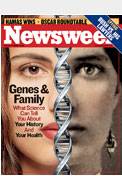
Newsweek has an article titled "DNA Testing: In Our Blood", which offers layman's introduction to the world of population genetics and geneaological testing.
From the article:
The research led Skorecki's team to Africa, where they tested members of the Lemba tribe, a group that believed they were descended from the Biblical land of Judea. Some of their DNA matched the Cohan signature. "We share a common paternal ancestry," says Skorecki. In 2001, Father Bill Sanchez, a Roman Catholic priest in Albuquerque, N.M., discovered he closely matched the Cohan signature, too. Sanchez's Jewish roots go back to Spain (his mother's heritage is Native American). Today he keeps pictures of his Christian and Jewish ancestors on his wall; in November he traveled to Israel. Now his niece Jessica Gonzales, 24, wants to go. Raised Catholic, she wants to learn more about her family roots. "I've been reading a lot about Judaism," she says.I don't know the specifics of Father Sanchez family origins, but I have to wonder when Skorecki et al. will finally decide to come clean about the significance of their "Cohen signature" and the little-known fact that it is neither a Jewish nor a Cohen-specific signature. I have a feeling that there are quite a lot of people out there who've been "reading about Judaism" based on false beliefs created by dubious science.
Also, from the article:
Last fall, Wells packed up 500 blood-collection tubes, needles, alcohol wipes and cheek swabs and headed off to Chad, one of the project's first testing sites, where he took 300 DNA samples from towns and villages around the country. Thirty-five to 40 came from members of the isolated Laal community, whose population, at fewer than 750, is declining. Wells fears that this community will die out within the next 10 to 30 years, taking with it valuable DNA and cultural traditions and an ancient language—information that could provide critical insights into the first people to live in Central Africa more than 40,000 years ago. "We can use DNA to figure out some of these great mysteries, to make sense of the past," says Wells.I guess I was right about Dr. Wells' activities in my New Year's predictions... and their name is Laal. Now, let's hope that Dr. Wells and his team will find some time to devote to the other 6,000,000,000-750 of us.
Subscribe to:
Posts (Atom)