An interesting recent talk by Wolf-Dietrich Niemeier.

Showing posts with label Homer. Show all posts
Showing posts with label Homer. Show all posts
March 31, 2013
February 20, 2013
Estimating the date of composition of the Homeric epics

Bioessays DOI: 10.1002/bies.201200165
Linguistic evidence supports date for Homeric epics
Eric Lewin Altschuler et al.
The Homeric epics are among the greatest masterpieces of literature, but when they were produced is not known with certainty. Here we apply evolutionary-linguistic phylogenetic statistical methods to differences in Homeric, Modern Greek and ancient Hittite vocabulary items to estimate a date of approximately 710–760 BCE for these great works. Our analysis compared a common set of vocabulary items among the three pairs of languages, recording for each item whether the words in the two languages were cognate – derived from a shared ancestral word – or not. We then used a likelihood-based Markov chain Monte Carlo procedure to estimate the most probable times in years separating these languages given the percentage of words they shared, combined with knowledge of the rates at which different words change. Our date for the epics is in close agreement with historians' and classicists' beliefs derived from historical and archaeological sources.
Link
July 26, 2012
The social network of the Iliad is highly realistic

In an attempt to place the three mythological networks on the spectrum from the real to the fictitious, we compared their properties to actual and imaginary social networks. Table 2 summarises the broad properties of the different types of networks. Of the three myths, the network of characters in the Iliad has properties most similar to those of real social networks. It has a power-law degree distribution (with an exponential cut-off), is small world, assortative, vulnerable to targeted attack and is structurally balanced. This similarity perhaps reflects the archaeological evidence supporting the historicity of some of the events of the Iliad.
arXiv:1205.4324v2 [physics.soc-ph]
Universal Properties of Mythological Networks
Pádraig Mac Carron, Ralph Kenna
(Submitted on 19 May 2012 (v1), last revised 18 Jul 2012 (this version, v2))
As in statistical physics, the concept of universality plays an important, albeit qualitative, role in the field of comparative mythology. Here we apply statistical mechanical tools to analyse the networks underlying three iconic mythological narratives with a view to identifying common and distinguishing quantitative features. Of the three narratives, an Anglo-Saxon and a Greek text are mostly believed by antiquarians to be partly historically based while the third, an Irish epic, is often considered to be fictional. Here we show that network analysis is able to discriminate real from imaginary social networks and place mythological narratives on the spectrum between them. Moreover, the perceived artificiality of the Irish narrative can be traced back to anomalous features associated with six characters. Considering these as amalgams of several entities or proxies, renders the plausibility of the Irish text comparable to the others from a network-theoretic point of view.
Link
October 01, 2008
Homer and Archaeology
Related: Support for "large" Troy at the time of the Trojan War, Historicity of the Trojan War.
Hidden histories: 'The Odyssey' and 'The Iliad' are giving up new secrets about the ancient world By Jonathan Gottschall:
Hidden histories: 'The Odyssey' and 'The Iliad' are giving up new secrets about the ancient world By Jonathan Gottschall:
In the last 50 years, most scholars have sided with the great classicist Moses Finley, who argued that the epics were "a collection of fictions from beginning to end" and that - for all their majesty and drama - they were "no guide at all" to the civilization that may have fought the Trojan War.
...
But thanks to evidence from a range of disciplines, we are in the middle of a massive reappraisal of these foundational works of Western literature. Recent advances in archeology and linguistics offer the strongest support yet that the Trojan War did take place, with evidence coming from the large excavation at the likely site of Troy, as well as new analysis of cuneiform tablets from the dominant empire of the region.
...
In a project that has now been underway for 20 years, the German archeologist Manfred Korfmann and hundreds of collaborators have discovered a large lower city that surrounded the citadel. Using new tools, such as computer modeling and imaging technology that allows them to "see" into the earth before digging, Korfmann and his colleagues determined that this city's borders were 10 to 15 times larger than previously thought, and that it supported a population of 5,000 to 10,000 - a big city for its time and place, with impressive defenses and an underground water system for surviving sieges. And, critically, the city bore signs of being pillaged and burned around 1200 BC, precisely the time when the Trojan War would have been
fought.
In his influential book, "Troy and Homer," German classicist Joachim Latacz argues that the identification of Hisarlik as the site of Homer's Troy is all but proven. Latacz's case is based not only on archeology, but also on fascinating reassessments of cuneiform tablets from the Hittite imperial archives. The tablets, which are dated to the period when the Late Bronze Age city at Hisarlik was destroyed, tell a story of a western people harassing a Hittite client state on the coast of Asia Minor. The Hittite name for the invading foreigners
is very close to Homer's name for his Greeks - Achaians - and the Hittite names for their harassed ally are very close to "Troy" and "Ilios," Homer's names for the city.
"At the very core of the tale," Latacz argues, "Homer's 'Iliad' has
shed the mantle of fiction commonly attributed to it."
August 29, 2008
Determining whether an individual is in a mixed sample using microarrays
This is a very important new paper, blogged about by Gene Expression and the Spittoon.
A short explanation
DNA from many different individuals may be "mixed up", either literally (e.g. in a crime scene), or figuratively (in an allele frequency table where individual genotypes are averaged).
If you have the genotype of a particular individual, can you tell whether or not he is included in the mix?
The surprising answer is yes, even if the person contributes less than 1% to the mixture, provided that you study a large number of markers, such as the multi-100K chips by companies such as Illumina or Affymetrix.
An individual's DNA shifts the sample's allele frequencies by very small amounts. If the individual is included in the mix, then averaged over many loci, the sample will deviate from the overall population standard in the direction of the individual.
Let's give a non-genetic analogy (I'm making these numbers up, but they'll do). If the Chinese height average is 1.75m, and a sample of Chinese has a height average of 1.8m, then Yao Ming is more likely to be in that sample.
Of course, using one trait, it is impossible to conclude firmly that Yao Ming is in the sample: any number of tall Chinese could raise the sample average. But, averaged over many traits, Yao Ming's individual traits would stand out, whereas those of other tall Chinese men would not.
The power of this technique relies on using a very large number of variables, which has become possible with the use of microarray chips measuring hundreds of thousands of polymorphisms.
Why is this important?
The forensic applications are clear: people's DNA gets mixed up all the time, yet investigators are interested in determining whether a particular individual (e.g. criminal or missing person) was present in a scene.
The scientific implications are less clear, but more troubling. From now on, releasing a table of "allele frequencies" in a sample can't be guaranteed to mask the identities of individuals.
Suppose someone asked you to participate in a scientific study, and you were told that no individual genetic information would be disclosed to the public, but only averaged information over all participants.
You can no longer be content with that promise. Someone who has acquired your genotype can now figure out whether or not you participated in the study.
What is troubling, at least for me is the proposed solution to this problem:
But, who decides who can get access to the data? If an obscure "scientist" from some far-away land asks for data for a study he is conducting, is he entitled to it? Or, will the data be shared by a close-knit group, thus making it more difficult to evaluate it independently, or to create derivative applications (such as EURO-DNA-CALC, which would have been impossible without allele frequency data)
PLoS Genet 4(8): e1000167. doi:10.1371/journal.pgen.1000167
Resolving Individuals Contributing Trace Amounts of DNA to Highly Complex Mixtures Using High-Density SNP Genotyping Microarrays
Nils Homer et al.
Abstract
We use high-density single nucleotide polymorphism (SNP) genotyping microarrays to demonstrate the ability to accurately and robustly determine whether individuals are in a complex genomic DNA mixture. We first develop a theoretical framework for detecting an individual's presence within a mixture, then show, through simulations, the limits associated with our method, and finally demonstrate experimentally the identification of the presence of genomic DNA of specific individuals within a series of highly complex genomic mixtures, including mixtures where an individual contributes less than 0.1% of the total genomic DNA. These findings shift the perceived utility of SNPs for identifying individual trace contributors within a forensics mixture, and suggest future research efforts into assessing the viability of previously sub-optimal DNA sources due to sample contamination. These findings also suggest that composite statistics across cohorts, such as allele frequency or genotype counts, do not mask identity within genome-wide association studies. The implications of these findings are discussed.
Link
A short explanation
DNA from many different individuals may be "mixed up", either literally (e.g. in a crime scene), or figuratively (in an allele frequency table where individual genotypes are averaged).
If you have the genotype of a particular individual, can you tell whether or not he is included in the mix?
The surprising answer is yes, even if the person contributes less than 1% to the mixture, provided that you study a large number of markers, such as the multi-100K chips by companies such as Illumina or Affymetrix.
An individual's DNA shifts the sample's allele frequencies by very small amounts. If the individual is included in the mix, then averaged over many loci, the sample will deviate from the overall population standard in the direction of the individual.
Let's give a non-genetic analogy (I'm making these numbers up, but they'll do). If the Chinese height average is 1.75m, and a sample of Chinese has a height average of 1.8m, then Yao Ming is more likely to be in that sample.
Of course, using one trait, it is impossible to conclude firmly that Yao Ming is in the sample: any number of tall Chinese could raise the sample average. But, averaged over many traits, Yao Ming's individual traits would stand out, whereas those of other tall Chinese men would not.
The power of this technique relies on using a very large number of variables, which has become possible with the use of microarray chips measuring hundreds of thousands of polymorphisms.
Why is this important?
The forensic applications are clear: people's DNA gets mixed up all the time, yet investigators are interested in determining whether a particular individual (e.g. criminal or missing person) was present in a scene.
The scientific implications are less clear, but more troubling. From now on, releasing a table of "allele frequencies" in a sample can't be guaranteed to mask the identities of individuals.
Suppose someone asked you to participate in a scientific study, and you were told that no individual genetic information would be disclosed to the public, but only averaged information over all participants.
You can no longer be content with that promise. Someone who has acquired your genotype can now figure out whether or not you participated in the study.
What is troubling, at least for me is the proposed solution to this problem:
Considering privacy issues with genetic data, it is now clear that further research is needed to determine how to best share data while fully masking identity of individual participants. However, since sharing only summary data does not completely mask identity, greater emphasis is needed for providing mechanisms to confidentially share and combine individual genotype data across studies, allowing for more robust meta-analysis such as for gene-environment and gene-gene interactions.In other words, the proposed solution would deprive the public of access to any type of genetic information produced by studies the public actually pays for. Instead, individuals' genotype data, it is proposed, will be shared among scientists themselves.
But, who decides who can get access to the data? If an obscure "scientist" from some far-away land asks for data for a study he is conducting, is he entitled to it? Or, will the data be shared by a close-knit group, thus making it more difficult to evaluate it independently, or to create derivative applications (such as EURO-DNA-CALC, which would have been impossible without allele frequency data)
PLoS Genet 4(8): e1000167. doi:10.1371/journal.pgen.1000167
Resolving Individuals Contributing Trace Amounts of DNA to Highly Complex Mixtures Using High-Density SNP Genotyping Microarrays
Nils Homer et al.
Abstract
We use high-density single nucleotide polymorphism (SNP) genotyping microarrays to demonstrate the ability to accurately and robustly determine whether individuals are in a complex genomic DNA mixture. We first develop a theoretical framework for detecting an individual's presence within a mixture, then show, through simulations, the limits associated with our method, and finally demonstrate experimentally the identification of the presence of genomic DNA of specific individuals within a series of highly complex genomic mixtures, including mixtures where an individual contributes less than 0.1% of the total genomic DNA. These findings shift the perceived utility of SNPs for identifying individual trace contributors within a forensics mixture, and suggest future research efforts into assessing the viability of previously sub-optimal DNA sources due to sample contamination. These findings also suggest that composite statistics across cohorts, such as allele frequency or genotype counts, do not mask identity within genome-wide association studies. The implications of these findings are discussed.
Link
June 24, 2008
The eclipse of 1178BC and the return of Odysseus to Ithaca
 Odysseus' return from Trojan War dated:
In the epic "Odyssey," one of the cornerstones of Western literature, the legendary Greek hero Odysseus returns to his queen Penelope after enduring 10 years of sailing the wine dark sea.
Now scientists have pinned down his return to April 16, 1178 B.C., close to noon local time, according to astronomical references in the epic poem that seem to pinpoint the total eclipse of the sun on the day that Odysseus supposedly returned on.
...
The possible solar eclipse comes up in the 20th book of the "Odyssey," as the suitors begin their final lunch. At this point, the goddess of war Athena "confounds their minds," making the suitors laugh uncontrollably and see their food spattered with blood. The seer Theoclymenus then foresees the death of the suitors, ending by saying, "The sun has been obliterated from the sky, and an unlucky darkness invades the world."
The Greek historian Plutarch suggested the prophecy of Theoclymenus referred to a solar eclipse.
More recently, astronomers Carl Schoch and Paul Neugebauer computed in the 1920s that a total solar eclipse occurred over the Ionian islands — of which Ithaca is one — about noon on April 16, 1178 B.C., and would have coincided roughly a decade before the most often cited estimate for the sack of Troy — about 1190 B.C.
...
Still, a great deal of skepticism remains over whether Theoclymenus refers to this or any eclipse. To shed light on the issue, researchers Marcelo Magnasco and Constantino Baikouzis at Rockefeller University in New York decided to analyze other passages in the "Odyssey" for astronomical references without assuming an eclipse.
...
The scientists first created a rough chronology of events depicted in the "Odyssey." First, 29 days before the supposed eclipse and the massacre of the suitors, three constellations are mentioned as Odysseus sets out from the island of Ogygia, where he has spent seven years as a captive of the beautiful nymph Calypso. Odysseus is told to watch the Pleiades and late-setting Boötes and keep the Great Bear to his left. Next, five days before the supposed eclipse, Odysseus arrives in Ithaca as the Star of Dawn — that is, Venus — rises ahead of the sun.Finally, the night before the eclipse, there is a new moon.
Also, the messenger of the gods, Hermes, is sent west to Ogygia by the king of the gods Zeus to release Odysseus and then immediately returns back east roughly 34 days before the eclipse. The researchers conjecture this trip refers to an apparent turning point of the motion of the planet Mercury. (Mercury was the Roman name for Hermes.)
...
The scientists then searched for potential dates that satisfied all these astronomical references close to the fall of Troy, which has over the centuries been estimated to have occurred between roughly 1250 to 1115 B.C. From these 135 years, they found just one date satisfied all the references — April 16, 1178 B.C., the same date as the proposed eclipse.
...
"That's just one day out of about 50,000 days," Magnasco told LiveScience. "If our findings are correct, it would be pretty spectacularly strange. How could Homer have known about this eclipse, about planetary positions that happened some 100 years before him? If this is all true, it would change the timetable of what we think they knew about astronomy then." Homer, if he really existed, is said to have composed the "Odyssey" sometime near the end of the ninth century B.C.
Proc. Natl. Acad. Sci. USA, 10.1073/pnas.0803317105
Is an eclipse described in the Odyssey?
Constantino Baikouzis, and Marcelo O. Magnasco
Abstract
Plutarch and Heraclitus believed a certain passage in the 20th book of the Odyssey ("Theoclymenus's prophecy") to be a poetic description of a total solar eclipse. In the late 1920s, Schoch and Neugebauer computed that the solar eclipse of 16 April 1178 B.C.E. was total over the Ionian Islands and was the only suitable eclipse in more than a century to agree with classical estimates of the decade-earlier sack of Troy around 1192–1184 B.C.E. However, much skepticism remains about whether the verses refer to this, or any, eclipse. To contribute to the issue independently of the disputed eclipse reference, we analyze other astronomical references in the Epic, without assuming the existence of an eclipse, and search for dates matching the astronomical phenomena we believe they describe. We use three overt astronomical references in the epic: to Boötes and the Pleiades, Venus, and the New Moon; we supplement them with a conjectural identification of Hermes's trip to Ogygia as relating to the motion of planet Mercury. Performing an exhaustive search of all possible dates in the span 1250–1115 B.C., we looked to match these phenomena in the order and manner that the text describes. In that period, a single date closely matches our references: 16 April 1178 B.C.E. We speculate that these references, plus the disputed eclipse reference, may refer to that specific eclipse.
Link
March 16, 2008
Ithaca may be Homeric Ithaca after all
 I can understand people searching for Atlantis, or Shangri-La, El Dorado or whatever is one's favorite lost city/continent/civilization, but, c'mon Ithaca? Why search for something whose location already exists, and it is, (surprise), Ithaca.
I remember reading about the book coming out of the project to identify Homeric Ithaca with Cephalonia. The main argument for denying Ithaca's claim to be itself was that the Homeric account can't be reconciled well with the reality of the island, e.g., the idea that Ithaca is the westmost of the Ionian islands, which doesn't correspond to its real location. I always thought this was a shoddy argument. Greece has thousands of islands, and I'd bet that with the exception of locals, geography wizards or career seamen, very few people know the exact location on the map of most of them. Why would Homer, or whoever composed the Odyssey, who, most likely live in the west coast of Asia Minor, know the relative position of Ithaca or the details of its geography?
‘Ithaca was Homeric land of Odysseus’
Greeks yesterday hailed a new study showing the modern-day island of Ithaca is the same as that of Homer's legendary hero Odysseus, rejecting a recent British theory that pointed to a nearby island.
British researchers last year claimed they had solved an intriguing classical puzzle, saying the kingdom of Ithaca was located on another Ionian island, further west.
«This new study shows how wrong and inaccurate the British theory is,» Ithaca councilor and former island Mayor Spyros Arsenis told Reuters of the study conducted by Greek geology professors and other scientists over eight months.
Arsenis also heads the island's Friends of Homer society.
The British study - which suggested that Homer's Ithaca was actually part of what is modern-day Cephalonia - had enraged islanders who are fiercely proud of their renowned ancestor, the wiliest of the ancient Greek writer's epic heroes.
The British team suggested that drilling showed the Paliki peninsula on Cephalonia may have once been an island and that it better matched Homer's description of the homeland which Odysseus left behind to fight in the Trojan War.
«The new Greek study shows... the geological formations could not have been formed in just 3,000 years and there is no evidence of any sea channel,» Arsenis said.
The study will be officially presented next week. The island's local council also welcomed the results.
«This study rules out once and for all the theory that the Paliki peninsula was once a separate island. It is a slap in the face for the British researchers,» it said in a statement.
Finding ancient Ithaca could rival the discoveries in the 1870s of ancient Troy on Turkey's Aegean coast and the mask of Agamemnon, who led the Greek forces against the Trojans. No one knows for certain whether Odysseus or his city really existed.
The discovery of the ruins of Troy, where Odysseus, Achilles, Paris, Menelaus and other Greek heroes did battle, has led scholars to believe there is more to Homer's tales than just legend.
August 29, 2006
Dumb theory of the day: Odyssey and Iliad were written by a woman
 ... according to a British "scholar". Never mind that there is no single mention of a female author of these poems, or any epic poetry at all. Never mind that the authorship of the Iliad and the Odyssey was universally attributed to Homer in historical times by all Greeks who ever bothered to mention what was common knowledge. Never mind that the poems universally assign the role of story teller to men, and confine women to domestic pursuits. What is the "scholar"'s evidence?
Dalby explained that women throughout the ancient world were "often the last and most skillful exponents of an oral tradition."Yep, the Sumerians, Japanese, Irish, English and the Brothers Grimm did it, ergo the Iliad was written by a woman. QED. Mr. Darby gives us his own scholarly "guesses" too:
For example, the world’s first named poet was a Sumerian woman named Enheduanna, who lived from around 2285-2250 B.C. Dalby said women also saved the ancient oral poetry of the northern Japanese, many Irish traditions, and numerous English folk ballads.
Another recent book, Clever Maids: The Secret History of the Grimm Fairy Tales, claims the Brothers Grimm gathered most of their famous stories from women. Author Valerie Paradiz told Discovery News that the brothers "only gave credit to one woman by name," but then linked most other tales to male editors who also gathered stories from women.
If the poet was a woman, Dalby believes her name is probably lost to history.Well, too bad they never said anything about it. How convenient for Mr. Dalby's speculations! If anyone is still wondering Who Killed Homer? now we have an answer: Mr. Dalby, and "scholars" like him.
"I would guess that Sappho (a female Greek poet) and her contemporary, the male poet Alkaios, probably knew the name, but they did not mention it in their own poetry," Dalby said.
PS: I don't mind people writing what they want. We should not however award any respect to crackpots. Mr. Dalby's theory belongs in the same category as the "Merovingians were descended from Jesus Christ" or "Homer in the Baltic".
March 29, 2006
Palace of Telamonian Aias found in Salamis
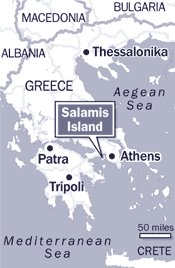
Palace of Homer's hero rises out of the myths (The Times)
ARCHAEOLOGISTS claim to have unearthed the remains of the 3,500-year-old palace of Ajax, the warrior-king who according to Homer’s Iliad was one of the most revered fighters in the Trojan War.
Classicists hailed the discovery, made on a small Greek island, as evidence that the myths recounted by Homer in his epic poem were based on historical fact.
The ruins include a large palace, measuring about 750sq m (8,000sq ft), and believed to have been at least four storeys high with more than thirty rooms.
Yannos Lolos, the Greek archaeologist who made the discovery, said he was certain that he had come across the home of the Aiacid dynasty, a legendary line of kings mentioned in the Iliad and the Classical Greek tragedies. One of the kings, Ajax (or Aias), was described by Homer as a formidable fighter who, at one point in the Trojan campaign, held off the Trojans almost singlehandedly while his fellow Greek Achilles sulked in his tent because his slave-girl had been taken away from him.
The city of Troy is believed to have fallen about 1180BC — at about the same time, according to Mr Lolos, that the palace he has discovered was abandoned and left to crumble. Ajax, therefore, would have been the last king to have lived there before setting off on the ten-year Trojan expedition.
“This is one of the few cases in which a Mycenaean-era palace can be almost certainly attributed to a Homeric hero,” Mr Lolos said.
Fellow archaeologists said that they believed that the ruins were indeed those of a Mycenaean palace. Curtis Runnels, Professor of Archaeology at Boston University, said: “Mr Lolos has really delivered the goods.”
The Mycenaean ruins appear to be at the site where Homer records a fleet of ships setting out to take part in the war on Troy. The Iliad is believed to portray conditions at the close of the dominance of Mycenae, the prime Greek power of the second millennium BC.
The ruins have been excavated over the past five years at a site near the village of Kanakia on the island of Salamis, a few miles off the coast of Athens.
The palace was built in the style of those of the period, including the vast acropolis at Mycenae.
“The complex was found beneath a virgin tract of pine woods on two heights by the coast,” Mr Lolos said. “All the finds so far corroborate what we see in the Homeric epics.”
Homer compares Ajax to a wall and describes him carrying a shield made of seven layers of thick oxhide. Unlike other heroes, he fights without the aid of deities or the supernatural. According to Sophocles, who wrote 800 years after the Trojan War, Ajax committed suicide after the fall of Troy without seeing his homeland again.
Several relics of oriental and Cypriot origin were found at the site at Kanakia, such as bronze armour strips stamped with the emblem of Pharaoh Rameses II of Egypt, indicating trade or possible war in the 13th century BC.
Salamis became famous as the site of a sea battle in 480BC in which the Greek navies destroyed the invasion fleet of the Persian king Xerxes and put paid to the Persian threat.
The other main site where archaeologists claim to have discovered relics of places recounted in the Iliad is at the castle of Pylos in southeastern Greece, believed to be the home of King Nestor.
April 18, 2005
Modern technology and the Oxyrhynchus Papyri
Oxford scientists have made some incredibly exciting new discoveries in the Oxyrhynchus Papyri.
Decoded at last: the 'classical holy grail' that may rewrite the history of the worldSee also a different article on the same topic, and an older post on a different potential source of ancient writings, that of Herculaneum.For more than a century, it has caused excitement and frustration in equal measure - a collection of Greek and Roman writings so vast it could redraw the map of classical civilisation. If only it was legible.
Now, in a breakthrough described as the classical equivalent of finding the holy grail, Oxford University scientists have employed infra-red technology to open up the hoard, known as the Oxyrhynchus Papyri, and with it the prospect that hundreds of lost Greek comedies, tragedies and epic poems will soon be revealed.
In the past four days alone, Oxford's classicists have used it to make a series of astonishing discoveries, including writing by Sophocles, Euripides, Hesiod and other literary giants of the ancient world, lost for millennia. They even believe they are likely to find lost Christian gospels, the originals of which were written around the time of the earliest books of the New Testament.
...
Christopher Pelling, Regius Professor of Greek at the University of Oxford, described the new works as "central texts which scholars have been speculating about for centuries".
Professor Richard Janko, a leading British scholar, formerly of University College London, now head of classics at the University of Michigan, said: "Normally we are lucky to get one such find per decade." One discovery in particular, a 30-line passage from the poet Archilocos, of whom only 500 lines survive in total, is described as "invaluable" by Dr Peter Jones, author and co-founder of the Friends of Classics campaign.
...
The previously unknown texts, read for the first time last week, include parts of a long-lost tragedy - the Epigonoi ("Progeny") by the 5th-century BC Greek playwright Sophocles; part of a lost novel by the 2nd-century Greek writer Lucian; unknown material by Euripides; mythological poetry by the 1st-century BC Greek poet Parthenios; work by the 7th-century BC poet Hesiod; and an epic poem by Archilochos, a 7th-century successor of Homer, describing events leading up to the Trojan War. Additional material from Hesiod, Euripides and Sophocles almost certainly await discovery.
Oxford academics have been working alongside infra-red specialists from Brigham Young University, Utah. Their operation is likely to increase the number of great literary works fully or partially surviving from the ancient Greek world by up to a fifth. It could easily double the surviving body of lesser work - the pulp fiction and sitcoms of the day.
August 23, 2004
2,400BC golden mask of Thracian king

Bulgarian archaeologist Georgi Kitov holds a 2,400-year-old golden mask he discovered Thursday in the tomb of a Thracian king in Shipka, Bulgaria. The solid gold mask “has no comparison in the world,” said Kitov, who believes it may depict the image of King Seutus III.
Toronto Star. Aug. 21, 2004. 01:00 AM.
Golden mask `sensational'
Artifact unearthed in Bulgaria
Find may depict ancient king
SHIPKA, Bulgaria—A Bulgarian archaeologist has unearthed a 2,400-year-old golden mask in the tomb of an ancient Thracian king — a find he says is unrivalled in the study of classical antiquity.
"It is sensational," said Georgi Kitov, who found the mask Thursday near the village of Shipka, 200 kilometres east of Sofia.
He believes it may depict King Seutus III, a 5th century BC leader of the Thracians, the dispersed tribes who once lived in parts of what is now modern-day Bulgaria, Romania, Macedonia, Turkey and Greece.
Kitov said the mask "has no comparison in the world," and may be a more significant find than the Mask of Agamemnon, the Greek hero described by Homer in the Iliad. It's one of the most famous images of Greek antiquity, and the centrepiece of the National Archaeological Museum in Athens.
"The Mask of Agamemnon was made of gold foil and weighs only 60 grams, while this mask weighs 690 grams (24 oz.) and is of solid gold," Kitov said.
The burial place was covered with six stone slabs, each weighing at least two tonnes. The king's remains have not yet been found, but excavations at the tomb continue.
The Thracians lived on the fringes of the Greek and Roman civilizations, often intermingling and clashing with the more advanced cultures until they were absorbed around 45 AD. Archaeological finds have provided most of what is known of the culture.
Subscribe to:
Posts (Atom)